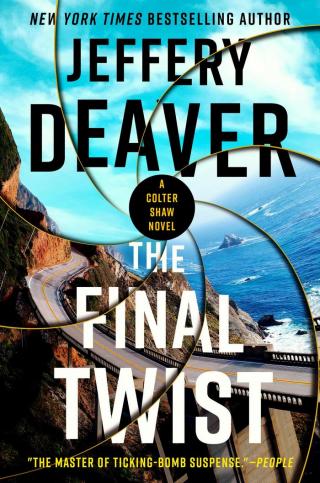
The Final Twist
- Автор: Дивер Джеффри
- Серия: Colter Shaw #3
- Год: 2021
- Язык: английский
- Год: G.P. Putnam's Sons
- ISBN: 978-0-525-53913-1
- Жанр: Триллеры

Электронная книга - «The Final Twist». Краткое содержание книги:
Following the enigmatic clues his father left behind, Shaw plays cat and mouse with the company’s sadistic enforcers, as he speeds from one gritty neighborhood in the City by the Bay to another. Suddenly, the job takes on a frightening urgency: Only by finding the courier bag can he expose the company and stop the murder of an entire family — slated to die in forty-eight hours.
With the help of an unexpected figure from his past, and with the enforcers closing the net, Shaw narrows in on the truth — and learns that the courier bag contains something unexpected: a secret that could only be described as catastrophic.
She looks up and waves to him and then points to his left, meaning to return to the path. He gives yet another raised arm of incomprehension.
She pulls her gloves off and digs out her phone. She makes a call. Colter sees him answer.
“Brad, honey, these boys say it’s an avalanche area. Go back to the trees. That path we were on before we started across the hill.”
Russell says, “Tell him to move very slowly. Really.”
She relays this information, puts the phone away and bends down to unhook her shoes. She gets one undone and, after a struggle, yanks it out.
Can’t she go any faster?
Uphill, Colter sees, the man starts toward the safety of the path.
He glances down and sees the trickles of snow accelerating away from beneath his feet.
More and more of them.
He panics and charges forward, slamming the oval snowshoes hard on the surface.
“No!” Colter and his brother shout simultaneously.
Just as the man scrambles out of the field, literally diving to safety, a shelf of snow breaks away and cascades downward. It is only ten feet wide or so and shallow but avalanches are a chain reaction. Colter knows this will trigger a much bigger fall.
The woman evidently hears the whoosh too and looks up at the wall sliding toward her. A brief scream. She is still forty feet from the safety of the high ground where the boys are. She’s trapped in place by the remaining snowshoe. She bends down into the froth and frantically tries to undo the strap.
Colter assesses:
Odds that the whole field will give way? Eighty percent.
Survival of somebody who has no deep-snow training? Five percent.
Somebody who had some training? Unknown but better than that.
He drops his backpack and discards his weapons.
Russell is staring at his younger brother.
“Colt, no. Don’t! It’s not our job.”
No time for discussion. Colter leaps off the ridge and runs quickly across the field, in the ungainly lope of a snowshoe jogger.
Just as he reaches her, the rest of the mountain cuts loose, a vast swath of snow, fifty or sixty yards wide, dropping, tumbling, picking up speed. Tides like this can easily exceed a hundred miles an hour.
As he pops the quick release of his shoes and steps out of them he sees her panicked face, tears streaming. She has large dark eyes, an upturned nose and lipstick, or sunscreen, that matches her violet snowsuit.
“Your other shoe?”
“What’s going to happen?” she cries.
“Shoe?” he snaps.
“Undone.” She straightens up and tries to pull it out. She blinks as she looks him over, maybe realizing for the first time how young he is.
“Leave the shoe!” Colter orders.
He lifts her camera off and tosses it away. In the turbulence of an avalanche, solid objects, even small ones, can maim and kill.
A glance crestward. They have thirty seconds.
“Listen to me. When it hits, don’t fight it. Pretend you’re swimming, kick with your arms and legs. Swim with it, like you’re in the surf. Got that?”
No answer.
“Have you got it?” he insists.
“Yes, swimming.”
Twenty seconds till the tide slams into them.
“When you feel yourself slowing, curl up and take a deep breath, as deep as you can. And with one hand clear a space around your mouth for air. Lift the other arm up as high as you can, so the searchers know where you are. Make a big space around your mouth. There’ll be enough air for a half hour.”
“I’m scared!”
Ten seconds. The wave is six feet high, now seven, now eight and accelerating. It’s trailed by dust swirling and thick as forest fire smoke.
“You’ll do fine. Swim, hand to mouth, arm up.”
It’s a slough avalanche — more loose snow than slabs. If they died it would be by suffocation, not a blow to the head. Colter doesn’t know which is worse. Suffocation probably.
She stares at the wave. Colter turns her around so that she’s facing downhill.
Five seconds.
Colter shuffles away so their bodies don’t become bludgeons.
“Swim!”
She does. He does too and takes a deep breath.
In the time it takes to fill his lungs, the world turns black.
23
Mary Dove finishes tending to the wounds on her fourteen-year-old son’s neck and cheek.
While most of the avalanche was slough — granular hoar snow — Colter didn’t escape a chunk of sharp ice. Or possibly a rock.
The damage isn’t severe.
They are in her office, which is a typical physician’s, except for the walls, which are — as everything in the cabin — made of hand-hewn logs.
“Anywhere else?” she asks.
“No,” Colter says. “Just a little sore.”
“How far did it sweep you?”
“Football field,” Colter says, though he doesn’t have much frame of reference, only pictures in newspapers or magazines. He’s never seen a game. In a home with no TV and no internet, one doesn’t have a chance to view broadcast spectator sports, and the nearest teams are those of the colleges and high schools around Fresno. When the family went there, they always had errands to run or acquaintances and family to see. None of the children had much inclination anyway. If parents aren’t excited about sports, their youngsters probably won’t be either.
Mary Dove executes some range-of-motion tests, arms and legs, which her son seems to pass. More or less.
He goes into his bathroom and takes a very hot shower, minding the rule to keep the bandages dry. He towels off, dresses and lies down on his blanket, which is brown and woven in a Native American design.
He closes his eyes briefly, picturing the torrent of snow enwrapping him.
He followed the same advice he’d given the woman.
When he slowed, though, he realized that extending his arm to signal his whereabouts would do no good. He was too far under the surface, so he’d pulled his arm back, and taken another deep breath and, using both hands, cleared a large air reservoir in front of his face.
Finally he stopped sliding and he wasted no time in attempting to free himself, kneeing and punching and elbowing. The space he opened up before him was completely black, and he was disoriented as to where the surface might be. He recalled his father’s lesson and made small snowballs and dropped them near his face and hands to see where they landed, so he could tell which way was down.
Never question gravity...
Then came the digging — scooping the snow down, packing it and then pushing upward with his feet and arms. Inches at a time.
Finally there was slight illumination over his head and he broke through, sucking in the air, which as in all snowfields gave off a sweet electrical scent.
He climbed out and rolled onto the snow surface, catching his breath. He called to his brother, who was probing the field nearby with a long branch. He dropped it and ran to Colter to help him up.
“The woman?” Colter asked. “She all right?”
His brother pointed.
The man who’d been with her, Brad, was digging her out of a deep pile of snow near the avalanche’s toe — the end. She’d been swept much farther than he’d been. Colter saw that she had survived and was helping to dig herself out. She was unhurt.
Colter struggled to his feet, with Russell helping. His brother looked up the mountain and said, “The whole pack didn’t come down. There’s more that’s unstable, a lot more. We should get them out and into the trees.”