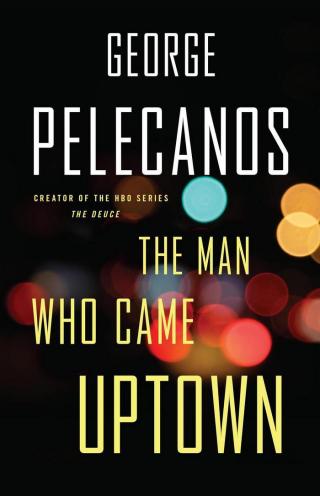
The Man Who Came Uptown
- Автор: Пелеканос Джордж
- Год: 2018
- Язык: английский
- Год: Mulholland Books / Little, Brown and Company
- ISBN: 978-0-316-47982-0
- Жанр: Криминальные детективы

Электронная книга - «The Man Who Came Uptown». Краткое содержание книги:
When Michael was working at his station he stood grounded on rubber mats and wore an apron. To his left was an iron spiral staircase that led to the dining room. Food runners had to negotiate it, as did he when he delivered the racks of glassware to the bar. The steps were textured like manhole covers to minimize slippage. A person had to be careful and in fairly good shape to work here.
In the morning before opening and whenever else it was necessary, he went outside, split the logs of kiln-dried oak, brought bundles into the kitchen, and stacked them by the oven. The kitchen workers constantly fed the wood into the oven, which ran up to eight hundred degrees. They used long-handled peels to get pizzas, calzones, and roasted veggies in and out of the oven. Their inner forearms were frequently marked with burns.
Michael had figured out everything his first morning on the job. Didn’t take a Rhodes Scholar to learn how to wash dishes, and that was the disappointing thing, at first. There was nothing really to look forward to; it was strange to realize that he wasn’t going to have any more knowledge a year from now than he had acquired that very first day. But it was a paying job, and it was the routine he needed in his life.
The ladies in the kitchen, Maria and Blanca, were hardworking, devout Catholics and friendly to him despite the language barrier. He was cracking that pretty quickly too. He used mucho, caliente, rapido, para qué, and gracias, señora and sometimes señorita if he was being innocently flattering. They called him Miguel and “baby,” and he called them mamacita and “mommy.” They were in their twenties, had children, and already looked middle-aged, but they had light in their eyes and in their smiles.
The men who worked the kitchen were less friendly but not aggressively so. Maybe they had been tight with the man whom Michael had replaced. Befriending them would take more time. But Michael had made headway there too. One of the men, Joe, would greet Michael in a boxer’s stance and throw soft combinations at him as he passed. That was his idea of an olive branch. They called Michael el hombre alto. He towered over all of them.
On day and night shifts, the kitchen workers played their Spanish music through a Bluetooth speaker set up near the colds station. To Michael it sounded like he was at a party or a carnival all the time. After a day he tired of it and began to use earbuds to listen to his own stuff, a little go-go and hip-hop but mainly the R & B he had heard his mother play while he was growing up in her house. He could have listened to novels that way too, but he found he didn’t care for the experience. He didn’t read e-books either. To him, a book was like a painting that hung in a museum. It was like a piece of art. There was nothing that compared to holding a book in his hands and scanning the words on the page. It made him “see” what he was reading. It was how he dreamed.
So he brought a book with him to work every day. Read it at lunch up in the empty dining room on the third floor or sitting at one of the picnic tables on the patio if it was nice outside. Sometimes Angelos Valis would join him, just for a few minutes, not to bother him but to ask him how things were going.
“Why they call this place the District Line?” said Michael. “We’re five, six miles away from Mer’land.”
“The owner’s father remembers a column called the District Line that ran every day in the Washington Post. A guy named Bill Gold wrote it.”
“When dinosaurs roamed the earth.”
“There’s another local restaurant with the same name, in a hotel. They don’t bother us about it.”
“Y’all should change the name.”
“What would you name this place if you had the chance?”
“Michael Hudson’s.”
“Of course.” Angelos smiled. “I’ll see if I can get the sign changed today.”
At the end of those conversations, Michael always thanked Angelos for the opportunity he had given him. He meant it too.
Since his interview with Christopher Perry, Phil Ornazian had attempted to reach out to several of the kids who’d attended the Weitzman party, with little response. Most of them had ignored the messages he’d sent through Facebook, and those who had hit him back told him they had no interest in speaking with him. Finally, a girl named Britany, a friend of Lisa’s, said that she’d meet with him somewhere that was not her home.
He got up with Britany after school one day at the food court in Montgomery Mall. He bought her some food at Cava, a fast-casual Mediterranean spot, and as she ate, he asked her questions. She claimed she didn’t know who had robbed the Weitzman home or who had assaulted Lisa. Her eyes and body language told Ornazian that these assertions were lies. He found her both dishonest and vacuous and wondered why she was here beyond a free lunch. But when she easily gave up the name of a boy who had been at the party, along with his home address, Ornazian realized why she’d agreed to speak with him. Britany wanted to point him toward someone with whom she had had a relationship that was now a personal beef. From the way she talked about him, he could sense that she was angry at the kid and was also still into him. He was a boy who’d done her wrong.
His name was Billy Hanrahan. He went to a private school in Potomac, which was good for Ornazian. She said that Billy had recognized one of the older guys who’d crashed the party. So the meeting with Britany, which had seemed worthless at first, had turned up gold.
As Britany finished off her meal, Ornazian got a text from Marisol, the woman who worked at the brothel in Columbia Heights. She would see him but had only a small window in which to do so, and it was now.
“I’ve got to go,” said Ornazian.
“Don’t give me up,” said Britany.
Ornazian left her there and drove back into town.
Marisol had texted him a photo, so Ornazian knew who he was looking for, and he found her seated alone at Compass Coffee on Seventh Street, in Shaw. She was an attractive girl in her early twenties, wearing an inexpensive, low-cut dress beneath a spring coat. Her eyes were almond-shaped and very dark, as were her eyebrows. He surmised her hair was naturally black, but today it was reddish from a rinse. She had the features of a native Guatemalan.
After he introduced himself, he bought them two coffees, returned to the wood-laminate table, and sat down. She was nervous as a cat, looking around and out the plate-glass window that fronted the store. He spoke softly in an attempt to put her at ease.
“I’m going to take some notes,” said Ornazian, opening the Moleskine notebook with lined paper that he carried with him. “For me only. No one else will ever see them. Okay?”
“Yes, Mr. Ornay-jun.”
“Call me Phil.”
“Phil.”
“Where do you work?”
She told him. It was a row house on a mostly residential street in Columbia Heights, just inside Georgia Avenue, northwest of Howard U.
“Describe the layout,” said Ornazian.
“There is a bar and place to sit on the first floor where we present ourselves. Four small rooms upstairs where we work.”
“Security?”
“A couple of men, always. And Gustavo and his man, when they come.”
“His man?”
“Cesar. His segundo and bodyguard. Gustavo has a business down the street. Little more than a bar and a pool table. Is called the Nine Ball.”