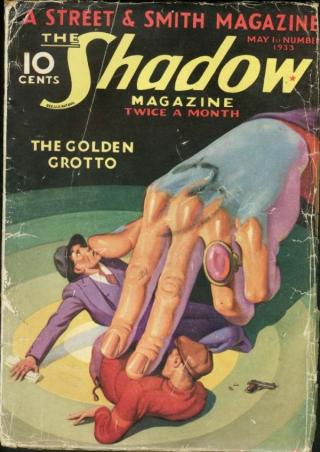
The Golden Grotto
- Автор: Грант Максвелл
- Серия: The Shadow #29
- Год: 1933
- Язык: английский
- Год: Street and Smith
- Жанр: Крутые детективы

Электронная книга - «The Golden Grotto». Краткое содержание книги:
He had seen no newspapers — either at Woodruff’s or at Sheldon’s. Although it was Harry’s custom to keep posted on events of the day, he could see no present necessity, particularly as he knew that The Shadow would keep him posted on all matters which concerned him. It was Harry’s job to look for any unusual signs — that was all.
In his visit to the professor’s house, Harry had obtained a note from the band of the gray hat. This was the second coded message from The Shadow. It was simply another admonition to maintain contact, and to send in a full report of whatever might occur at East Point.
Radio broadcasts had brought no further orders. It was obvious to Harry that The Shadow was playing a waiting game, gathering certain items of information, withholding action until the time would prove right. If, as Harry supposed, the gold robbers who had attacked the Patagonia were also lying low, the period of waiting would eventually end in exciting events.
WITH very little to report to The Shadow, Harry spent the morning strolling on the beach beside the bay. At times, he turned a cautious eye toward the cottages.
He saw Downs ride down toward the little town, and return about half an hour later. Otherwise, nothing occurred until nearly noon, when Harry became suddenly aware that Malbray Woodruff was approaching in the rowboat. As on yesterday afternoon, the artist had come from behind the mound-shaped island just off the sandy shore.
Woodruff was rowing with quick, eager stroke, and Harry was surprised to see the artist show so much activity. The boat grounded in the sand. Woodruff clambered out and dragged his easel after him. He shot a quick glance at Harry, and made a sign to come with him. Together, they walked hastily to the cottage.
Woodruff closed the door as soon as they had entered. He motioned Harry to a chair and placed the easel in a corner. With the air of a man who has something important to say, but is doubtful how to begin, the artist paced back and forth across the floor, while Harry watched him without comment. At last, Woodruff halted, faced his friend, and asked a point-blank question.
“Why are you out here, Vincent?”
Harry, raised his eyebrows in a puzzled manner.
“I mean,” explained Woodruff, “do you have any special purpose for being at East Point? Are you a detective — for example?”
“Of course not,” replied Harry, with a laugh. “Why do you ask that, Woodruff?”
The artist stared steadily at his guest, while his hands acted mechanically in filling his pipe with tobacco.
“Don’t misunderstand me, Vincent,” Woodruff said. “I just want to get matters straight. If you are investigating out here, I want to be of assistance to you. If you are not, I want you to help me. So the result will be the same in either case.”
The statement was Harry’s cue. He made the most of it by putting a question of his own.
“What’s up, Woodruff?” he asked.
The artist decided to explain. He seemed to have confidence in Harry, and the frank question made him resolve to treat his new friend as a confidant.
“Something is wrong here at East Point,” asserted Woodruff. “I sensed that a long time ago — when I first came here. One night I was sure I saw a mysterious light out in the bay. At other times, I have heard men outside this house.
“When the coast guards came to investigate, it increased my suspicions. They went away, after looking the place over very carefully. Everything was quiet after that. But since you came, I have become suspicious once more.
“Night before last, I heard something that sounded like a motor — very muffled. My room is in the front of the house, and I listened at the window. Knowing that you were at the side of the house, I doubted that you could have heard the sound. I came in to speak to you, but saw you were asleep. I wanted to talk to you about these matters.
“Later, I was sure that I heard sounds on the beach. I fancied that I saw a prowler passing Professor Sheldon’s house. At last, I went to sleep, and forgot all about it. Nothing occurred yesterday; but last night, I thought I heard new sounds from the beach. Again, I felt sure that prowlers were about.
“Then, when I went to get my boat this morning, I noticed that its position was different from the way I had left it on the beach. Going back in my mind, I realized dimly that I had seen the same fact yesterday. Some one, Vincent, has been going out in that boat at night!”
Woodruff paused dramatically. He saw that Harry was listening intently. The artist seemed determined to convince his companion that this belief was more than mere conjecture.
“When I was rowing back this morning,” Woodruff continued, in a low voice. “I skirted the wooded island just offshore. Little Knob, they call it. Those scrubby trees run right down to the water line, and the edge of the island is rocky and irregular.
“I generally keep away from it because of rocks. But to-day, I saw something floating in the water. I picked it up — it had evidently been hooked against the brush on the shore of the island — and here it is.”
With that, Woodruff produced a fragment of cloth and spread it, damp, upon the table. The object was a portion of a handkerchief. The corner bore the embroidered initials:
EC
“A girl’s handkerchief,” commented Harry.
“Are you sure of that?” asked Woodruff.
“Certainly,” said Harry. “Look at the embroidery. I would be positive that it was a girl’s handkerchief.”
“It might be a man’s handkerchief,” responded Woodruff.
Harry shook his head. He picked up the cloth and sniffed it, hoping to detect the scent of perfume; but the handkerchief had evidently been floating for some time in the salt water.
Nevertheless, in examining the cloth, Harry found three corners, and he pointed to that fact as proving that the handkerchief was less than twelve inches square.
“Pretty small for a man’s handkerchief,” observed Harry. “So I disagree with you, Woodruff. I cannot offer any theory as to how the handkerchief arrived where you found it; but I am quite sure that its former owner was a lady whose initials are E. C.”
“That’s just it!” exclaimed Woodruff triumphantly. “E. C.! Those initials prove the very point that I am after. This is a man’s handkerchief, and I know who the man is. Elbert Cordes!”
THIS statement placed a new light on the subject. Harry, despite the fact that he was sure this was a woman’s handkerchief, was forced to acknowledge that the initials were the same as those of Elbert Cordes.
“Yes,” affirmed Woodruff, “Elbert Cordes was out in that boat of mine. For some reason, he went over to Little Knob. Why did he go there? That’s what I want to find out.”
“Have you any reason to find out?” asked Harry, in an indifferent tone.
“Reason?” Woodruff’s tone was indignant. “Isn’t it sufficient reason when you suspect that some dirty work is going on? Why does Cordes keep to himself? Why does he act suspiciously all the time? I’ve tried to keep out of his affairs, because they were none of mine; but now that he’s making it my business, I’m going to know the reason!”
Harry was in a quandary. He saw where Malbray Woodruff could be either an advantage or a disadvantage in the process of investigation at East Point. Woodruff was in a position to learn facts concerning Elbert Cordes. With Harry as his confidant, the artist would be of indirect aid to The Shadow.
On the other hand, should Woodruff become precipitous in action; should he decide to accost Cordes, and accuse him of using the boat at night, the result would very likely be damaging.
The obvious course was to line up with Woodruff; to artfully suggest ideas to the man. In that way, Harry could make Woodruff prove useful.
Harry sensed that developments were due at East Point. Observing that Woodruff was looking to him for advice, Harry employed the power of suggestion.