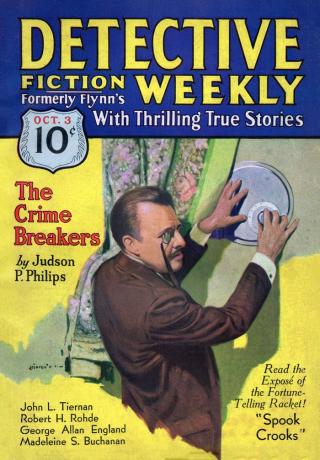
Detective Fiction Weekly. Vol. 62, No. 2, October 3, 1931
- Автор: Энгланд Джордж Аллан, Philips Judson P.
- Год: 1931
- Язык: английский
- Год: The Red Star News Company
- Жанр: Другие детективы

Электронная книга - «Detective Fiction Weekly. Vol. 62, No. 2, October 3, 1931». Краткое содержание книги:
IV
Inspector Hogan stood in the center of the office of the late Chris Schuyler, importer, surveying the scene of murder. His straw hat was back on his head. His hands were poised at his hips. He shook his head despairingly.
“Bad, bad,” he muttered, “a butcher did that one... a butcher walked in broad daylight into the Excelsior Building... and walked out again.”
Hogan’s experts were on their knees around the desk. Jenkins was leaning over the body. Cohn was examining the hatchet. Crawford was examining the pigskin bag.
“This is the most amazing thing I’ve ever heard of,” said Jenkins, his voice tinged curiously with admiration.
“Never mind that!” snapped Hogan. “You’re paid to find facts... stick to them.”
Hogan was in a bad mood. It was a terrifically hot afternoon and this was a particularly ugly case. He didn’t like it at all.
“There was no struggle,” said Jenkins. “It seems that the murderer merely came in here and beaned this chap with an ax.”
“But before he beaned him,” said Cohn, “he put on a pair of rubber gloves. There’s not a finger-print mark on this handle.”
Hogan groaned.
“Do you expect me to believe that this guy sat back,” he demanded indignantly, “and let somebody put on a pair of rubber gloves and crown him with a hatchet!”
“He did exactly that,” said Cohn, “or the murderer walked along Broadway at high noon wearing rubber gloves and carrying a hatchet.”
Hogan wiped the perspiration from his brow, shook his head for the twentieth time.
“Is that dumb dame outside,” he said, “is that dumb dame in fit condition yet to talk.”
“She’s still a little hysterical,” said Stewart, who was standing between the offices. Hogan could still hear the sobbing Louise.
The elevator operator, who had been standing in a corner, pop-eyed, stepped forward.
“I tell you she’s lying,” he said. “I never took anybody up to this office this morning.”
Hogan laughed harshly.
“Of course you didn’t, sap,” he said. “The person that killed this fellow walked up the back steps, did his job and walked out again.”
The elevator operator muttered stubbornly. Jenkins stood up.
“She’s probably lying, chief,” he said. “Her story sounds awful fishy.”
“Oh, no,” said Hogan. “Nobody could be so dumb as to make up a story like that. You’d just have to be born that dumb. It’s got to be true.”
“I can’t understand,” said Jenkins, “how anybody could be within eight feet of a murderer and not run over and open a door and take a good look at him.”
“It’s a gift,” said Hogan. He walked out into the next room and Louise was so entirely dejected that he couldn’t find the heart to be stern with her.
“Listen, sister,” he said, “you’ve got to pull yourself together.”
There was no doubt that she was badly frightened. She was pitiful.
“I... I don’t know anything about it,” she said between sobs. “I’ve only been working here a week and I don’t know what it’s all about.”
Hogan was inclined to believe that she didn’t know what it was all about.
“But, the business,” asked Hogan. “What did they do here? What did they import?”
She sighed.
“Mr. — Mr. — ” she stammered.
“Hogan is the name,” said Hogan.
“Mr. Hogan, I haven’t got any idea what the business was about. I never could find out. They used to dictate letters to me and I’d answer the phone, but... but I never could understand what it’s all about.”
Hogan flushed angrily.
“Listen, young lady,” he said, “you are not as dumb as all that. Nobody could be.”
Jenkins was at his elbow. He shook his arm.
“Aw, you might as well lay off, chief,” he said. “She’s probably just as dumb as she looks and... and I got the whole case cracked, anyway!”
Hogan swung around, a bright light in his eyes.
“What... what’s that?” he said.
“Easy,” said Jenkins. “This is the headquarters of that gang that’s been flooding the country with fake lottery tickets. And Schuyler tried to run out with a million dollar take on Al Pope. Here’s the note and a ticket that Pope found when he came in and surprised Schuyler.”
Hogan, hands trembling with excitement, grasped a crumpled note and a ticket on the fake Royal Caledonian Sweepstakes.
“Where did you get this?” demanded Hogan.
“On the floor, chief,” said Jenkins, “on the floor on the further side of the desk — where Al Pope dropped it just before he swung the hatchet that killed Schuyler.”
Inspector Hogan grinned, looked from one to another of his detectives.
“Tell headquarters,” he said, “to get that racketeer Pope — for murder! He’s the man!”
Cohn and Crawford nodded and were gone. Hogan, grinning, turned to the girl secretary, who was still weeping.
“Well, sister,” he said, “you made an awful botch of this. But just the same we’ve got this case solved. Al Pope did it.”
Inspector Hogan rubbed his hands together. He felt good, despite the oppressive heat.
V
At nine o’clock that night Al Pope sat in the anteroom of the Schuyler Importing Company. Around him were grouped three burly detectives. Pope was looking them square in the eye.
“Out with it,” snarled Hogan. “You might as well come through with it, Pope. We’ve got you cold!”
Pope looked slowly from one to the other of the detectives and grinned.
“You mean warm, don’t you, Hogan?” he said to the inspector. “It’s kind of warm in here.” He ran his hand along his wilted collar.
Jenkins stood over him menacingly.
“Aw, let me crack him one, chief!” he said. “This guy thinks it’s a joke.”
Hogan held up his hand to stay Jenkins.
“Wait!” he said. Then he turned to Pope. “You are just being a fool,” he said. “You might as well crack. We could send you to the chair right now. You and Schuyler were in on this crooked lottery deal. You sneaked into Schuyler’s office and caught him about to beat it with the dough. The wise-cracking letter he wrote you, the letter he didn’t expect you to see until Monday, proves it. The rest of the story tells itself.”
Al Pope was looking squarely at the inspector.
“Listen, Hogan,” he said calmly, “I admit that I was in on this lottery deal—”
“You bet you were in on the lottery deal,” snarled Hogan.
“Yes,” said Pope, “but that isn’t murder. I haven’t been near this office all day.
“I didn’t know anything about this until you fellows picked me up at the Centre Hotel. What about Talbott? He was in on it, too.”
Hogan laughed dryly.
“That’s it,” he said. “One rat turns on another. We’ll have Talbott in a little while if he’s anywhere in New York. But you’ve got to explain a lot more than Talbott. What about that letter?”
Pope shrugged his shoulders.
“Maybe,” he said calmly, “Talbott came here and found Schuyler ready to leave, maybe he smelled a rat and opened the letter, addressed to me, and then killed Schuyler.”
Hogan groaned, wiped his perspiring forehead with a big cotton handkerchief. He had to admit, to himself, that there might be logic in Pope’s words.
He was sure that one of the partners in the fake lottery killed Schuyler. But — which one?
“If that dumb stenographer,” he muttered, “had only run across the room and taken a look out that door we wouldn’t have all this stalling.”