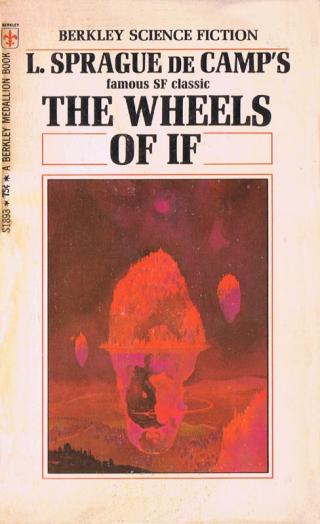
The Wheels of If And Other Science-Fiction
- Автор: Де Камп Лайон Спрэг
- Год: 1970
- Язык: английский
- Год: Berkley Medallion
- ISBN: 0-425-01893-8
- Жанр: Научная фантастика

Электронная книга - «The Wheels of If And Other Science-Fiction». Краткое содержание книги:
The coffin, smothered in flowers, was, like all coffins in Vinland, shaped like a Viking longboat. It was also filled with pine planks. Some people were weeping a bit. Even Callahan, in the front row, was appropriately solemn.
"Friends, we have gathered here to pay a last gild to one who has passed from among us ..."
THE BEST-LAID SCHEME
Russell F. R. Hedges did not look like a world-destroyer. He was in fact an almost annoyingly harmless-looking soul, a plump person of forty-five in neat blue serge, with dark hair streaked with gray and in need of cutting, hanging down over his steel-rimmed glasses.
The folly of trying to judge people by their looks has been pointed out by generations of psychologists and such people. Rut this form of judgment seems to be ingrained in human folkways. Perhaps that is why Coordinator Ronald Q. M. Bloss underestimated Hedges. When the chief executive officer of the great North American continent is told by the head of the Bureau of Standards to do thus-and-so, thus-and-so being a program designed to put the affairs of the continent in the said head's hand, the Coordinator's natural reaction is to ring the buzzer and have the erring subordinate carted off to the hatch.
Bloss was curious. Finger poised over the button, he asked: "How, my dear Hedges, do you propose to destroy the world?"
Hedges smiled amiably. He spoke in barely more than a whisper, suspecting the presence of dictaphones: "Simple, my dear Bloss." (He was being offensively familiar; people normally addressed the Coordinator as "your Efficiency".) "You recall my investigations into the nature of Time. The process of temporal forward-jumping, vulgarly known as vanwinkling, has been an established fact for several decades, being a favorite occupation among those who are dissatisfied with the present world and hope to find a better one in the future."
"I know all that," said Bloss irritably. "You may as well calm yourself, my dear Bloss. Being in a position to be as verbose in my explanations as I please, I intend to indulge my whims in that direction. As I was about to say, the problem of backward-jumping has not hitherto been solved. It involves an obvious paradox. If I go back and slay my own grandfather, what becomes of me? It's all very well to say he wasn't killed, and that something will happen to prevent my carrying out my design. Who shall see to it that my design is in fact frustrated, once I have actually gotten back to his time and located him? Yet, if I kill him, I obviously disarrange subsequent history. Subsequent history is a tough fabric, and will no doubt try to adhere to its original pattern. That it will altogether succeed in doing so, I presume to doubt. In fact, any action on my part in bygone times that affects other persons will set in train a series of events that will ultimately wrench subsequent history of its normal channels. Someone will marry or fail to marry the spouse he would otherwise have chosen, and a great statesman will be born or will fail to be born, as the case may be. So, all I have to do is go far enough back, commit a few sufficiently significant acts, and presto! you and all the other inhabitants of the continent cease to be; or rather, you cease to be the persons you now are. You see, my dear Bloss?"
Bloss thought he saw very well. He pressed the button.
Hedges saw him do so. The Chief of the Bureau of Standards looked at his wrist-watch. It was a large wrist-watch, with a lot of buttons and things around its circumference. His fingers moved to one of these.
"Ah, well," he said, "it seems a demonstration is needed." And he vanished.
When the guards bounced in three seconds later, they found a worried-looking coordinator. He was not especially disturbed over Hedges' vanishment—he'd seen people do that before when they vanwinkled—but he was wondering if by some remote chance the man might not have actually gone back instead of forward.
He sent for Vincent M. S. Collingwood, head of the Continental Bureau of Investigation.
Collingwood pulled a sheaf of papers out of his briefcase. "Hah!" he said. "Here are the files on Russell F. R. Hedges. Our staff psychologist has him down as 'shrewd, ambitious, resourceful, and persevering beneath a deceptively mild exterior.' " Collingwood fixed his chief with a glittering eye. "That, Your Efficiency, is what I call sinister!"
"I don't know," said Bloss. "Maybe I'm foolish to get excited; maybe he was bluffing and did a vanwinkle on us."
"Hah!" grated Collingwood. "But did he? If it was an ordinary vanwinkle, he'd be stranded in the future and unable to get back. No, I'm sure there's a dastardly plot behind this."
Bloss began: "If—" He stopped with his mouth open. Through the White House ran a silent, motionless earthquake, if you can imagine such a thing.
Bloss stared at the wall behind Collingwood. "That picture," he said. "That picture behind you."
Collingwood scowled at the blank wall. "I don't see any picture."
"That's just it. It was there a second ago. And you are wearing a different necktie."
"Hah! So I am. This is sinister. He's gone back and done something—it doesn't matter much what—and changed subsequent history. Hah!"
"Stop saying 'hah' all the time," complained Bloss. "I want you to do something."
"Hah, you don't have to worry about my doing something, your Efficiency. Doing something is just my job."
"Well, what did you have in mind?"
"Why—uh—I don't just know. But don't worry."
"But I am worrying. Can't you at least put some of your men to following Hedges?"
"Of course, your Efficiency," cried Collingwood. "Just what I had in mind, hah! I'll put de Witt after him. He's the toughest man we have. Besides, he has an artificial eye."
"What's that got to do with it?"
"Hah! Wouldn't you like to know!"
Hedges popped back into sight, in the chair just recently vacated by Collingwood. Bloss jumped.
"Ah, my dear Bloss," said Hedges. "The demonstration was convincing, I trust?"
"Uh—huh," said Bloss warily. "What do you want me to do now?"
"I've told you already. Force a bill through giving the head of the Bureau" of Standards the powers I enumerated."
"All right. But it will take time to prepare it and to get it passed."
"I know that. I'm in no rush. I shall continue with my usual duties. You will of course not try anything so rash as to have me arrested—or assaulted. If you do, I shall go back quite a way, and I shall devote my efforts particularly to your own ancestors, all of whom I have looked up to be sure I can locate them. Good-day, Your Efficiency."
Bloss watched him leave in a more conventional manner. The Coordinator thought of telling Collingwood to dispose of Hedges in any way he chose, so long as Hedges was gotten rid of. But he had hesitated. He was a stickler for legality, and the assassination of inconvenient citizens without due process of law was highly felonious in the North America of 2365. Besides, there was a close election coming up, and his opponents would be sure to find his sins out and use them.
Now, there was an even better reason for preserving Hedges' immunity: if the C. B. I. attacked Hedges with gun or blackjack, but were not successful at the very first try, Hedges would disappear into the past, and would, in revenge, do something really drastic to the fabric of history. Maybe Bloss would find himself no longer Coordinator—or no longer Bloss. As Bloss had considerable affection for himself, the thought of such separation was painful.
Meanwhile Vincent M. S. Collingwood had called in his toughest operative, Mendez S. D. de Witt. This de Witt was in disgrace for having killed a man; he said it was necessary to keep the man from escaping; others said it was not. Nothing had been done to de Witt, but he was made to feel that he'd have to go some to get back in the Department's graces. He was a thick-bodied man with short black hair standing on end. Nobody would have suspected his artificial eye, which he had made some curious uses of in his work. He had a carefully cultivated slovenliness of dress and manner.