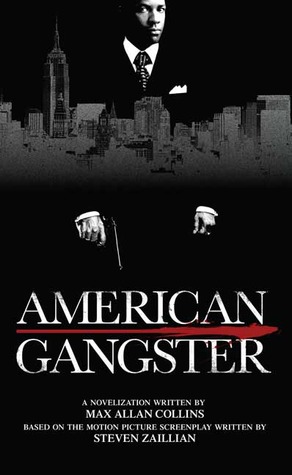
American Gangster
- Автор: Коллинз Макс Аллан
- Год: 2007
- Язык: английский
- Год: Tom Doherty Associates
- ISBN: 978-0-7653-5901-8
- Жанр: Криминальные детективы

Электронная книга - «American Gangster». Краткое содержание книги:
Sheila studied him. She laughed, once, a tiny thing that didn’t make it out of her throat. “You want this bad enough to invest another twenty?”
They’d been keeping their voices low, but now Richie whispered: “What, pay some prick judge off?”
She sighed. “Well, I’m not to going to sit on a hard bench all day.”
And Sheila got a twenty dollar bill from her purse, and took it up to the judge’s assistant with it clipped to Richie’s paperwork.
When the bailiff said, “All rise,” Richie rose, but he wasn’t in a hurry about it.
Finally Frank Lucas got the nerve up to make an important call. He got the number from Joe Louis, who after all owed him a favor; this one might be well worth the fifty grand.
“I want you to know who I am,” Frank said to her. Even over the phone her voice retained its music, its magic. “That you’re an important man in Harlem?”
“No. Who I am. Where I come from. Are you free Saturday afternoon?”
And at one o’clock Saturday, Eva was waiting on a corner in Riverside, right where they’d arranged, just as much a vision in a dark sweater and skirt and handbag as in the gold-lamé gown.
Doc pulled the Lincoln Town Car up to the curb, and Frank told him, “I got this,” and opened the rear door and stepped out and stood before her as awkward as any downhome suitor.
“I hope you weren’t waiting long,” Frank said.
“No. No, you’re right on time.”
“A woman as beautiful as you shouldn’t have to wait for anything.”
She smiled at that, almost laughed, and then she saw he meant every word.
The perfect gentleman, Frank held the door for her, then slid in after her.
“And where are we going?” she asked.
“Teaneck,” he said.
“What’s in Teaneck?”
“My mother.”
Before long the lovely young Hispanic woman was studying family photos on the mantel of the living room’s fireplace, with Frank at her side.
“Is that your father?” she asked, indicating a photograph of a well-dressed, respectable-looking Bumpy Johnson.
“No.”
“Who is it?”
“Martin Luther King.”
“It’s not! You’re a big tease.”
“You’re right.” Frank smiled at Bumpy’s visage. “To me, he was just as important as Dr. King. More so.”
“What his name?”
“Johnson.”
“What did he do?”
“Lot of things. And he had a lot of friends. He served New York and it served him back.”
Eva wasn’t looking at the photo now; it was Frank she was studying. “What was he to you?”
“Well, let me think about it... More than an employer. Teacher.”
“What did he teach you?”
Frank’s head moved to one side; his eyes narrowed. “How to take my time.”
“Is that important?”
“Yes. It is if you’re going to do something, do it right, with care... with love.”
He hadn’t meant to make the words sound seductive, but she clearly was warming to him, standing closer, her voice softer now as she asked, “What else did he teach you?”
The images flew unbidden into his brain: men beaten to a pulp, guys shot to death, Bumpy watching as gasoline was poured onto a competitor and a match was lit...
“How to be a gentleman,” Frank said.
Bumpy’s calm, benign face in the photograph seemed to agree with this assessment.
“Is that what you are?” She slipped her arm in his. “A gentleman?”
Her smile said she doubted this; but it also said she didn’t mind. She was clearly marking the time before he tried to take her upstairs. His mother’s house — right. Sure...
But Frank said smoothly, “I got five different apartments in the city I could’ve taken you to. I have a penthouse that would steal your breath away. But I brought you here, instead...”
A voice from the nearby staircase said: “Oh, is this her?”
Eva turned toward the voice and so, smilingly, did Frank.
His gray-haired mother was making her way down the stairs, beaming at them.
“I brought you here,” he whispered, “to meet my mother.”
Who was crossing the room with her arms wide open, saying, “Oh, she’s beautiful, Frank. Just look at her — an angel come down from heaven.”
Then Momma was embracing Eva, who looked at Frank questioningly, wondering if she’d been had.
Not yet, he thought. Not yet.
13. Mean Machine
Every street cop gets used to the spike of fear that certain sights send through you. But that sick feeling usually didn’t come in the middle of sitting at your desk and going through the morning mail, which was what Richie Roberts was doing when he came across the deceptively mundane-looking envelope from the New Jersey Bar Association.
He sat staring at the thing, holding the letter in both hands, trying to get up the goddamn nerve to open it, the only color in his face provided by the amber light of the sun’s rays slanting in through the looming stained-glass windows.
Over at the bulletin boards, the trio who had become his squad within the squad — skinny Spearman, Afro-sporting Jones and matinee-idol Abruzzo — were revising the organized-crime food-chain chart, pinning up new surveillance photos of various Italian wise guys.
Jones was saying, “Ice-Pick Paul goes here—”
“Naw,” Abruzzo insisted, “he’s under Benny Two-Socks.”
Jones shook his head. “No, man, you’re thinkin’ of the other Benny, Benny the Bishop. Benny Two-Socks is Cattano’s deadbeat son-in-law.”
Spearman was nodding. “Jonesy’s right. You put the wrong asshole up there...”
Richie rose from his desk, came over, and the others looked over their shoulders at him while he studied the table of organization for several long moments. Then, as he began untacking photos, from the top down, the three detectives exchanged wide-eyed glances and shrugs.
Finally Jones asked, “What’re you doin’, Rich? We just put them up there—”
“For a cop,” Richie said, not lecturing, just stating facts, “the uppermost thing is the arrest. For a prosecutor, the arrest is nothing without the evidence to convict.”
Spearman said, “I’m in favor of evidence. Evidence is cool.”
Richie went on: “But we don’t have any real evidence on anybody on this board, so... down they come.”
“Gonna look awful blank,” Abruzzo said.
“We’ll fill it with new pictures.”
“New pictures?” Jones asked.
Richie nodded. “We’re starting over. From the street up.”
Abruzzo’s handsome mug twisted sarcastically. “What are you, all of sudden, a fuckin’ prosecutor?”
Richie just smiled at the guy, then tacked up his exam results on the bulletin board.
“Son of a bitch passed,” Spearman said, eyeballing it.
With a self-satisfied little smile, Richie went back to his desk and got back to work.
That afternoon, on a street in Newark, the four detectives sat in an unmarked car watching blue cellophane packets change hands. This particular dealer, a nondescript moke who might have worked in a drugstore or supermarket, seemed to specialize in white kids, college-looking types, who were making expeditions to the “bad” part of town for their fun powder; but the dealer was democratic: he sold to street junkies, too.
The buyers Richie and his team ignored; it was the seller who had their attention — though they did snap pictures of him, he was hardly their chief concern. Where he might lead them was.