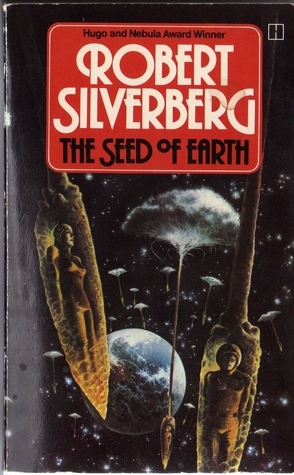
The Seed of Earth
- Автор: Силверберг Роберт
- Год: 1978
- Язык: английский
- Год: Hamlyn Paperbacks
- ISBN: 0 600 38314 8
- Жанр: Научная фантастика

Электронная книга - «The Seed of Earth». Краткое содержание книги:
Four humans, imprisoned in a cave by alien raiders, awaiting an unknown fate, watching for the inevitable crackup that would hurl each at the others' throats —knowing that whatever they did would determine the future of their colony...
'How long did they look? Half an hour?'
Haas said with a trace of impatience, 'Dave, if you want to discuss this further, take it up in private with me.
We can't spare men for a patrol until the stockade's been built. Besides which, your aliens, if they exist, are probably more afraid of us than we are of them.' Haas chuckled. 'Let's get busy. We've got plenty more things to do by nightfall - including the marrying.'
Dawes moistened his lips. Yes, the marrying I He had pushed the thought into the back of his mind, but now there was no avoiding it.
He drew his jacket tighter around himself. Like most thin people, he had little use for cold weather; the wind seemed to cut right through his jacket and between his ribs. The survey team report had said Osiris was Earthtype, uninhabited, and fairly fertile, but they hadn't said anything about that damned nor-wester that ripped down constantly from the forest.
Haas stepped down from his packing crate and called over Noonan, Stoker, Donaldson, and several of the other stronger men of the group, to discuss plans for setting up the colony. According to the booklets that had been distributed before landing, there was a fixed and time-tested procedure for setting up a new colony - a procedure that had worked well on the hundreds of worlds to which humanity had already spread.
The first step was to establish a stockade, to mark the original boundaries of the colony and to provide a tangible measure of the colony's foothold, as well as to serve in keeping stray alien creatures away.
Once the stockade was up, the bubble-houses went up, the homes of the colonists. No more the painstaking hewing of logs for cabins; the bubble-houses sprouted simply and easily from the extrusion nozzles. A gallon of the self-polymerizing fluid could serve to create homes for thousands of colonists; once it was gone, the science of architecture would begin on the new world.
Once the fifty couples were settled, the next matter was that of being fruitful and multiplying. Since the colonists were screened for fertility, it was reasonable to expect thirty or forty offspring in the first year of the colony, twenty or thirty in each succeeding year. By the time ten years had passed, the older children would be able to care for the new crop of babies. After fifteen years, the total population of the colony might be as much as five hundred - and the first second-generation marriages would be taking place. Given unlimited space and no economic problems, breeding could be unlimited for several generations. Population would expand: eight hundred, a thousand, fifteen hundred. It leaped upward by exponential bounds in each generation. And the colony spread outward into the alien wilds, until the raw settlement became a village, a city, a city among other cities.
One by one, a series of new Earths would thus be carved across the reaches of space by grumbling, miserable, conscripted pioneers.
Haas took a while to formulate his plans for the first day's work. Dawes waited at the edge of the clearing. The idle colonists, in no hurry to receive their orders, had formed into the shipboard cliques again. Eight or nine women stood in one bleakfaced little clump not far away, their faces reflecting their realization of where they were and how dead their past lives were. Further away Dawes saw a circle composed of the younger unmarried men, joking tensely, nudging each other in the ribs. The four married couples - The Wilsons, Zacharies, Frys and Nortons - remained apart, as if emphasizing the fact that they would not be concerned with the mass mating soon to take place.
Dawes stole a look at the little group of women. At least half of them were far too old for him to begin to consider as potential mates. If he had last choice, he might indeed have one of them thrust at him, but he hoped not.
Most of the women were in their middle or late twenties. Carol Herrick, at twenty-two, was closest to his own age. Dawes looked at her. She was shivering slightly in the cold wind, tugging her lightweight jacket closed. She was a slim girl with brown hair, black eyes, and a kind of dewy-faced prettiness about her. Dawes had not exchanged many words with her in the four weeks, only the standard introductions. She seemed shy, as shy as he, and he liked that. She was bound to catch the eye of one of the older men, and whoever preceded him in the picking would probably grab her up.
He wondered about the other girls. Cherry Thomas, for instance; he heard her loud laughter as she stood joking with some of the men. She was tall, lively, sophisticated-looking. She looked to be about twenty-five or so, and she looked as if she'd been around a lot in her time.
The impartial scoop of the lottery seized all kinds.
What of the others? Claire Lubetkin, she of the nervous tic and the faint predisposition toward hysteria?
Chunky, dark-haired Louise Marino, who seemed to have spent a man-starved life? Some of the women had never been married; others had husbands, now widowers, on Earth, against whom they were bound to measure any new mate.
A strange uneasiness stole over Dawes and he turned his attention away from the women. One of them would be his wife, on this bitter, wind-tossed world. He would know which one soon enough.
Haas had finished working out his plans. He whistled once again for attention.
'The order of business right now is to get the stockade up. You've been divided into six work gangs. Gangs one, two, and three will be led by Ky Noonan, Howard Stoker and myself. We'll distribute blasters to those three gangs and you'll gather tree-trunks for the backbone of the stockade. Work gang four will be under Sid Nolan, and that gang will be in charge of placing the trunks in the ground. Work gang five, under Lee Donaldson, will bind the trunks together with permospray. Work gang six, under Mary Elliot, will unpack the crates and provisions.'
It was neatly arranged. Most of the men were assigned to the three logging groups. Dawes and sixteen others went into Nolan's group, which did the actual building of the stockade. The women were split between Donaldson's group and Mary Elliot's.
The work went smoothly enough, thanks to the tools supplied by Earth. The forest was thick with barkless trees twenty feet high and six or eight inches in diameter; the three logging groups made swift work of burning them down, trimming away the limbs and the fragrant needley foliage, and sizing the trees to a uniform twenty-foot length. It took only a few minutes to prepare each tree; within half an hour, several dozen were stacked at the border between the forest and the clearing.
At that point, Nolan's group went into action. They had already laid out their boundaries, and now it was a simple matter of scooping out a pit with the vacuum extractor, shoving the sharpened point of the trunk some four feet into the ground, and tamping down the ground.
Dawes hove to with the rest, feeling a pleasant thrill at the thought that the colony was under way, that his hands were helping to shape its walls.
As the row of stakes grew, placed regularly in the ground three feet apart, Donaldson followed along with the extrusion machine, spewing out a binding layer of plastic between each wooden rib. And within the stockade boundaries the women worked, ripping into the sealed crates and laying bare their contents.
After nearly two hours of steady work, the stockade had taken definite shape on three sides. After three hours, it was practically finished, and Haas and his crew, no longer required to supply more logs, were fashioning the gate and bolt for the stockade's entrance. Already the place seemed snug, the winds less cruel, Dawes thought. He felt exhausted from his work, the constant hoisting of logs and placing them in the ground, but it was a good kind of exhaustion, the warm feeling of constructive exertion.
Nightfall came. Giant Vega had dipped far below the horizon, and a sprinkling of unfamiliar constellations brightened the darkening sky. No moon had risen. But, by floodlights, the work had gone on. The stockade was nearly perfect, having sprung up miraculously in only a few hours. And the bubble-houses had been blown: fifty of them, small opaque blue domes that glinted dully in the floodlights' glare. A fifty-first dome, larger than the rest, stood in the very center of the stockade. It would be the central gathering-place of the colony in the early days.