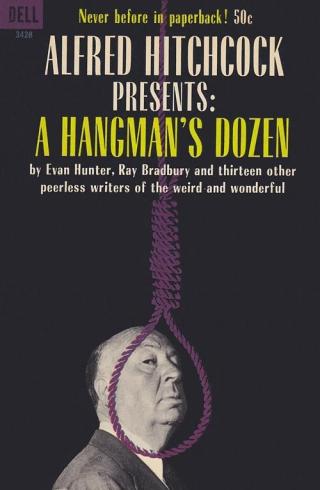
Alfred Hitchcock’s A Hangman’s Dozen
- Автор: Артур Роберт, Брэдбери Рэй Дуглас
- Год: 1962
- Язык: английский
- Год: Dell Publishing
- Жанр: Другие детективы

Электронная книга - «Alfred Hitchcock’s A Hangman’s Dozen». Краткое содержание книги:
It was not long before the deer tracks crossed the old main line. I could see the trail made by Endicott where he had passed earlier. When I saw the second pair of tracks following his I pulled up sharply. They were the same tracks I had noticed the day before and as I stared at them I realized with a sick feeling what it was about them that had disturbed me.
They were small — tracks made by a boy, or a woman. I followed them...
She was crouched behind a large stump, the remnant of what had once been a giant Norway pine, and she was so intent on aiming that she was not aware of my coming up quietly behind her. He had stopped some distance up the road to light a cigarette and his back made a nice red target.
In the vast stillness of the forest the click as she cocked the carbine was a distinct sound. She had taken the mitten off her trigger hand. I still wore mine. I clamped down on the action just in time. Startlement made her pull the trigger but my thumb was there and the hammer snapped down and caught some of my glove between it and the firing pin and that was what kept the carbine from going off. Surprise so unsettled her that I easily tore the carbine out of her grasp.
She huddled there in the snow, pressed up hard against the stump, her balled right fist against her mouth. She had uttered a sharp, short gasp. That had been her only sound.
He never knew what happened behind him. When I glanced his way he was moving on, rifle cradled in the crook of his arm. He never once looked back. Soon he was out of sight.
I had known pain of mind and heart before but it was nothing compared to what I experienced now. Now it was the deep anguish of final disillusionment.
I looked down at her. There was hurt in me, lots of hurt, the kind of hint that fades but never dies, yet there was no hate and I was surprised at that. Even now when I finally knew her for what she really was I still couldn’t hate her. What I had felt for her had been too real, too deep to be replaced by hate.
“So you don’t know how to shoot,” I said, “and guns scare you and you’d get lost if you wandered more than ten feet from the cottage.” It was snowing steadily now and a wind had begun to blow. The tracks we’d made were filling in. “You wanted to make sure you’d never be suspected, didn’t you? That’s why you didn’t try it yesterday, why you waited until today; today the snow would cover your tracks. And in case you were suspected you prepared for that, too. My carbine. If they dug the bullet out of him and had a ballistics done on it, it would be me, wouldn’t it, since you don’t know how to shoot?”
Two tears welled up in her eyes, trembled a moment on the lashes, then trickled down her cheeks. She shook her head mutely from side to side. Another time this might have touched me and moved me but I was suddenly old now and wise.
“Even last night,” I went on, “when you let me kiss you and be seen kissing you... it was all to set me up, wasn’t it? A motive for killing him. What would be a better one than his wife. Are you alone in this?”
She spoke now, her lips moving stiffly. They had lost their rose color, they were almost as pale as the snow that passed in front of her face. “I love you, Sam; I love you.”
“Do you? Or is it someone back home? Is that why you tried it? Or is he too old for you and you want to be free of him but you want his money, too?”
“I love you, Sam. I do. Please believe me.”
She saw it was no use. “What’re you going to do?”
“I won’t tell a soul, Rosemary. I won’t ever tell anyone. Who would believe me against you anyway? Let’s go.”
“Go? Where?”
“Back to camp...”
It would be my word against hers. Remembering how Endicott doted on her, I realized it would be useless to tell him anything. She would twist it around in her favor somehow. She would turn those big, sad, lost eyes on him and look frail and weak and persecuted and he would believe her rather than me.
And she would try it again. Not any more this way, perhaps, but some other way, some other time. I couldn’t tell him — he loved her too much.
I turned off the fire lane into the timber. She stopped and hesitated. “That isn’t the way back,” she said.
“Short cut,” I said.
Still she hesitated.
“Can’t you see how it’s storming? I want to get back as soon as I can. You coming?”
She followed. The timber closed about us. The wind moaned in the tree tops but down on the ground we hardly felt it. This was another world down here, a primeval world, a baffling world of trees and more trees, all of them alike, every direction alike, not even the sun to tell which way was which, nor the sky, for the snow swirled so thick and fast you could not see above the tree tops.
I quickened my pace.
“Sam,” she called, “please slow down, Sam. I can’t keep up with you.” Each word was a gasp.
I moved still faster.
“Sam,” she screamed finally, and began to run after me.
I broke into a run. “Sam, Sam, Sam,” and then she tripped and went sprawling and I kept on, running, running.
“Sam, Sam, Sam...”
Running, running, tripping, swiping my face against a low limb and behind me the shrill, terrified shrieking.
“Sam, Sam, Sam...”
Fainter and fainter until I knew it was only in my mind.
I was with the search party that found her and so was he. The storm had let up after two days and we found her huddled behind a windfall, all curled up on her side with one cheek pillowed on her folded hands. The sheriff brushed the snow gently from her face and she seemed to be asleep with her eyes closed and her lips a thin, sad line and that melancholy look on her features. I turned away and almost wept but no one thought anything of it because they all felt the same way.
“Why?” he cried, tears streaming down his cheeks. “Why did she wander away? Why, when she was so scared of the woods? Will somebody tell me why?”
The Curious Facts Preceding My Execution
Richard Stark
Life in the suburbs, from all reports, is one gay round after another. Week ends are sunny. Commuting is a conversation piece. And among the premiums offered for a book or two of green stamps is tranquillity.
I’m not sure when it was, exactly, that I knew I must murder Janice. Oh, I’d been thinking of it, wistfully, for months, but I don’t know precisely at what moment my idle daydreams metamorphosed into a cold and determined plan.
Perhaps it was the day the mailman brought the bill for Janice’s mink coat, a coat I had not even heard of until then. And when I asked her if I could at least see this coat for which I was expected to pay almost two thousand dollars, a fifth of a year’s wages, she informed me, off-handedly, that she had lost the dear thing on the train, coming home from the city after an exhausting and nerve-racking day spent shopping along Fifth Avenue.
Or perhaps it was before that, the evening I returned to our midtown apartment, wearied from my labors in the advertising vineyard, and learned that in my absence Janice had managed to buy a house in Connecticut. No more were we to be pallid cliff-dwellers in Manhattan. The invigorating air of the ranch style developments for us. It would be good for my health, too, for me to arise an hour earlier each morning and sprint for the train.
Or perhaps it was that evening, out in our little bit of suburbia, when I was poring over our household financial records and discovered that, in the last six months, we had spent more in bank-fines resulting from overdrawn checks than we had spent on food. Janice’s rejoinder, when calmly I shrieked this news at er, was that it was obviously my fault, since I didn’t put enough money into the bank to cover the money she wanted to take back out.