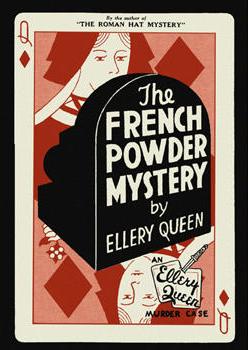
The French Powder Mystery
- Автор: Куин (Квин) Эллери
- Серия: Ellery Queen #2
- Год: 1930
- Язык: английский
- Год: Frederick A. Stokes
- Жанр: Классические детективы

Электронная книга - «The French Powder Mystery». Краткое содержание книги:
“I can’t see that at all,” objected the Inspector. “Can’t see that it has anything to do with it.”
“Let’s not quarrel about it,” murmured Ellery. “I can see one very, very interesting possibility that makes my question logical and the item of Marion French’s scarf seems to point the same way. I think that I’ll be able to check up soon on the facts — which will put me in a position to prove more definitely what I’ve just postulated... Let me get on to point number two.
“The natural thought one has on finding the body in this window is that the crime was committed here. Of course! Usually, one would not even stop to question it.”
“It seemed funny to me, though,” said the Inspector, frowning.
“Ah! It did, eh? Perhaps I can crystallize your suspicion a bit later,” said Ellery brightly. “We enter, we see a body, we say: Crime was committed here. But then we stop to observe. We are told by Prouty that the woman has been dead some twelve hours. The body is found a bit after noon. That would make it a short time after midnight when Mrs. French died. In other words, when the crime was committed. Observe that in any case the crime was committed in dead of night. What is the appearance of this window at such a time — of this whole section of the building? Total darkness!”
“And—?” put in the Inspector dryly.
“You don’t seem to take my dramatics very seriously,” laughed Ellery. “Total darkness, I repeat. Yet we are supposing that this window is the scene of the crime. We prowl about the window, ask ourselves: Are there lights in here? If there are, that’s the end of it. With the door closed, and these heavy drapes on the street side, light would be unobserved outside the window-room. We investigate and find — no, no lights. Plenty of lamps, plenty of sockets — no bulbs. I doubt, indeed, if the lamps are even wired. So — we suddenly visualize a crime in total darkness. What... you don’t like that idea? Neither do I!”
“There are such things as flashlights, you know,” objected Queen.
“So there are. That occurred to me. Then I asked myself: If there was a crime here, there was some logically necessary antecedent action. A crime presupposes a meeting, a probable quarrel, a murder, and in this case, disposal of the body in a very queer and inconvenient place — a wall-bed... And all in the rays of a flashlight! As redoubtable Cyrano would remark: No, I thank you!”
“Might have carried bulbs with him, of course,” muttered the Inspector, then their eyes met and they both laughed at once.
Ellery grew serious. “Well, let’s leave the little matter of illumination for the present. You’ll admit it reeks slightly of improbability?
“And now to that exceedingly fascinating little thingamajig,” he continued, “the lipstick engraved with the letter C. That’s my point number three. In many ways, it’s of extreme significance. The immediate conclusion is that Lipstick marked C does not belong to Mrs. French, whose initials, engraved on three other articles in her bag, are W. M. F. Now, Lipstick marked C is of a noticeably darker shade than the paint on the dead woman’s lips. Which not only corroborates the premise that Lipstick marked C is not Mrs. French’s, but also that there is another lipstick extant somewhere which did belong to Mrs. French. Follow? Now where is that lipstick? It is not in this window anywhere. Therefore it is somewhere else. Did the murderer take it, along with the key? That seems silly. Ah... but haven’t we a clue. Of course! for observe...” he paused, “the dead woman’s lips. Half-finished! And of a lighter shade. What does this mean? Undoubtedly that Mrs. French was interrupted while she was dabbing at her lips with her own lipstick now missing.”
“Why interrupted?” demanded the Inspector.
“Have you ever seen a woman who began to paint her lips leave them half-painted? It just isn’t done. It must have been an interruption which prevented those lips from being entirely daubed. And a violent interruption, I’ll wager; nothing short of an unprecedentedly odd occurrence would stop a woman from smearing that last red blob on the right place.”
“The murder!” exclaimed the Inspector with a queer light in his eye.
Ellery smiled. “Perhaps. — But do you grasp the implication, dad? If she was interrupted by the murder or the incidents immediately preceding the murder, and the lipstick is not in this window—”
“Of course, of course!” exclaimed the old man. He sobered. “It’s true, though, that the lipstick might have been taken by the murderer for purposes of his own.”
“On the other hand,” returned Ellery, “if it was not taken by the murderer, then it is still somewhere in or about the building. You might institute a search through six floors of this dry goods mortuary.”
“Oh, impossible! But I suppose we’ll have to have a try at it later.”
“Perhaps it won’t be necessary in about fifteen minutes,” said Ellery. “At any rate, a genuinely interesting question comes up: To whom does the C lipstick belong, if it is not Mrs. French’s? You might look into that, dad. I have an idea that the answer to that question will bring complications — à la Scott Welles...”
At mention of the Police Commissioner’s name the Inspector’s features lengthened. “You’d better finish what you began, Ellery; he’ll be here any minute now.”
“And so I shall.” Ellery removed his pince-nez and twirled it recklessly in the air. “Before we proceed to point number four, bear in mind that you’re cherchez-ing two feminine accessories — la lipstick de Madame, et sa clef...
“To point number four, then,” continued Ellery with a faraway gleam in his eye. “For point number four we must credit the habitually sharpened perceptions of our grossly underpaid and revered medico, Sam Prouty. He thought it strange that wounds of the nature of Mrs. French’s should have bled so little. At least, there was little trace of blood on her body and clothes... By the way, there was also a smear of dried blood on the palm of her left hand — you noticed it, of course?”
“Saw it, all right,” muttered the Inspector. “Probably clapped her hand to one of the wounds at the moment she was shot, and then—”
“And then,” finished Ellery, “her hand dropped in death and the divine ichor, which by all the laws of physics, according to friend Sam, should have gushed forth, did — what? I should say,” he remarked seriously after a pause, “that it obeyed the immutable laws of that exact science and did gush forth freely...”
“I see what you mean...” murmured the old man.
“It gushed forth freely — but not in this window. In other words, we must look for an interesting combination of elements to explain away the phenomenon of two bloody revolver-wounds being practically bloodless on the discovery of the body...
“Let me sum up the indications to this point,” Ellery continued swiftly. “To my mind the absence of Mrs. French’s apartment key; the absence of normal illuminating-facilities in this window; the absence of Mrs. French’s rightful lipstick, which she must have had almost directly before her death, since her lips are only half-painted; the absence of blood from two logically bloody wounds; the presence of Marion French’s scarf; and another item of a more general but none the less convincing nature — all converge into one conclusion.”
“And that is that the murder was not committed in this window,” said the Inspector, taking snuff with a steady hand.
“Exactly.”
“Just what do you mean by still another item which points toward that conclusion, Ellery?”