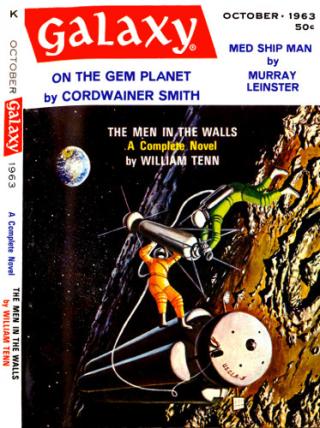
Med Ship Man
- Автор: Лейнстер Мюррей
- Язык: английский
- Жанр: Научная фантастика

Электронная книга - «Med Ship Man». Краткое содержание книги:
He raised the magnification. He raised it again. Still no motion. He upped the magnification until the lattice-pattern of the telescope's amplifying crystal began to show. But at the ship's distance from the planet, a ground-car would represent only the fortieth of a second of arc. There was atmosphere, too, with thermals; anything the size of a ground-car simply couldn't be seen.
But the city showed quite clearly. Nothing massive had happened to it. No large-scale physical disaster had occurred. It simply did not answer calls from space.
Calhoun flipped off the screen.
"I think," he said irritably into the communicator microphone, "I suspect I'll have to make an emergency landing. It could be something as trivial as a power failure—" but he knew that was wildly improbable—"or it could be—anything. I'll land on rockets and tell you what I find."
The voice from the Candida said hopefully:
"Can you authorize us to refuse to land our passenger for his own protection? He's raising the devil! He insists that his business demands that he be landed."
A word from Calhoun as a Med Service man would protect the spaceliner from a claim for damages. But Calhoun didn't like the look of things. He realized, distastefully, that he might find practically anything down below. He might find that he had to quarantine the planet and himself with it. In such a case he'd need the Candida to carry word of the quarantine to other planets and thus to Med Service sector headquarters.
"We've lost a lot of time," insisted the Candida. "Can you authorize us—"
"Not yet," said Calhoun. "I'll tell you when I land."
"But—"
"I'm signing off for the moment," said Calhoun. "Stand by."
He headed the little ship downward, and as it gathered velocity he went over the briefing sheets covering this particular world. He'd never touched ground here before. His occupation, of course, was seeing to the dissemination of medical science as it developed under the Med Service. The Service itself was neither political nor administrative. But it was important. Every human-occupied world was supposed to have a Med Ship visit at least once in four years to verify the state of public health.
Med Ship men like Calhoun offered advice on public-health problems. When something out of the ordinary turned up, the Med Service had a staff of researchers who hadn't been wholly baffled yet. There were great ships which could carry the ultimate in laboratory equipment and specialized personnel to any place where they were needed. Not less than a dozen inhabited worlds in this sector alone owed the survival of their populations to the Med Service, and the number of those which couldn't have been colonized without Med Service help was legion.
Calhoun reread the briefing. Maya was one of four planets in this general area whose life systems seemed to have had a common origin, suggesting that the Arrhenius theory of space-traveling spores was true in some limited sense. A genus of ground-cover plants with motile stems and leaves and cannibalistic tendencies was considered strong evidence of common origin.
The planet had been colonized for two centuries now, and produced organic compounds of great value from indigenous plants, most of which were used in textile manufacture. There were no local endemic infections to which men were susceptible. A number of human-use crops were grown. Cereals, grasses and grains, however, could not be grown because of the native ground-cover motile-stem plants. All wheat and cereal food had to be imported, which fact severely limited Maya's population. There were about two million people on the planet, settled on a peninsula in the Yucatan Sea and a small area of mainland. Public-health surveys had shown a great many things about a great many subjects ... but there was no mention of anything to account for the failure of the spaceport to respond to arrival calls from space. Naturally!
The Med Ship drove on down, and the planet revolved beneath it.
As Maya's sunlit hemisphere enlarged, Calhoun kept the telescope's field wide. He saw cities, and vast areas of cleared land where native plants were grown as raw materials for the organics' manufacturies. He saw very little true chlorophyll green, though. Mayan foliage tended to a dark olive color.
At fifty miles he was sure that the city streets were empty even of ground-car traffic. There was no spaceship aground in the landing-grid. There were no ground-cars in motion on the splendid, multiple-lane highways.
At thirty miles altitude there were still no signals in the atmosphere, though when he tried amplitude-modulation reception he picked up static. But there was no normally modulated signal on the air at any frequency. At twenty miles—no. At fifteen miles, broadcast power was available, which proved that the landing-grid was working as usual, tapping the upper atmosphere for electric charges to furnish power for all the planet's needs.
From ten miles down to ground-touch, Calhoun was busy.
It is not too difficult to land a ship on rockets, with reasonably level ground to land on. But landing at a specific spot is something else. Calhoun juggled the ship to descend inside the grid itself. His rockets burned out pencil-thin holes through the clay and stone beneath the tarmac. He cut them off.
Silence. Stillness. The Med Ship's outside microphones picked up small noises of wind blowing over the city. There was no other sound at all.
—No. There was a singularly deliberate clicking sound, not loud and not fast. Perhaps a click—a double click—every two seconds. That was all.
Calhoun went into the airlock, with Murgatroyd frisking a little in the expectation of great social success among the people of this world. When Calhoun cracked the outer airlock door he smelled something. It was a faintly sour, astringent odor that had the quality of decay in it. But it was no kind of decay he recognized. Again stillness and silence. No traffic-noise; not even the almost inaudible murmur that every city has in all its ways at all hours. The buildings looked as buildings should look at daybreak, except that the doors and windows were open. It was somehow shocking.
A ruined city is dramatic. An abandoned city is pathetic. This was neither. It was something new. It felt as if everybody had walked away, out of sight, within the past few minutes.
Calhoun headed for the spaceport building with Murgatroyd ambling puzzledly at his side. Murgatroyd was disturbed. There should be people here! They should welcome Calhoun and admire him—Murgatroyd—and he should be a social lion with all the sweets he could eat and all the coffee he could put into his expandable belly. But nothing happened! Nothing at all.
"Chee?" he asked anxiously.
"They've gone away," growled Calhoun. "They probably left in ground-cars. There's not one in sight."
There wasn't. Calhoun could look out through the grid foundations and see long, sunlit and absolutely empty streets. He arrived at the spaceport building. There was—there had been—a green area about the base of the structure. There was not a living plant left. Leaves were wilted and limp. The remains had become almost a jelly of collapsed stems and blossoms of dark olive-green. The plants were dead; but not long enough to have dried up. They might have wilted two or three days before.
Calhoun went in the building. The spaceport log lay open on a desk. It recorded the arrival of freight to be shipped away—undoubtedly—on the Candida now uneasily in orbit somewhere aloft. There was no sign of disorder. It was exactly as if the people here had walked out to look at something interesting, and hadn't come back.
Calhoun trudged out of the spaceport and to the streets and buildings of the city proper. It was incredible! Doors were opened or unlocked. Merchandise in the shops lay on display, exactly as it had been spread out to interest customers. There was no sign of confusion anywhere. Even in a restaurant there were dishes and flatware on the tables. The food in the plates was stale, as if three days old, but it hadn't yet begun to spoil. The appearance of everything was as if people at their meals had simply, at some signal, gotten up and walked out without any panic or disturbance.