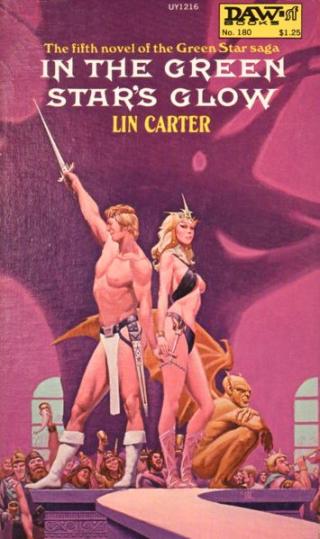
In the Green Star's Glow
- Автор: Картер Лин Спрэг
- Серия: Green Star Rises #5
- Язык: английский
- Жанр: Научная фантастика

Электронная книга - «In the Green Star's Glow». Краткое содержание книги:
But he was also an Earthling, whose helpless body lay in suspended animation in a guarded mansion in New England. It was his alien mind that drove Karn through perils that no other wold dare...
In the Green Star's Glow is a science fantasy novel in the tradition of Edgar Rice Burroughs. Written by American author Lin Carter, it is the final book in his Green Star series. It was first published in 1976.
First he had sought the secret within the body itself, thinking that some gland or organ or nerve center, under the appropriate drugs or stimuli, might immortalize the body and enable it to repair or to replace worn-out tissues. These experiments had led to the creation of such monstrosities as Number Nine.
Failing to find the secret of eternal life in that avenue of research, Quoron had next turned to the preservation of the only essential part of a human body—the brain.
His experiments in this direction had, thus far, resulted in failure.
The bodiless head in the white chamber—the mindless idiot-thing he called, contemptuously, by the name of Wa-Wa—was the only brain he had thus far managed to keep alive for any significant length of time, after removing it from its body.
The brain lived, but the mind was dead.
The problem of continuing the supply of fresh oxygen to the vital brain centers during the difficult process of decapitation was his present area of research.
Quoron now felt that the answer lay in attaching the veins and arteries to the system of valves and pumps he called his artificial heart before the cranium was severed from the torso.
That way the fatal interval would be overcome, during which the mind centers died of oxygen-starvation.
Quoron now felt he was approaching his ultimate goal.
Niamh had never dared inquire of the dwarf his ultimate purpose in holding her captive in the Opal Tower.
She was afraid to, for she feared the worst.
Instead she questioned Quoron as to how he intended to preserve his own life by this method, once he had mastered the technique. After all, one can scarcely decapitate oneself.
He replied that he had foreseen that eventuality. Number Nine would perform the entire operation.
Niamh was incredulous. “That clumsy monstrosity? You would entrust so delicate an operation to—to—?”
“To Number Nine?” He chuckled. “Of course! To whom else could I possibly entrust so excessively difficult a task? The twin brains of Number Nine have been sponged clean of every thought and memory; they are like tablets of fresh clay, ready to be written upon. Once the techniques are perfected, Nine will be schooled with exquisite thoroughness in every step and detail of the process. Why do you think I gave the brute four hands? So that it can perform the operation with twice the speed and twice the care of an ordinary person.”
Quoron smiled thinly.
“You need not fear for me, my dear. Nine retains no memory, its dual brain is completely blank. It functions only in obedience to my will, and remembers nothing from one day to another.”
But Niamh was not so certain of this.
Sometimes, during the early evening when the candles where lit, as the brute was serving her supper, she observed a strange thing happen.
As the three functional hands were laying the table with deft, mechanical precision, the eyes of the twin heads would stray.
The wavering flame of the candles would catch those dull, mindless eyes. The flames that were identical with the candle-flame in which Quoron had once commanded his pet monster to hold its hands until the skin and flesh of the fingers of that hand crisped and fried.
Was it the flicker of fear Niamh thought she glimpsed in those four dull eyes?
Or was it the memory of pain?
Or was it—just possibly—anger?
The Fourth Book
KARN AMONG THE AMAZONS
16.
The Mind-Search
At length, having failed to discover the whereabouts of Delgan of the Isles, Zorak of Tharkoon, or Niamh the Fair, and having failed as well to find out what had happened to myself, Prince Andar called off the search.
Although he did so with the greatest reluctance, it was obvious to all that further expeditions into the edges of the forest country would be equally as fruitless as those which had already been so tirelessly prosecuted.
The searchers embarked for their return voyage to the royal isle of Komar, leaving behind only Zarqa the Kalood.
The Winged lean politely declined Prince Andar’s invitation to return to Komar and rejoin his comrades, the newly married Prince Janchan and Princess Arjala, who were anxiously awaiting news of their lost friends.
I shall remain here in the forest for a time, Zarqa said in the telepathic mode of communication his kind employed in lieu of vocal speech. It may yet be possible to ascertain the whereabouts of my dear friends. At least, it is my most earnest desire to attempt it.
“Well, I can certainly understand your determination, Zarqa, and your desire to find your friends,” said Andar the Komarian thoughtfully. “But why do you think that you might succeed, where so many of my men have already failed?”
To this query the Winged Man made a polite but largely evasive reply. Always cautious of hurting the feelings of humans, whom he could not help but regard as less fortunate than he, Zarqa restrained himself from giving voice to his real thoughts.
He felt that he, being an immortal, and for that reason less conscious of the passing of time, was capable of far greater patience than were the Komarians. No matter how deeply and sincerely they desired to find and rescue from the perils of the wilderness the strangers who had come to their assistance in reconquering the kingdom of Komar from the Blue Barbarians, they were still mortal, and therefore time-bound. A day, a week, was an appreciable division of time to their way of thinking, because it was a measurable fraction of their lives.
Not so, to Zarqa the Kalood. To search the worldwide forest of gigantic trees for a year or even ten, meant nothing to a being whose lifespan was to be measured in many millions of years. Zarqa was more than willing to devote so long a time to the search. Not only did the Kalood suffer less than did humans from deprivation, due to his enormously tough and resilient physical makeup, but he seldom required nutriment and never needed to sleep.
And I, Karn, was the first true friend he had found in all the world since the death of the last of his kind a million years ago. I had been the first human to extend to Zarqa the warm handclasp of friendship and, in so doing, to bridge the abyss which lay between his kind and my own.
Zarqa was unable to forget that. He was ready to devote the remainder of his life, however long his immortality might last, to the search for me and my friends, or for our remains.
Moreover, it was undeniably true that Zarqa possessed one unique faculty which made his ability to search the forest of mile-high trees far more swiftly and easily than could Andar’s men, for all their numbers. And that was his wings.
Therefore, bidding Prince Andar and the others farewell for a time, Zarqa watched as they embarked for the voyage back to Komar. Then he turned, spread his great batlike golden wings, and glided from the branch into the green-gold twilight world of the giant trees.
The immediate edge of the world-forest had already been thoroughly combed by the Komarian force. They had started at the approximate point at which the sky craft, bearing Delgan and Zorak and Niamh, had been observed to enter the vast wall of treetrunks, and had searched with minute care along the edge and then deeper into the almost impenetrable woods.
Zarqa, therefore, wasted no energy in retracing their steps but sailed deeper yet into the forest, and then began to scrutinize the great trees, bough by bough, branch by branch, for any sign of human habitation.
With his enormous patience and his lack of any need for rest or sleep or food, the gaunt Kalood was able to search tirelessly, even into the hours of darkness; for his visual organs, designed along somewhat different lines than those of the human eye, required far less light in order to see.