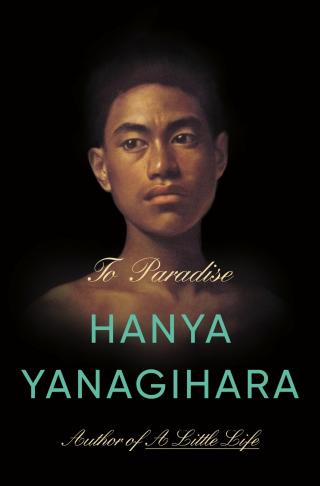
To Paradise
- Автор: Yanagihara Hanya
- Год: 2022
- Язык: английский
- Год: Knopf Doubleday Publishing Group
- Жанр: Современная русская и зарубежная проза

Электронная книга - «To Paradise». Краткое содержание книги:
In an alternate version of 1893 America, New York is part of the Free States, where people may live and love whomever they please (or so it seems). The fragile young scion of a distinguished family resists betrothal to a worthy suitor, drawn to a charming music teacher of no means. In a 1993 Manhattan besieged by the AIDS epidemic, a young Hawaiian man lives with his much older, wealthier partner, hiding his troubled childhood and the fate of his father. And in 2093, in a world riven by plagues and governed by totalitarian rule, a powerful scientist's damaged granddaughter tries to navigate life without him--and solve the mystery of her husband's disappearances.
These three sections are joined in an enthralling and...
The next evening, I was making dinner when I heard the noise of keys in the locks, and although of course it was only my husband, in the moment I was so frightened that I dropped the entire pan of potatoes on the floor. After he had helped me clean them up, and as we were eating dinner, my husband said, “I have an idea. Why don’t we have a pair of code words, something we can say when we’re entering the apartment, so we’ll each know it’s the other? I’ll say my word, and you’ll say yours, and then we’ll both know that we are who we say we are?”
I thought about it. “What words will we use?” I asked.
“Well,” my husband said, after thinking. “Why don’t you be—let’s see—a cobra?” I must have looked surprised, or offended, because he smiled at me. “Cobras are very fierce,” he said. “Small, but quick, and deadly if they catch you.”
“And what will you be?” I asked.
“Let’s see,” he said, and I watched him think. My husband liked zoology, he liked animals. The day we met, there had been a report on the radio that Magellanic penguins had been declared officially extinct, and my husband had expressed sorrow over that, had said that they were resilient animals, more resilient than people thought, and more human than people knew as well. When they were sick, he said, they toddled away from their flock so they could die alone, with none of their kin to watch them.
“I’ll be a mongoose,” he said at last. “A mongoose can actually kill a cobra, if it wants to—but they very rarely do.” He smiled again. “It’s too much work. So they just respect each other. But we’ll be a cobra and a mongoose that do more than just respect each other: We’ll be a cobra and a mongoose that unite to keep each other safe from all the other animals in the jungle.”
“Cobra and Mongoose,” I repeated, after a pause, and he nodded.
“A little more dangerous than Charlie and Edward,” he said, and smiled again, and I saw that he was teasing, but teasing in a nice way.
“Yes,” I said.
I had told David that story on one of our earliest walks, back when he was still a tech at the Farm, and my husband was still alive. And so, as we stood at my door before he left, he said, “What about using code words—like Cobra and Mongoose? That’s how you’ll know the people coming to meet you are who they should be.”
“Yes,” I agreed. It was a good idea.
Now I stayed crouched in position beneath the middle plank seat. The boat bobbed and rocked, and yet it kept moving, the sounds of the oars stroking through the water steady and swift. Then, rumbling through the bottom of the boat, I heard the sound of a motor, and as I listened, it grew louder and louder.
“Oh shit,” I heard one of the men curse.
“Is that one of ours?” the other asked.
“Too far to tell,” said the first, and swore again.
“What the fuck is that craft doing out here?”
“Fuck if I know,” said the first man. He swore once more. “Well, there’s no way out. We just have to take our chances, and hope it’s one of ours.” He nudged me with his foot, not hard. “Miss: Be very quiet and keep very still. If it’s not one of our people—”
But then I could no longer hear him, because the sound of the motor was now too loud. I realized that I had never asked David what I should do if I was caught, and that he had never told me. Was he so certain everything would unfold as he had described? Or was this in fact the plan, and was I being delivered to people who would hurt me, who would take me somewhere and do things to me? Surely David, who knew so much and had foreseen so much, would have told me what I was to do if something went wrong? Surely I wasn’t so helpless that I wouldn’t have thought to ask him? I began to cry, quietly, folding a piece of the tarp into my mouth. Had I been wrong to trust David? Or had I been right, and had something happened to him? Had he been arrested, or shot, or disappeared? What would I do if I was caught? Officially, I was nobody: I didn’t even have my papers with me. Of course, they could do whatever they wanted to me even if I had my papers, but without them, it would be that much easier. I wished I had Grandfather’s ring in my hand, so I could squeeze it and pretend I was safe. I wished I was at home, and my husband was alive, and I hadn’t seen or experienced any of the things I had in the past three days. I wished I had never met David; I wished he were with me now.
But then I realized: No matter what happened, this was the end of my life. Perhaps it was the actual end. Perhaps it was just the end of the one I had known. But either way, my life mattered less to me, because the person to whom it had mattered most was gone.
“You,” I heard someone say, but over the motor, I couldn’t tell if it was one of the people in the boat with me, or in the other boat, which I could feel was pulling alongside us, or to whom they were speaking. And then the tarp was being pulled away from me, and I could feel the breeze on my face, and I lifted my head so I could see who was speaking to me, and where I was going next.
PART X
September 16, 2088
Dearest Peter,
I’m writing fast, because this is the last chance I’ll have—the person who’s going to find a way to get this to you is standing just outside my cell but has to leave in ten minutes.
You know that I’m going to be executed in four days. The insurgency needs a face, and the state needs a sacrificial lamb, and I was the compromise. I managed to get some concessions from both of them in return for being publicly hanged in front of a braying crowd, however: that they would leave Charlie and her husband alone, that she would never be punished for me; that Wesley will always treat her decently. No matter which side triumphs, she’ll be protected—or at least not harassed.
Do I trust them? No. But I also have to. I don’t care about dying, but I can’t bear to leave her here, in this place, alone. Of course, she won’t be alone. But he can’t stay here, either.
Peter, I love you. You know I do, and I always have. I know you love me, too. Please take care of her, my Charlie, my granddaughter. Please find a way to get her out of this country. Please give her the life that she should have had, if I had gotten out of here earlier, if I had been able to save her. You know she needs help. Please, Peter. Do everything you can. Save my little cat.
Who would have thought that New Britain, of all places, would one day be heaven, and this place so spectacularly rotten? Well, you did, I know. And so did I. I’m sorry for it. I’m sorry for it all. I made the wrong decisions, and then I made more and more of them.
My only other request—not to you, but to someone or something—is this: Let me come back to earth someday as a vulture, a harpy, a giant microbe-stuffed bat, some kind of shrieking beast with rubbery wings who flies over scorched lands, looking for carrion. Wherever I wake, I’ll fly here first, whatever they’re calling it then: New York, New New York, Prefecture Two, Municipality Three, whatever. I’ll pass by my old house on Washington Square and look for her, and if I don’t find her, I’ll fly north to Rockefeller and look for her there.
And if she’s not there, either, I’ll assume the best. Not that she’s been disappeared, or died, or interned somewhere, but that you have her, that you managed to save her in the end. I won’t even circle above Davids Island, or the crematoriums, or the landfills or prisons or reeducation or containment centers, trying and failing to detect her scent, cawing her name as I do. Instead, I’ll rejoice. I’ll kill a rat, a cat, whatever I can find, eat it for strength, and stretch my ribbed wings wide and let out a squawk, a sound of hope and anticipation. And then I’ll turn east and begin my long flight across the sea, flapping my way toward you, and her, and maybe even her husband, all the way to London, to my loves, to freedom, to safety, to dignity—to paradise.