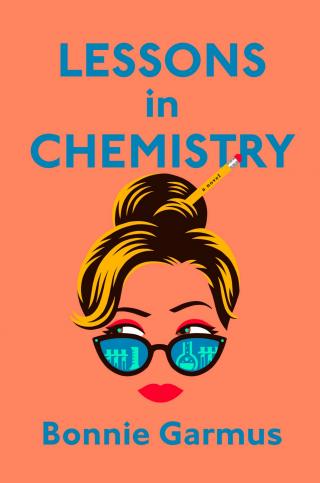
Lessons in Chemistry
- Автор: Garmus Bonnie
- Год: 2022
- Язык: английский
- Год: Doubleday Canada
- Жанр: Современная русская и зарубежная проза

Электронная книга - «Lessons in Chemistry». Краткое содержание книги:
“Oh. I’m a rower. Trying to be.”
“Are you any good?”
“No.”
“Then why are you doing it?”
“I’m not sure.”
He shook his head. “Boy, do I get that.”
—
“How’s your project going?” Calvin asked Elizabeth a few weeks later as they sat together at lunch. He took a bite of his turkey sandwich, chewing vigorously to disguise the fact that he already knew. Everybody knew.
“Fine,” she said.
“No problems?”
“None.” She sipped her water.
“You know if you ever need my help—”
“— I don’t need your help.”
Calvin sighed, frustrated. It was a form of naïveté, he thought, the way she continued to believe that all it took to get through life was grit. Sure, grit was critical, but it also took luck, and if luck wasn’t available, then help. Everyone needed help. But maybe because she’d never been offered any, she refused to believe in it. How many times had she asserted that if she did her best, her best would win? He’d lost count. And this was despite significant evidence to the contrary. Especially at Hastings.
As he finished their lunch — she barely touched hers — he promised himself he would not intervene on her behalf. It was important to respect her wishes. She wanted to handle this on her own. He would not get involved.
—
“What’s your problem, Donatti?” he roared approximately ten minutes later as he burst into his boss’s office. “Is it an origin of life issue? Pressure from the religious community? Abiogenesis is just more proof that there actually is no God and you’re worried this might not play well in Kansas? Is that why you’re canceling Zott’s project? And you dare to call yourself a scientist.”
“Cal,” Donatti had said, his arms stretched casually behind his head. “As much as I love our little chats, I’m kind of busy right now.”
“Because the only other viable explanation,” Calvin accused, shoving his hands in the front pockets of his voluminous khakis, “is that you don’t understand her work.”
Donatti rolled his eyes as a puff of stale air escaped his lips. Why were brilliant people so dumb? If Evans had any brains at all, he’d accuse him of attempting to horn in on his good-looking girlfriend.
“Actually, Cal,” Donatti said, stubbing out a cigarette, “I was trying to give her career a little boost. Giving her a chance to work with me directly on a very important project. Help her grow in other areas.”
There, Donatti thought. Grow in other areas — how obvious could he be? But Calvin started in on her latest test results as if they were still talking about work. The guy was clueless.
“I get offers every week,” Calvin threatened. “Hastings isn’t the only place I can conduct my research!”
This again. How many times had Donatti heard it? Sure, Evans was a hot ticket in the research world, and yes, much of their funding was based on his mere presence. But that was only because funders erroneously believed that Evans’s name attracted other big-brained talent. Hadn’t happened. Anyway, he didn’t want Evans to leave; he only wanted Evans to fail — to become so unhinged by love lost that he self-destructed, ruining his reputation and tanking all research opportunities going forward. Once that happened, then he could leave.
“Like I said,” Donatti replied in a measured voice, “I was only trying to give Miss Zott a chance for personal growth — I’m trying to help her career.”
“She can take care of her own career.”
Donatti laughed. “Really. And yet here you are.”
—
But what Donatti didn’t tell Calvin was that a huge fly had recently landed in his get-rid-of-Evans-via-Zott ointment. A donor with impossibly deep pockets.
The man had appeared, out of the blue, two days ago, with a blank check and an insistence to fund — of all things — abiogenesis. Donatti mounted a polite argument. What about lipid metabolism, he suggested. Or cell division? But the man insisted: abiogenesis or nothing. So Donatti had no choice: he put Zott back on her ridiculous mission to Mars.
Truth was, he wasn’t making much headway with her anyway. She’d steadily refused to yield to his repeated “you’re not smart” put-downs. No matter how many times he said it, she hadn’t once responded in the proper fashion. Where was the low self-esteem? Where were the tears? If she wasn’t restating her boring case for abiogenesis in a professional way, then she was saying, “Touch me again and live to regret it.” What the hell did Evans see in this woman? He could keep her. He’d have to find some other way to fix the big man’s wagon.
—
“Calvin,” Elizabeth said, rushing into his lab later that afternoon. “I have great news. I’ve been keeping something from you and I apologize, but it was only because I didn’t want you to get involved. Donatti canceled my project a few weeks back and I’ve been fighting to get it back. Today that fight paid off. He reversed his decision — said he’d reviewed my work and decided it was too important not to move forward.”
Calvin smiled broadly in what he hoped was the appropriate expression of surprise — he’d left Donatti’s office less than an hour ago. “Wait? Really?” he said, clapping her on the back. “He tried to cancel abiogenesis? Well that must have been a mistake from the start.”
“I’m sorry I didn’t tell you about it. I wanted to handle it on my own and now I’m glad I did. I feel like it’s a real vote of confidence in my work — in me.”
“Definitely.”
She looked at him more closely, then took a step back. “I did get this on my own. You had nothing to do with it.”
“First time I’ve heard about it.”
“You never talked to Donatti,” she pressed, “you never got involved.”
“I swear,” he lied.
After she left, Calvin clasped his hands together in a silent fit of glee and flipped on the hi-fi, dropping the needle on “Sunny Side of the Street.” For a second time, he’d saved the person he loved the most, and the best part was, she didn’t know.
He grabbed a stool, opened a notebook, and began to write. He’d been keeping journals since age seven or so, jotting down the facts and fears of his life between lines of chemical equations. Even today his lab was full of these nearly illegible notebooks. It was one of the reasons everyone assumed he was getting a lot done. Volume.
—
“Your handwriting is hard to read here,” Elizabeth had noted on several occasions. “What’s that say?” She’d pointed to an RNA-related theory he’d been toying with for months.
“A hypothesis about enzymatic adaptation,” he answered.
“And this?” She pointed farther down the page. Something he’d written about her.
“More of the same,” he said, tossing the notebook aside.
It wasn’t that he was writing anything terrible about her — just the opposite. Rather, it was more that he couldn’t risk having her discover that he was obsessed with the notion that she might die.
—
He’d long ago decided that he was a jinx and he had solid proof: every person he’d ever loved had died, always in a freak accident. The only way to put an end to this deadly pattern was to put an end to love. And he had. But then he’d met Elizabeth and, without meaning to, had stupidly and selfishly gone on to love again. Now here she was, standing directly in line of his jinx fire.
As a chemist, he realized his fixation on jinxes was not at all scientific; it was superstitious. Well, so be it. Life wasn’t a hypothesis one could test and retest without consequence — something always crashed eventually. Thus he was constantly on the lookout for things that posed a threat to her, and as of this morning, that thing was rowing.