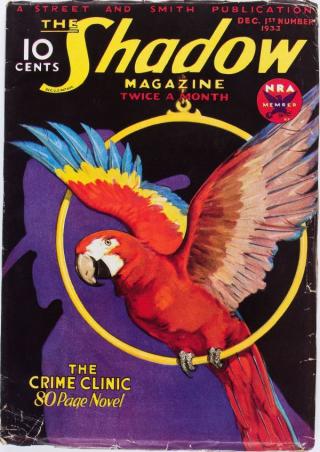
The Crime Clinic
- Автор: Грант Максвелл
- Серия: The Shadow #43
- Год: 1933
- Язык: английский
- Год: Street and Smith
- Жанр: Крутые детективы

Электронная книга - «The Crime Clinic». Краткое содержание книги:
“Your pets?”
“Yes.” Sarborn arose and beckoned. Melken followed him into an unfurnished room. There, in a long, wide cage, Melken observed a dozen green plumaged birds that were sitting solemnly on perches.
“Parakeets,” remarked Sarborn. “I made quite a study of them, and brought these along with me.”
“Do they chatter much?” asked Melken.
“Not these,” returned Sarborn, “but there’s the baby that does — when he feels in the mood.”
Melken turned toward the corner of the room. There, perched upon a metal bar set in the front of a deep window sill, was one of the most beautiful birds that he had ever seen. Its plumage was of a vivid red; the size of the bird was also remarkable. It measured nearly three feet from head to tail.
“A great scarlet macaw,” explained Sarborn. “A rare species for one to find in captivity. This bird is worth more than the whole cageload of parakeets.”
“Does the macaw talk?”
“Yes. When coaxed. I have trained him.”
SARBORN approached the bird. He reached up and scratched the macaw’s head. The big bird began to ruffle its throat feathers and open its bill, but no sound came. Sarborn continued the treatment. He nodded to Melken, and motioned him toward the door.
“Bustle up toward the bird,” he ordered. “Make out that you are threatening it. Stop short, though, before you arrive too close.”
The macaw was watching Melken as it moved its bill. The young man followed Sarborn’s instructions. As he made a fierce advance, a shrill warning came from the scarlet macaw.
“Keep away! Keep away!”
Melken stopped suddenly as he heard the high falsetto cry. Sarborn, still scratching the macaw’s head, laughed at his friend’s surprise. He gave another order.
“Be more affable,” he said. “Then stroll away and pretend that you are going out the door.”
Melken followed instructions. As he hesitated at the door, another call came from the macaw’s trembling beak.
“Come back!” shrilled the bird. “Come back!”
“Remarkable!” exclaimed Melken, as the cry died. “The bird seems to have almost human intelligence.”
“It is observant,” admitted Sarborn. “More than that, it has an aptitude for remembering things that it hears. It only chooses words that appeal to it, however. Try some.”
“New York,” suggested Melken.
“Repeat it,” ordered Sarborn. “Emphasize the name.”
“New York — New York—”
“New York!” screamed the macaw. “New York!”
Melken laughed. Sarborn ceased stroking the bird’s head. The macaw kept ruffling its throat, but gave no further cry. Melken approached, scratched the bird’s head; there was no response.
“It will only take its cues from me,” explained Sarborn. “Speaking of birds — here are some interesting eggs. I brought a small collection with me from South America.”
Sarborn pointed to a glass case in the corner. There, Melken saw a variety of eggs of different sizes. He remarked upon a large, blotched egg that was about three inches in length.
“What species of egg is that?” he questioned.
“A condor’s egg,” replied Sarborn. “The condor is one of the largest of all birds. They can fly to greater altitudes than the eagle.”
“It must be difficult obtain their eggs.”
“No. They have no marked nesting habits. The eggs are found upon rocks, in the mountains. Such eggs are not particularly rare.”
A slight sound came from a covered box in the corner. Melken looked in that direction. Sarborn reached over and raised the lid of the box. A small monkey poked its head into view.
“Are you raising monkeys, too?” laughed Melken, as he saw the little creature scramble up to Sarborn’s arms.
“No,” replied Sarborn. “I started to, but gave it up. I’m going to get rid of this little beast later on. Affectionate, but a nuisance. Just a common species. South American monkey. Called a sapajou.”
The monkey had seized Sarborn’s necktie. It was starting to climb up it, hand over hand. Sarborn wrested the sapajou free, and dropped it back into the box. He closed the lid and strolled back to the living room.
“Well,” he remarked, “you’ve seen the menagerie. Wouldn’t do at the Ritz. Better here. Guess I’ll get rid of the whole shebang. All except the macaw.”
“How long are you going to be in town?” questioned Melken anxiously.
AGAIN, Sarborn looked quizzically at his friend. He seemed to sense the worriment that was present in Melken’s mind.
“Quite a while,” said Sarborn. “Why?”
“Thought we might get together occasionally,” returned Melken. “I’ve been nervous during the past few days.”
“Why?”
“The trouble out at Casslin’s house. You must have read about it in the newspapers.”
“The murder of the millionaire?”
“Yes.”
“You were there?”
“Yes.”
“Hm-m-m.” Sarborn was shaking his head. “Very mysterious affair. Read about it in the newspapers. None of the guests were implicated, were they?”
“No,” answered Melken, “but I’m worried just the same. Farrell, there were some other robberies a few months ago — robberies that took place at houses where I had been. This was the first one where a murder occurred.”
“You think—”
“I don’t know what to think. I’m worried. If there’s one crook in back of all these robberies, there’s no telling what may happen next.”
“Why should it concern you?” Sarborn asked.
“Here’s why.” Melken’s tone became serious. “It’s going to look as though someone might be on the inside of some of these crimes. It’s also going to be tough for anyone who might observe too much.”
“You mean something might be planted on you?”
“Not on me,” broke in Melken hastily. “That is — not necessarily on me. On someone, though, and I might be the person.”
“Or,” added Sarborn calmly, “someone might decide that you knew too much and give the orders to bump you off?”
“I don’t know,” responded Melken. “I only know that I’ve been terribly worried since Casslin was killed. I’ve had a feeling that there is a menace hanging over me. We’re old friends, Farrell. You’re the only man to whom I can talk about this.”
Sarborn arose and clapped his friend on the shoulder. His action seemed to given Melken encouragement. There was a firmness in Sarborn’s manner that aroused confidence.
“Don’t worry, old top,” volunteered Sarborn. “If you have any idea whatever that trouble is brewing, let me know. If you’re uneasy, maybe you can arrange for me to be with you. I’ve faced everything. Anacondas to orangutans. I like trouble.”
Bart Melken nodded. Under this persuasion, he was ready to talk further.
“At Casslin’s,” he said seriously, “Yvonne saw a face at the window. She told me about it. That was just before the murder. She told the police afterward; but I didn’t say that she had spoken to me when she saw the face.
“That’s what has me worried, Farrell. I’ll be looking for danger signs from now on. I won’t be able to keep myself from doing so. If — if I begin to look like I’m — well, a menace to some crooks — they may decide to put me on the spot.”
“Don’t worry, Bart,” reassured Sarborn. “This hunch of yours is interesting. I think we’d better stick around together a bit.”
Bart Melken shook hands warmly. He felt the value of this friendship. When he left Sarborn’s apartment, a while later, he decided that he had accomplished something.
Melken, like Cardona and The Shadow, was out to learn the identity of The Jackdaw. His purpose was not guided by any dislike of crime; it was merely inspired by a desire for self-preservation; to escape a bargain that was proving one-sided.