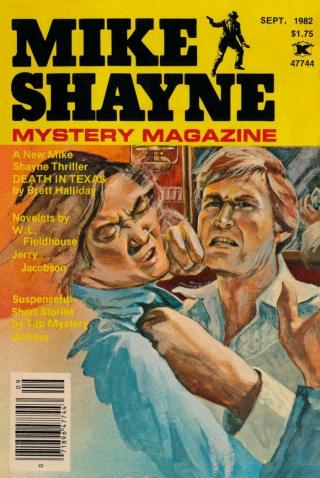
Mike Shayne Mystery Magazine, Vol. 46, No. 9, September 1982
- Автор: Холлидэй Бретт, Moore Arthur
- Год: 1982
- Язык: английский
- Год: Renown Publications
- ISBN: 0026-3621
- Жанр: Криминальные детективы

Электронная книга - «Mike Shayne Mystery Magazine, Vol. 46, No. 9, September 1982». Краткое содержание книги:
“I’d appreciate that,” Siderman said. “I’ve blown a Pulitzer through neglect and deadened instincts and just plain laziness. So this appears to be the next best satisfaction.”
Neither man could argue that.
Million Dollar Murder
by W. L. Fieldhouse
Major Clifford Lansing of the CID was going back to America — but it was a sad homecoming for him. This time he was going to investigate the murder of his father!
Why didn’t I come home sooner? Major Clifford Lansing thought solemnly as the 747 touched down on the runway of the Detroit International Airport.
Lansing knew the answer. He’d been too involved with his job as a homicide investigator in the Criminal Investigation Department of USAEUR. Lansing hadn’t left West Germany since 1978, and he hadn’t had a vacation or an extended leave during that time. Once he’d taken a three day pass to Bonn to visit an old jump buddy from the days when Lansing was an Airborne Ranger in Vietnam. Even then, he’d encountered another homicide and another investigation.
Now, for the first time in four years, he had returned to America — on an emergency leave for personal reasons. Once again, a murder was involved.
He stared out the window of the plane and thought how all airports look alike just about anywhere in the world. This time he wasn’t being assigned to a case. Lansing was a military investigator and he had no authority in the civilian world. He had come to attend a funeral and visit his family...
At least that’s what he’d told General Clayton before he left.
Detective Captain Robert Winfield recognized Lansing immediately. His tall, lean figure, dressed in a Class A, green dress uniform with polished brass buttons and a gold oakleaf on each shoulder, stood out among the other passengers that deplaned from Flight 177. But Winfield would have known him anyway. Major Lansing looked like his father had twenty years ago.
“Cliff?” he called out.
Lansing emerged from the crowd. “Good to see you, Bob,” he said, taking the other man’s hand. “It’s been a long time.”
“Yeah,” Winfield, a stocky, balding man with a pleasant round face, replied. They shook hands warmly. “I’m sorry about what happened.”
The major nodded. “When’s the funeral?”
“In three days,” the cop said as they walked through the corridor toward the baggage department. “Your Aunt Glenda handled the arrangements. She wanted to give you and your brother enough time to get here. Dave’s an insurance salesman in San Diego, you know.”
“No, I didn’t,” Lansing admitted. “Dave and I haven’t stayed in touch much.”
“My car’s in the lot. Traffic shouldn’t be too heavy if we hurry.”
“How did it happen, Bob?” Lansing asked.
Winfield sighed. “A goddamn burglar broke into your Dad’s house. The son of a bitch must have been going through the dresser drawers in the bedroom. When John woke up, the bastard let him have it with a .357 Magnum. The medical examiner says your father was dead almost as soon as the bullets hit him. It was quick, Cliff.”
“Did you catch the killer?”
“Not yet. But we will. We’ve got a list of the stuff he took and sooner or later it’ll show up in a pawnshop or someplace like that. We’ll get him.”
Major Lansing merely nodded in reply.
“Your father was awful proud of you, Cliff,” Winfield said. “Whenever I was over at John’s house, he showed me the scrap book with your pictures in it. He had all the newspaper clippings from The Stars and Stripes and The Overseas Weekly that told about all those homicides you’ve solved over in Europe. Really proud, Cliff.”
Lansing wiped a hand under his moist eyes. “We’d better go,” he said softly.
The late John C. Lansing had retired from the Detroit Police Department and lived the remaining years of his life at a small house in the town of Lottsville. It was the same house in which Clifford and David Lansing had been raised. Memories flooded the major’s mind and heart as he stepped across the threshold. He recalled his mother, who’d died in a car accident when he was eleven. He remembered watching his father strap on a gun before he left for work and wondering if he’d be an orphan the next day. Lansing remembered how happy John C. had been when he joined the force and how upset he’d been when Lansing decided to resign and enlist into the U.S. Army.
“Hello, Cliff,” a voice only vaguely familiar with the passing of time, greeted in a tone void of emotion.
A figure dressed in a conservative blue suit with a striped tie stood in the front room. He wasn’t as tall as the major and his middle revealed a slight bulge from inactivity in middle-age. His dark brown hair was longer than Lansing’s and it hadn’t grayed at the temples.
“David,” Clifford Lansing replied. He held out a hand. “How have you been?”
“Just selling insurance,” his brother replied, shaking hands without enthusiasm. “Haven’t caught a single killer yet.”
“Everybody can’t be a cop,” Lansing smiled.
“Father would say every Lansing should be one,” the younger man said dryly. “I’m glad you got the telegram Aunt Glenda sent you. It’s only right you should attend the funeral since you were his favorite son.”
“David...”
“I suppose it doesn’t matter now.” David shook his head. “It’s ironic. Thirty years with the department and he never got a scratch. Then some punk burglarizes the place and blows him away.”
“A punk with a .357 Magnum,” Lansing commented. “That’s an expensive and good quality weapon.”
“I wouldn’t know,” his brother said. “I never shared your fondness for guns and karate or playing cops and robbers, Cliff.”
“Everybody has his own interests,” the major said. “How are Carol and the kids doing?”
“Okay,” David answered. “Do you still like being in the Army?”
“I like my MOS — Military Occupational Speciality. I guess that’s the same thing,” Lansing replied. “How about you?”
“The insurance business is nice steady work, but sales is dog eat dog — even if nobody’s shooting at you. At least we don’t have the godawful winters in San Diego we used to have here. I suppose Germany gets pretty cold.”
“It has its moments,” Lansing admitted. “How long will you be here?”
“I’ve got a plane back to California the night after the funeral.”
“We will get together before you leave, won’t we?” Lansing asked hopefully.
“If you like,” David said. “I’m staying at Glenda’s place. She let me borrow her car. Do you need a lift?”
“No, thanks,” the major replied. “I’ve rented the yellow Volkswagen Rabbit parked at the curb.”
“Let me know where you’re staying,” David said as he walked to the door.
Lansing watched his brother leave. It had been nearly six years since they’d last seen each other. We sound like casual acquaintances who happened to meet in a supermarket, Lansing thought. Certainly, after all this time, we should have more to talk about.
But he had no idea what that might be.
Then his eyes fell on the china closet in the dining room. The antique dinnerware his grandmother had given John Lansing on his wedding day was still there. He opened a drawer beneath the glass top. A genuine set of Sterling silverware gleamed back at him. Lansing slammed the drawer angrily.
He entered his father’s office and strode to a small metal desk by the window. Lansing jerked open the center drawer and saw a rat’s nest of papers within. He shut it and opened the others. A snubnosed .38 caliber Smith & Wesson revolver was in one drawer. A box of shells and a belt holster for the gun were in another. Lansing noticed three framed photographs on the desktop — his mother, he and David as children and a picture of Major Lansing in uniform. He hoped his brother hadn’t seen the pictures too.