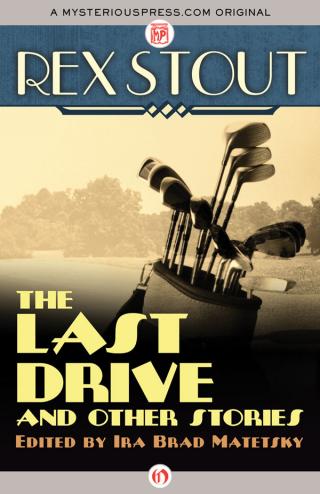
The Last Drive and Other Stories
- Автор: Стаут Рекс Тодхантер
- Год: 2015
- Язык: английский
- Год: MysteriousPress.com/Open Road
- ISBN: 978-1-5040-1134-1
- Жанр: Классические детективы

Электронная книга - «The Last Drive and Other Stories». Краткое содержание книги:
The door of the room opened and Fraser Mawson appeared on the threshold.
Rankin, who had started forward, his eyes flashing with excitement, stopped abruptly. Harry and Fred regarded him in inquiring wonder. Mawson glanced at each of them, then came quietly forward.
“About that loan, Harry,” he said to the younger of the two brothers. “I’m going to town for an hour in the morning. Since your friend — I didn’t know—”
“He won’t need the loan, Mr. Mawson.” It was Rankin who spoke, in a voice that seemed to tremble a little. He had turned to face the newcomer with gleaming eyes.
“You’re just in time,” he went on more evenly. “To witness the lucky achievement of a curious dilettantism. Fraser Mawson, you are under arrest, charged with the murder of Carson Phillips.”
There was a gasp of amazement from Fred Adams, and Harry got excitedly to his feet. For one swift instant the color left Mawson’s face — then he smiled and bowed.
“Ah! You try to force your way through the darkness then. What can I do but humor you?”
“Quite commendable,” replied the detective grimly. “I’ll begin forcing my way by searching you. You may have another of those little needles in a handy pocket. Better still, I’ll fix you so you can’t use it.”
He stepped forward swiftly, seized Mawson’s arms from behind, and pinioned him.
“Mr. Rankin!”
“Fred! Harry! Help me here.”
And despite the lawyer’s protests his arms were tied firmly behind him and he was led to a chair.
The detective, crossing swiftly to the bag of golf clubs in the corner, paid no heed to him. One by one he lifted out the clubs and examined the butt of the shaft. Next to last was the driver. He glanced at it, held it closer, then straightened up and turned with an expression of triumph.
But the look on Fraser Mawson’s face made it unnecessary to say anything. During the few seconds that Rankin had been inspecting the clubs the lawyer’s countenance had gone from purple to white; the blazing light had gone from his eyes and left a dead despair; his whole form trembled, and though his lips moved no words came. As Rankin turned to face him he got halfway to his feet, then sank back again into the chair, ashen grey, limp, inert.
Two hours later he was lodged in the Brockville jail, and the New York dailies were preparing extra editions with sensational headlines six inches high across the front page.
That night Canby Rankin was explaining the mechanism of the driver to Doctor Wortley.
“Devilishly ingenious, Doctor. The spring concealed in the shaft was so arranged that it could be released only by the impact of the ivory inset in the face of the club against the ball; and the force of the released spring ejected the needle from the upper end of the shaft. Of course at the moment of impact the butt end of the shaft was aiming at the Colonel’s stomach, upwards, and the needle found its mark.”
“Then why didn’t it happen at the first tee?” demanded the doctor.
“Because he was using his brassie. Harry told us that yesterday. He took out the driver for the first time at the fifth tee. Mawson of course had contrived this thing as an exact replica of the Colonel’s own driver and substituted it in his bag. Staying here at Greenlawn, he wouldn’t lack an opportunity for that.”
The doctor was silent, examining the tiny hole in the butt of the shaft with speculative eyes.
“I don’t see how you ever got onto it,” he observed finally.
“Nor I,” admitted the detective. When I saw Fred swinging that iron the idea simply struck me from nowhere.” He smiled a little as he added:
“Perhaps it was curious dilettantism.”
Afterword
The Last Drive revolves around the killing of a well-respected figure on a golf course. Before identifying the murderer, the detective must first identify the murder weapon itself. It turns out to be a poison dart that entered the victim’s chest while he was golfing.
Anyone familiar with the Nero Wolfe novels will recognize this as the same murder method used in Fer-de-Lance, Stout’s first book featuring Nero Wolfe and Archie Goodwin, written and published in 1934. There is no evidence that anyone made the connection, however — any more than anyone remembered how Nero Wolfe and Archie Goodwin were dimly prefigured by Simon Culp and his office boy in Justice Ends at Home. As Professor Ross Davies has observed, “there is a pleasing symmetry in the fact that publishing history suggests that the primary literary inspiration for Stout’s greatest characters (Wolfe and Goodwin) was his own earlier story, Justice Ends at Home, and that the primary literary inspiration for the plot of his first great detective story (Fer-de-Lance) was his own earlier story, The Last Drive. Stout was, in other words, demonstrably his own best source of inspiration.”
The Last Drive seems to have been completely forgotten by 1934. It was certainly forgotten by the 1970s, when McAleer wrote Stout’s biography. The two men never discussed The Last Drive or Golfers Magazine. But although McAleer knew nothing of The Last Drive, he did speculate that elements of Fer-de-Lance might have been inspired by earlier works of mystery fiction. Perhaps, he suggested, Stout might have drawn the idea of a golf-course killing from Agatha Christie’s Murder on the Links (1923), or Ronald Knox’s Murder at the Viaduct (1926). Now we know it was not so. Stout came up with the idea himself, used it once, and consciously or otherwise, memory-banked it to use again two decades later. The second time was the charm.
The Paisley
This short romance story, one of Stout’s first, features three main characters: a lonely man, a lonely woman, and a paisley dog who helps bring man and woman together, at least to the point of sharing tea at the Plaza. The story appeared in Young’s Magazine, a general-fiction pulp magazine aimed primarily at a female audience.
Sammis Thrawn was lonely. Anyone who knew Thrawn would have declared this to be impossible; but it was true. As he sauntered aimlessly along an unknown path in Central Park he made a lazy mental survey of the possibilities of an amusing afternoon, and heaved a deep sigh at the hopelessness of it all.
It was four o’clock of one of those days which June holds up to the remainder of the calendar with an air of serene superiority. By its witchery the clanging of street cars is made musical and the smoke from automobiles becomes fragrant. Everything is as it should be.
But still, Sammis Thrawn was lonely. It is all very well to have a host of friends and a disgracefully large income, but there are times—
Thrawn heaved another sigh, glared angrily at a robin perched on an overhanging branch, and, I am ashamed to say, even went so far as to strike at it with his walking stick. Of course, he was careful to miss; and the robin, retreating hurriedly to a little grassy mound, barely removed from the path, turned her back on poor Thrawn, every feather on her plump, round body expressive of resentment.
Thrawn eyed the robin with severe disapproval, clenched his stick more tightly — and then, sighing once more, continued on his way down the path.
“What the devil!” he mused. “I am bored! Actually bored!” He poked his stick lazily toward a little blue terrier that had stationed itself directly in his way and stood blinking up at him in the sunlight.
Thrawn suddenly turned and surveyed the path to the rear, then to the front. No one was in sight. He stooped deliberately, took the terrier in his arms, and hanging the stick over his wrist, proceeded down the path with an almost eager step.