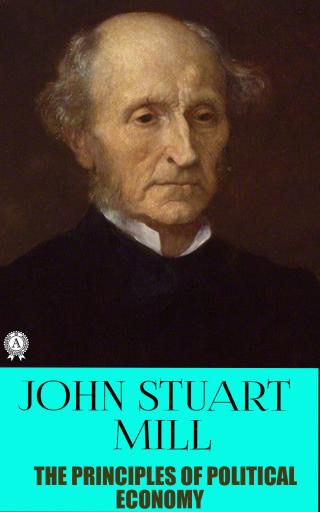
Principles Of Political Economy
- Автор: Mill John Stuart
- Год: 2022
- Язык: английский
- Год: Strelbytskyy Multimedia Publishing
- Жанр: Политика

Электронная книга - «Principles Of Political Economy». Краткое содержание книги:
Beside discussing descriptive issues such as which nations tended to benefit more in a system of trade based on comparative advantage (Mill's answer: those with more elastic demands for other countries' goods), the work also discussed normative issues such as ideal systems of political economy, critiquing proposed systems such as communism and socialism.
Along with A System of Logic, Principles of Political Economy established Mill's reputation as a leading public intellectual. Mill's sympathetic attitude in this work and in other essays toward contemporary socialism, particularly Fourierism, earned him esteem from the working class as one of their intellectual champions.
If our present revenue (of $400,000,000 in 1883) were all raised by direct taxes, an extreme dissatisfaction would certainly arise at having to pay so much; but while men's minds are so little guided by reason, as such a change of feeling from so irrelevant a cause would imply, so great an aversion to taxation might not be an unqualified good. Of the ($400,000,000) in question, nearly ($60,000,000) are pledged, under the most binding obligations, to those whose property has been borrowed and spent by the state; and, while this debt remains unredeemed, a greatly increased impatience of taxation would involve no little danger of a breach of faith. That part, indeed, of the public expenditure which is devoted to the maintenance of civil and military establishments ($206,000,000) (that is, all except the interest of the national debt), affords, in many of its details, ample scope for retrenchment. If so great an addition were made to the public dislike of taxation as might be the consequence of confining it to the direct form, the classes who profit by the misapplication of public money might probably succeed in saving that by which they profit, at the expense of that which would only be useful to the public.
There is, however, a frequent plea in support of indirect taxation, which must be altogether rejected as grounded on a fallacy. We are often told that taxes on commodities are less burdensome than other taxes, because the contributor can escape from them by ceasing to use the taxed commodity. He certainly can, if that be his object, deprive the Government of the money; but he does so by a sacrifice of his own indulgences, which (if he chose to undergo it) would equally make up to him for the same amount taken from him by direct taxation. Suppose a tax laid on wine, sufficient to add ($25) to the price of the quantity of wine which he consumes in a year. He has only (we are told) to diminish his consumption of wine by ($25), and he escapes the burden. True, but if the ($25), instead of being laid on wine, had been taken from him by an income-tax, he could, by expending ($25) less in wine, equally save the amount of the tax, so that the difference between the two cases is really illusory. If the Government takes from the contributor ($25) a year, whether in one way or another, exactly that amount must be retrenched from his consumption to leave him as well off as before; and in either way the same amount of sacrifice, neither more nor less, is imposed on him.
On the other hand, it is some advantage on the side of indirect taxes that what they exact from the contributor is taken at a time and in a manner likely to be convenient to him. It is paid at a time when he has at any rate a payment to make; it causes, therefore, no additional trouble, nor (unless the tax be on necessaries) any inconvenience but what is inseparable from the payment of the amount. He can also, except in the case of very perishable articles, select his own time for laying in a stock of the commodity, and consequently for payment of the tax. The producer or dealer who advances these taxes is, indeed, sometimes subjected to inconvenience; but, in the case of imported goods, this inconvenience is reduced to a minimum by what is called the Warehousing System, under which, instead of paying the duty at the time of importation, he is only required to do so when he takes out the goods for consumption, which is seldom done until he has either actually found, or has the prospect of immediately finding, a purchaser.
The strongest objection, however, to raising the whole or the greater part of a large revenue by direct taxes, is the impossibility of assessing them fairly without a conscientious co-operation on the part of the contributors, not to be hoped for in the present low state of public morality. In the case of an income-tax, we have already seen that, unless it be found practicable to exempt savings altogether from the tax, the burden can not be apportioned with any tolerable approach to fairness upon those whose incomes are derived from business or professions; and this is in fact admitted by most of the advocates of direct taxation who, I am afraid, generally get over the difficulty by leaving those classes untaxed, and confining their projected income-tax to “realized property,” in which form it certainly has the merit of being a very easy form of plunder. But enough has been said in condemnation of this expedient. We have seen, however, that a house-tax is a form of direct taxation not liable to the same objections as an income-tax, and indeed liable to as few objections of any kind as perhaps any of our indirect taxes. But it would be impossible to raise, by a house-tax alone, the greatest part of the revenue, without producing a very objectionable overcrowding of the population, through the strong motive which all persons would have to avoid the tax by restricting their house accommodation.
A certain amount of revenue may, as we have seen, be obtained without injustice by a peculiar tax on rent. Besides (1) the land-tax,[346] and (2) an equivalent for the revenue derived from stamp duties on the conveyance of land, some further taxation might, I have contended, at some future period be imposed, (3) to enable the state to participate in the progressive increase of the incomes of landlords from natural causes. (4) Legacies and inheritances, we have also seen, ought to be subjected to taxation sufficient to yield a considerable revenue. With these taxes, and (5) a house-tax of suitable amount, we should, I think, have reached the prudent limits of direct taxation. The remainder of the revenue would have to be provided by taxes on consumption, and the question is, which of these are the least objectionable.
§ 2. What forms of indirect taxation are most eligible?
There are some forms of indirect taxation which must be peremptorily excluded. (1.) Taxes on commodities, for revenue purposes, must not operate as protecting duties, but must be levied impartially on every mode in which the articles can be obtained, whether produced in the country itself, or imported. (2.) An exclusion must also be put upon all taxes on the necessaries of life, or on the materials or instruments employed in producing those necessaries. Such taxes are always liable to encroach on what should be left untaxed, the incomes barely sufficient for healthful existence; and on the most favorable supposition, namely, that wages rise to compensate the laborers for the tax, it operates as a peculiar tax on profits, which is at once unjust and detrimental to national wealth.[347] What remain are taxes on luxuries. And these have some properties which strongly recommend them. In the first place, they can never, by any possibility, touch those whose whole income is expended on necessaries; while they do reach those by whom what is required for necessaries is expended on indulgences. In the next place, they operate in some cases as a useful, and the only useful, kind of sumptuary law. A great portion of the expense of the higher and middle classes in most countries is not incurred for the sake of the pleasure afforded by the things on which the money is spent, but from regard to opinion, and an idea that certain expenses are expected from them, as an appendage of station; and I can not but think that expenditure of this sort is a most desirable subject of taxation. When a thing is bought, not for its use but for its costliness, cheapness is no recommendation.
§ 3. Practical rules for indirect taxation.
In order to reduce as much as possible the inconveniences, and increase the advantages, incident to taxes on commodities, the following are the practical rules which suggest themselves: 1. To raise as large a revenue as conveniently may be, from those classes of luxuries which have most connection with vanity, and least with positive enjoyment; such as the more costly qualities of all kinds of personal equipment and ornament. But with regard to horses and carriages, as there are many persons to whom, from health or constitution, these are not so much luxuries as necessaries, the tax paid by those who have but one riding-horse, or but one carriage, especially of the cheaper descriptions, should be low; while taxation should rise very rapidly with the number of horses and carriages, and with their costliness. 2. Whenever possible, to demand the tax, not from the producer, but directly from the consumer, since, when levied on the producer, it raises the price always by more, and often by much more, than the mere amount of the tax. 3. But as the only indirect taxes which yield a large revenue are those which fall on articles of universal or very general consumption, and as it is therefore necessary to have some taxes on real luxuries, that is, on things which afford pleasure in themselves, and are valued on that account rather than for their cost, these taxes should, if possible, be so adjusted as to fall with the same proportional weight on small, on moderate, and on large incomes. This is not an easy matter; since the things which are the subjects of the more productive taxes are in proportion more largely consumed by the poorer members of the community than by the rich. Tea, coffee, sugar, tobacco, fermented drinks, can hardly be so taxed that the poor shall not bear more than their due share of the burden. Something might be done by making the duty on the superior qualities, which are used by the richer consumers, much higher in proportion to the value; but in some cases the difficulty of at all adjusting the duty to the value, so as to prevent evasion, is said, with what truth I know not, to be insuperable; so that it is thought necessary to levy the same fixed duty on all the qualities alike. 4. As far as is consistent with the preceding rules, taxation should rather be concentrated on a few articles than diffused over many, in order that the expenses of collection may be smaller, and that as few employments as possible may be burdensomely and vexatiously interfered with. 5. Among luxuries of general consumption, taxation should by preference attach itself to stimulants, because these, though in themselves as legitimate indulgences as any others, are more liable than most others to be used in excess, so that the check to consumption, naturally arising from taxation, is on the whole better applied to them than to other things. 6. As far as other considerations permit, taxation should be confined to imported articles, since these can be taxed with a less degree of vexatious interference, and with fewer incidental bad effects, than when a tax is levied on the field or on the workshop. Custom duties are, cæteris paribus, much less objectionable than excise: but they must be laid only on things which either can not, or at least will not, be produced in the country itself; or else their production there must be prohibited (as in England is the case with tobacco), or subjected to an excise duty of equivalent amount. 7. No tax ought to be kept so high as to furnish a motive to its evasion, too strong to be counteracted by ordinary means of prevention; and especially no commodity should be taxed so highly as to raise up a class of lawless characters—smugglers, illicit distillers, and the like.
346
A land-tax is, to its extent, an evidence that the state claims a certain right in the soil, and that it stands to the contributor, as it were, in the place of a landlord. This tax, however, is generally so small that it does not materially diminish the rent of land. So far as it goes, it is a tax on rent.
347
Some argue that the materials and instruments of all production should be exempt from taxation; but these, when they do not enter into the production of necessaries, seem as proper subjects of taxation as the finished article. It is chiefly with reference to foreign trade that such taxes have been considered injurious. Internationally speaking, they may be looked upon as export duties, and, unless in cases in which an export duty is advisable, they should be accompanied with an equivalent drawback on exportation. But there is no sufficient reason against taxing the materials and instruments used in the production of anything which is itself a fit object of taxation.—Mill.