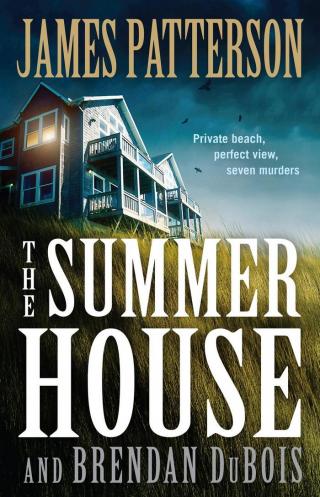
The Summer House
- Автор: Паттерсон Джеймс, Дюбуа Брендан
- Год: 2020
- Язык: английский
- Год: Little, Brown and Company
- ISBN: 978-0-316-53955-5
- Жанр: Триллеры

Электронная книга - «The Summer House». Краткое содержание книги:
To ensure that justice is done, the Army sends Major Jeremiah Cook, a veteran and former NYPD cop, to investigate. But the major and his elite team arrive in sweltering Georgia with no idea their grim jobs will be made exponentially more challenging by local law enforcement, who resists the Army’s intrusion and stonewall them at every turn.
As Cook and his squad struggle to uncover the truth behind the condemning evidence, the pieces just won’t fit — and forces are rallying to make certain damning secrets die alongside the victims in the murder house. With his own people in the cross-hairs, Cook takes a desperate gamble to find answers — even if it means returning to a hell of his own worst nightmares...
He knocks twice more before a woman cautiously opens the door. “Yes?” she asks.
The woman is in her late forties or early fifties, face worn and tired, her gray-black hair pulled back in a ponytail. She’s wearing a floral housecoat that she’s grasping around her neck, and she’s keeping the screen door closed.
“Ma’am, sorry to bother you, but I’m Special Agent Manuel Sanchez of the US Army.”
Her tired eyes widen. “The Army? For real?”
“Yes, ma’am,” he says. “Here’s my badge and identification.”
He holds his leather wallet up to the screen, and the woman gives it a quick glance and says in a voice that’s almost a hoarse whisper, “What’s the Army doing around here?”
“I’m part of a team investigating the murders of seven civilians who lived up the road, at The Summer House,” he says. “Four Army personnel have been arrested.”
The woman looks uneasy, and Sanchez says, “I’ve talked to Sheriff Williams about her investigation. She said a woman walking her dog saw a Ford pickup truck leave the house right after the shootings. It was you, correct?”
He waits.
Behind the woman the barking dog is louder and louder.
Sanchez wonders if he should press her when she says, “That’s right.”
Finally, he thinks, and he opens the screen door and gently presses himself into the house. “I promise, this will only take a few minutes.”
Inside the house, a large dog that looks to be a brown mongrel with large floppy ears leaps up and nearly knocks Sanchez on his ass. He backpedals as the woman says, “Toby, Toby, you knock that off, right now!’
A large smear of dog drool hits Sanchez’s pants leg as the dog barrels past him and bursts through the open front doors, howling and barking in apparent joy after breaking free.
She closes both doors and says, “That Toby. He sure has a spirit ’bout him. When he wants to run, he runs. When he don’t want to come in, he don’t come in.”
Sanchez quickly takes in the house. Before him and to the left is a kitchen area, and to the right is a small living room. Behind him is a small coatrack with a light jacket, a raincoat, and an umbrella hanging from pegs. There’s another water bowl and a half filled dog bowl below the coatrack.
He’s still looking around when he says, “Ma’am, I’m sorry, I don’t recall your name.”
“Oh,” she says. “Wendy. Wendy Gabriel. Would you like to sit down?”
The interior of the house is relatively cool after spending the last couple of hours traipsing outside in the hot Georgia sun, but Sanchez isn’t sure how to reply. The interior of the house is so crowded and cluttered that he can’t believe it’s still standing. There are piles of newspapers, magazines, stuffed cardboard boxes, folded-up clothes, more newspapers, and more magazines, and mail... hundreds of pieces, it looks like. A hollowed-out area in the living room reveals a worn couch and a television set, and a nightstand piled with bags of dog treats and candy.
A hoarder, he thinks, but he gives the woman credit: she’s a neat hoarder. Everything seems to be in its place, though there are lots of places.
“This way,” she says, and they go into the kitchen, where there’s a lonely uncluttered chair. Wendy picks up thick piles of Newsweek magazines — the top one has a photo of Ronald Reagan on the cover — and he sits down.
“Thank you, ma’am. I promise I won’t stay long.”
She sits down, too, hand still holding the housecoat closed. “Those killings... horrible, simply horrible. My God. Is the Army going to arrest them, too?”
“The crimes were committed off post, ma’am, so it’s under civilian police authority,” he says, taking out a small notebook and pencil. “But the Army still wants to know what happened, the how and the why.”
She says, “But how come you’re not in uniform?”
Which is approximately the nine hundredth time Sanchez has been asked this, and he says, “I’m with the Army’s Criminal Investigation Division. We usually wear civilian clothes because it helps us blend in while we’re doing our job. Now, if I may...”
He flips open to a blank page in the notebook and says, “Sheriff Williams told me that you witnessed a Ford F-150 pickup truck leaving the residence sometime Wednesday night. Do you recall what time it was?”
She says, “Oh, yes, without a doubt. A bit after 8:00 p.m., right after Jeopardy! was over. I was taking Toby for a walk.”
“Along the main road, then, right?”
“That’s right,” she says.
“And what did you see?”
She shifts in her chair. “We were heading home. We were on the side of the road where the dirt path leads into that place where the college kids were stayin’. The one everyone calls The Summer House. Is it true, they was all shot? And a baby girl, too?”
He nods. “True, I’m sorry to say. What did you hear? Or see?”
Wendy wipes at her eyes. “So sad. So very, very sad... Well, it wasn’t sad then, it was just strange, that’s all. I was with Toby, and I heard a loud bang, like a truck was backfiring. Then a bit of gunfire... not loud, but like... well, like they were shooting from the bottom of a well. Now, I know what regular shooting sounds like, but maybe it sounded different because it was inside, not outside? You know what I mean?”
“That I do,” he says. “And did you hear anything else?”
“Well, before the shooting happened, a helicopter flew over. And after the shooting stopped, we walked another minute or two, and just by that dirt road, this Ford pickup is driving real fast and nearly runs me and Toby down. They stopped for just a second, and then they sped off, went north.”
“Did you see who was driving?”
“This real angry-looking black man, and there was another fella sitting next to him. They both looked at me, and, Christ, I was scared. I don’t know why, but the way they looked at me, they frightened me some.”
“Had you ever seen those men before?”
“Nope.”
Sanchez is taking notes, mind dancing along, knowing that when this case comes to trial, she’s going to be one hell of a witness for the county.
“Ma’am, Sheriff Williams says you remembered the license plate of the truck. Is that right?”
“That’s right.”
“Well, excuse me for saying this, but did you write it down?”
“Nope.”
“Had you seen the truck before in the area?”
“Nope.”
“Then...”
The first smile of his visit appears. “You’re asking me how I remembered what I saw? Easy. I like doing them puzzle books, you know, fill in the blanks and the crossword puzzles? Letters and numbers, they stick with me. I remembered the first three letters and the first number... afraid I didn’t catch the rest.”
“And what was that?”
“The letters T-B-B, followed by the numeral 3. The sheriff later told me, when she thanked me for being a witness and picking those photos of those two fellas, she said she was able to trace down the letters and number and match it to that angry black guy driving the truck.”
“But the letters and the numeral 3? Why did you remember that?”
“Easy,” she says. “T for Toby. And B-B because I call him Baby all the time. And the number 3 — that’s how old he is. Toby Baby 3.”