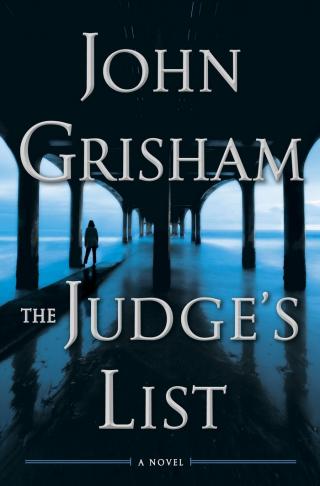
The Judge’s List
- Автор: Гришэм Джон
- Серия: Lacy Stoltz #2
- Год: 2021
- Язык: английский
- Год: Doubleday/Random House
- ISBN: 978-0-385-54602-7
- Жанр: Триллеры

Электронная книга - «The Judge’s List». Краткое содержание книги:
Then she meets a mysterious woman who is so frightened she uses a number of aliases. Jeri Crosby’s father was murdered twenty years earlier in a case that remains unsolved and that has grown stone cold. But Jeri has a suspect whom she has become obsessed with and has stalked for two decades. Along the way, she has discovered other victims.
Suspicions are easy enough, but proof seems impossible. The man is brilliant, patient, and always one step ahead of law enforcement. He is the most cunning of all serial killers. He knows forensics, police procedure, and most important: he knows the law.
He is a judge, in Florida — under Lacy’s jurisdiction.
He has a list, with the names of his victims and targets, all unsuspecting people unlucky enough to have crossed his path and wronged him in some way. How can Lacy pursue him, without becoming the next name on his list?
The Judge’s List is by any measure John Grisham’s most surprising, chilling novel yet.
“I got nothing else.”
“More than likely the work of someone who knows what he’s doing.”
“He brought the rope.”
“I say we call in the state boys. There’s no hurry. Let’s protect the scene and let them worry about the forensics.”
“Good idea.”
He had never returned to the scene. He had read countless stories, some fictional, others supposedly true, about killers who got a thrill by going back. And he had never planned to do so, but the moment suddenly seemed right. He had made no mistakes. No one had a clue. His gray pickup looked like a thousand others in the area. Its fake Mississippi license plates seemed perfectly authentic. And if for any reason things appeared threatening, he could always abort and leave the state.
He took his time and zigzagged back to the subdivision. He saw lights before he got to the street. It was blocked by squad cars. As he drove past he nodded at the cop and glanced beyond him. A thousand red and blue lights lit up the street. Something really bad must have happened down there.
He drove on, with a slight rush, but certainly no thrill.
Just before 10:00 p.m., Sheriff Black and Chief Deputy Mancuso approached the town of Neely. In the rear seat was Nic, a twenty-year-old college kid who hung around the police station as the department’s part-time techie. He was staring at his iPad and giving directions.
“We’re getting close,” he said. “Take a right. It appears to be at the post office.”
“The post office?” Mancuso said. “Why would he drop off a stolen cell phone at a post office?”
“Because he had to get rid of it,” Black said.
“Why not throw it in the river?”
“I don’t know. You’ll have to ask him.”
“Real close now,” Nic said. “Right here.”
Black pulled into the gravel lot and all three stared at the dark and deserted Neely Post Office. Nic fiddled with his iPad and said, “It’s actually right over there, in that blue drop box.”
“Of course,” Mancuso said. “Makes perfect sense.”
Black asked, “Who’s the damned postmaster around here?”
“Who’d want to be?” asked Mancuso.
Nic pecked away and said, “Herschel Dereford. Here’s his number.”
Herschel was sleeping peacefully in his small home five miles out from Neely when he answered the emergency call from a Sheriff Black. It took a few minutes for things to register, and Herschel was at first reluctant to get involved. He said he didn’t have the authority, under federal guidelines, to open “his” drop box and allow local authorities to pick through “his” mail.
Sheriff Black pressed harder and said that two men had been murdered that evening, not far away, and they were in pursuit of the killer. An iPhone tracking app had led them to Neely, to “his” post office, and, well, it was crucial to get their hands on the phone immediately. This frightened Herschel enough to agree. He showed up fifteen minutes later but was not happy to be called out. He mumbled something about violations of federal law as he rattled his keys. He explained that he collected the mail every afternoon at precisely 5:00 p.m. when he closed the post office. A truck from Hattiesburg picked it up. Since it was now pushing 11:00 p.m., he expected no other mail to be in the box.
Sheriff Black said to Nic, “Get your phone and film this. Everything.”
Herschel turned a key and the front door of the box swung open. From inside he removed a square aluminum box, which he sat on the ground. It had no top. Inside was a single mailer. Mancuso covered it with a flashlight.
Herschel said, “I told you there wouldn’t be much.”
Sheriff Black said, “Let’s go real slow here. Okay, I’m going to take my cell phone and call Mike Dunwoody’s number. Understood?”
The rest of them nodded as they stared at the small package. After a few seconds it began emitting a ringing noise.
Sheriff Black ended the call. He took his time and said, “Now, I’ll call Lanny Verno’s number, the one given to us by his girlfriend.” He tapped the number, waited, and from the envelope came the chorus of “On the Road Again” by Willie Nelson. Just as the girlfriend said.
With Nic filming with his iPhone and Mancuso holding his flashlight, and with Herschel not sure what to do next, if anything, the sheriff calmly explained, “Now, we called both numbers, and it’s safe to assume both cell phones are in the mailer, about five-by-eight, here in the drop box.” He reached into a pocket of his windbreaker and pulled out a pair of surgical gloves. Nic filmed it all. Black said, “Now I’m going to retrieve the package, the mailer, but we will not open it here. The prudent thing to do is to give it to the state crime lab and let their experts analyze things.”
He reached down, gently took the envelope, pulled it up for all to see, and for Nic to film, then turned it over. There was an address label on the flip side, and printed in a weird font was: Cherry McGraw, 114 Fairway #72, Biloxi, MS 39503.
He exhaled, mumbled an “Oh shit!” and almost dropped the envelope.
“Who is it, boss?” Mancuso asked.
“That’s my daughter’s address.”
His daughter was upset but unharmed. She had been married less than a year and lived near her parents. Her husband had been raised in the country, was an avid hunter, and owned a nice collection of guns. He assured the sheriff that they were safe and taking no chances.
A deputy was dispatched to sit in the sheriff’s driveway. Mrs. Black promised her husband that she was safe.
Halfway back to the crime scene, Nic in the rear seat finally said, “I don’t think he intended to mail the phones to your daughter.”
Sheriff Black did not suffer fools, was otherwise preoccupied anyway, and not eager to hear theories from a college kid who could pass for a fourteen-year-old. “Okay,” he said.
“He knew we’d find the phones, plain and simple. There are about ten different ways to find a lost cell phone and he knew we’d track ’em down. According to the postmaster, the late Friday mail is not picked up until Monday after 5:00 p.m. There’s no way the package would sit there for seventy-two hours without being found. He had to know that.”
“So why address the envelope to my daughter?”
“I don’t know. Probably because he’s a psychopath who’s smart as hell. Many of them are.”
Mancuso said, “He’s just having a little fun, huh?”
“Ha, ha.”
The sheriff was not in the mood for conversation. There were too many conflicting thoughts, unanswered questions, and frightening scenarios.
9
The nickname of “Cleopatra” had followed her from the Tourism Council, a much larger state agency where she had worked for a few years as a staff attorney. Before that, there had been brief stints in state offices that dealt in such matters as mental health, air quality, and beach erosion. It would never be known who tagged her as “Cleopatra,” and it wasn’t clear, at least to those laboring at the Board on Judicial Conduct, if Charlotte was even aware what her underlings called her. It stuck because it fit, or because Elizabeth Taylor’s version was somewhat similar. Pitch-black hair, straight and long with obnoxious bangs that tickled her thick eyebrows and must have required constant care; layers of foundation that strove to fill the cracks and wrinkles the Botox couldn’t get to; and enough liner and mascara to doll up a dozen hookers in Vegas. A decade or two earlier, Charlotte might have had a chance at being pretty, but the years of constant work and misguided improvements had robbed her of all possibilities. Any lawyer whose reputation and gossip dwelled on her bad makeup and tight clothing as opposed to her legal skills was doomed to toil in the netherworld of the profession.