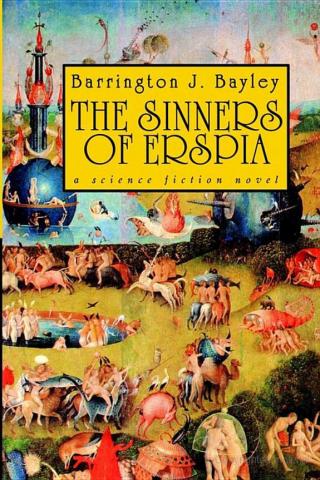
The Sinners of Erspia
- Автор: Бейли Баррингтон Дж.
- Год: 2011
- Язык: португальский
- Жанр: Научная фантастика

Электронная книга - «The Sinners of Erspia». Краткое содержание книги:
“Oh yes, this is Erspia,” the planetoid woman said brightly. “It's always been Erspia. What's the name of the world you come from?"
“Erspia!” Histrina said triumphantly.
Laedo sighed. “Look, it's only the name that's the same,” he explained to Histrina. “Klystar must have given the one name to both worlds.” He addressed the woman again. “Is there a being called Klystar on this world, by any chance?"
“Klystar?” She looked puzzled. “No, I don't think so."
The man looked at him with a new respect. “You speak of the great gardener,” he said gravely. “He who created the garden of Erspia and placed us in the midst of it. No, he doesn't live here himself. He lives in heaven.” He glanced back quickly at the projector station, a new thought seeming to strike him. “Can your spaceship go to heaven?"
Histrina laughed shortly.
The man laughed too, sharing her amusement even though ignorant of its cause. “My name is Lallalo,” he said, making it sound musical, almost a snatch of song. “And this is Lila. What are you called?"
Laedo told him, and Lallalo smiled. “Well, we'll see you again, perhaps. Call on us before you leave."
Unconcernedly the pair strolled away.
“Wait!” Histrina cried. “Where are you going? Take us with you!"
She was animated, excited. They looked back, and smiled. Histrina hurried after them.
There were several other matters that Laedo thought he ought to be attending to. But his curiosity was too great, and after a few moments he, too, followed after the innocent dwellers in the garden of Erspia-2.
THREE
Laedo's Seduction
Two main problems, Laedo believed, faced him. And they each divided themselves into two sub-problems, one practical, one ethical.
The first problem concerned his line of business. Laedo was a cargo carrier. He had a small, fast ship, and specialised in carrying small, valuable cargoes. Space being so large and so easy to get lost in, such a carrier had not only to be highly skilled but also trustworthy to the point of saintliness.
In short, his main qualification was an ethical one. Accordingly, Laedo was highly ethical. He had undergone lengthy analysis in the karmayoga , or right action, school of psychotherapy. He had a certificate from his analyst which, in effect, gave him a moral rating. The certificate also stated that he had been attracted to the karmayoga school of psychology by reason of innate qualities, not because it might get him a special cargo carrier's ticket.
There was no other way to become a class CCC special-cargo carrier.
In other circumstances Laedo might have been more than willing to spend a considerable length of time on Erspia-2. It was a delightful place. But as it was he was bound, almost regretfully, to bend his efforts to an early departure—not just because to act otherwise would prejudice his chances of future employment, but because it was his duty. In his cargo strongroom were three kilograms of crystalline cavorite—the only known substance in the universe not to respond to inertial fields such as gravitation. It was worth half a billion psalters, and he was already months overdue.
So far he had accomplished the easier part of his task. He had found his ship in the jungle, already engulfed in luxurious, fast-growing vegetation. The hull was dented, but otherwise the tough little vessel checked out unharmed. Again using the manoeuvring engine, he had raised it and steered it to the clearing where the projector station lay. With the help of the ship's dog-sized and not-too-bright handling robot, he had clamped it in place on the station, from which it now stuck out at an odd angle.
But, worried about losing his ship again, he had taken the cavorite from the strongroom and hidden it in the projector station.
The hard part was to gain control over the projector station's drive.
Mulling over this, Laedo sat on the grass in the shadow of a saffron-coloured orchid shot through with pale blue, in whose bell he and Histrina slept at night. Nearby other orchids towered, creating the usual varicoloured fairyland. These orchids formed a grove in the middle of the meadow, separated from the main expanse of the jungle and nearer to the lake of fresh, cool water.
Totally incurious as to why the newcomers were here, Lallalo and Lila had willingly introduced them to the society of Erspia-2 if society it could be called. The inhabitants of the planetoid lived scattered like woodland animals throughout the jungle, mostly in small groups, though they tended to wander a good deal. They were as simple as children, and their lives were purely idyllic. They did no work, and had no unfulfilled desires: the orchids supplied all their needs. There were orchids in which to have unbelievably delicious fornication. There were orchids in which to sleep at night or, if one wished, to shelter from the occasional warm rain (though Laedo and Histrina, who by now had dispensed with all clothing, preferred to expose their bodies naked to the downpour). There were orchids whose interiors produced various kinds of foods—a sweet bread-like substance flavoured with honey; pulpy fruit-like growths; crunchy stalks with an endless variety of flavours, and so forth—and orchids in whose bells could be found petal-shaped bowls and pools of refreshing, invigorating drinks, coloured, flavoured and sometimes effervescent.
And there were orchids which offered food, drink, pheromonic fornication and a bedchamber all rolled into one.
Always the orchids deposited pollen on the people who entered them—which they mostly did for sexual purposes. The big flowers all differed subtly in the quality of their pheromones, so that sex in a new one was rather like sex with a new person. Consequently people varied their copulating places a great deal—which was all part of the orchids’ reproductive strategy, of course.
Sex, in fact, was mainly what the people of Erspia-2 occupied themselves with. Everyone was almost permanently dusted with golden pollen, except early in the morning when a bath in fresh water was the custom.
Laedo found it amusing to see how the orchids had incorporated human sexuality into their reproductive function. There were children on Erspia-2 also, but the birthrate was clearly very low. He had seen only three or four youngsters, while he had encountered hundreds of adults.
And not one of them but was superb from the physical point of view. Laedo had indulged himself to excess, for the people here were wholly promiscuous and never refused an offer of love play. But he never went to an orchid with a native woman if Histrina was around. Although she herself coupled quite openly with practically every man she met, she became insanely jealous whenever Laedo showed an interest in anyone but her.
Histrina.
Histrina was his second problem.
Knowing that she would eventually find an opportunity to get the gun back off him, he had hidden it in the station along with the cavorite. But he felt uneasy whenever she was near. He knew she wasn't sane, and that she would do anything which, in her imprinted condition of comic-book evil, seemed to her wicked.
She would cheat, lie, steal, injure and murder. He felt, however, that he was safe from her violence for the time being. She needed him, or thought she did.
He was hoping that sating herself in fornication, which she also believed was unforgivably wicked, would keep her busy for the time being. But what was he going to do with her in the long run?
The simplest course seemed to be to leave her behind on Erspia-2. After all, she was having a good time.
But to some extent he was responsible for her condition. Although he had rescued her from Hoggora's camp, it was he who had flown her through the Ahrimanic beam at full intensity. Indeed, by bringing her aboard at all, he had wilfully taken her into his charge.
He could just imagine what his karmayoga analyst would say on hearing that he had abandoned his protegé. “This is bad, Laedo,” he would say, shaking his head. “You're going to suffer agonies of remorse for this. You can expect to pay for it in other ways, too, through events in later life. You took on a load of bad karma when you ditched that poor girl."