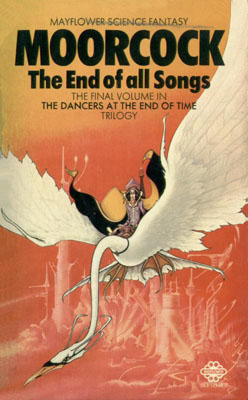
The End of All Songs
- Автор: Муркок Майкл
- Серия: Dancers at the End of Time #3
- Год: 1976
- Язык: английский
- Жанр: Научная фантастика

Электронная книга - «The End of All Songs». Краткое содержание книги:
But as the pandemonium progresses, some delicious and long-held mysteries are revealed and some distressing omens appear on the horizon. Due to circumstances beyond their control, immortality - at least as far as the immortals know it - will never be the same again.
She had chosen red for her chief colour. Her crimson eyes glittered with maternal joy at her son restored to her. Her scarlet hair curled itself here and there about her face, as if in ecstasy, and her poppy-coloured flesh seemed to vibrate with pleasure. As she moved, her perspex gown, almost the colour of clementines, creaked a little.
"You know there is to be a celebration?" she said. A party so that we may all hear Mongrove's news. He has consented to appear, to speak. And the Duke of Queens, Bishop Castle, My Lady Charlotina — we shall be there to give our tales. And now you and Mrs. Underwood? Where have you been, you rogues? Hiding here, or adventuring through History?"
Mrs. Underwood began: "We have had a tiring experience, Mrs. Carnelian, and I think…"
"Tiring? Mrs. What? Tiring? I'm not certain of the meaning. But Mrs. Carnelian — that is excellent. I never thought — yes, excellent. I must tell the Duke of Queens." She cruised for the door. "But I'll interrupt your meal no longer. The theme for the celebration is of course 1896 —" a gesture to Mrs. Underwood — "and I know you will both surpass yourselves! Farewell!"
Mrs. Underwood implored him: "We are not going?"
"We must!"
"It is expected?"
He knew secret glee in his own cunning. "Oh, indeed it is," he said.
"Then, of course, I shall go with you."
He eyed her crisp cream dress, her pinned auburn hair. "And the beauty of it is," he said, "that if you go as you are, the purity of your conception will outshine all others!"
She snapped a branch from a savoury frond.
9. The Past is Honoured: The Future Reaffirmed
First there came a broad plane, a vast, level carpet of pale green; the jade power-boat sped low over this — then avenues approached — spaced to have their entrances arranged around the perimeter of a semi-circle; each avenue leading inwards to a hub. The air-car selected one. Cypresses, palms, yews, elders, redwoods, pines, shoe and plane trees, sped by on either side — their variety proclaiming that the Duke of Queens had not lost his vulgar touch (Jherek wondered, now, if he would have it otherwise). The focus became visible, ahead, but they heard the music before they recognized details of the Duke's display.
"A waltz!" cried Mrs. Underwood (she had renounced the sensible day dress for fine blue silk, white lace, a flounce or two, even the suggestion of a bustle, and the hat she wore was two feet across at the brim; on her hands, lace gloves, and in them a blue and white parasol). "Is it Strauss, Mr. Carnelian?"
In the tweeds she had helped him make, he leaned back against the side of the car, his face half-shaded by his cap. One hand fingered his watch-chain, the other steadied the briar-wood pipe she had considered fitting ("a manlier, more mature air, altogether," she had murmured with satisfaction, after the brogues were on his feet and the cravat adjusted, "your figure would be envied anywhere" and then she had become a fraction confused). He shook his head. "Or Starkey, or Stockhausen. I was never as familiar as I should have been with the early primitives. Lord Jagged would know. I hope he is there."
"He became almost garrulous at our departure," she said. "I wonder if he regrets that now, as people sometimes do. I remember once that the brother of a girl I knew at school kept us company for an entire vacation. I thought he disliked me. He seemed disdainful. At the end of the holiday he drove me to the station, was taciturn, even surly. I felt sorry for him, that he should be burdened. I entered the train. He remained on the platform. As the train left, he began to run beside it. He knew that I should probably never see him again. He was red as a raspberry as he shouted his parting remark." She inspected the silver top of her parasol.
He could see that there was a small, soft smile on her lips, which was all that was visible to him of her face, beneath the brim of the hat.
"His remark?"
"Oh!" She looked up and, for an instant, the eye which met his was merry. "He said 'I love you, Miss Ormont', that was all. He could only declare himself when he knew I should not be able to confront him again."
Jherek laughed. "And, of course, the joke was that you were not this Miss Ormont. He confused you with another."
He wondered why both tone and expression changed so suddenly, though she remained, it seemed, amused. She gave her attention back to the parasol. "My maiden name was Ormont," she said. "When we marry, you see, we take the name of our betrothed."
"Excellent! Then I may expect, one day, to be Jherek Underwood?"
"You are devious in your methods of clinging to your points, Mr. Carnelian. But I shall not be trapped so simply. No, you would not become Jherek Underwood."
"Ormont?"
"The idea is amusing, even pleasant." She checked herself. "Even the hottest of radicals has never suggested, to my knowledge, such a reversal." Smiling, she chewed her underlip. "Oh, dear! What dangerous thoughts you encourage, in your innocence!"
"I have not offended?"
"Once, you might have done so. I am shocked at myself, for not feeling shocked. What a bad woman I should seem in Bromley now!"
He scarcely followed, but he was not disturbed. He sank back again and made the pipe come alight for the umpteenth time (she had not been able to tell him how to keep it fuming). He enjoyed the Duke's golden sunshine, the sky which matched, fortuitously, his loved one's dress. Other air-carriages could be seen in other avenues, speeding for the hub — red and gold, plush and gilt, a fanciful reproduction of the Duke's only prolonged experience with the nineteenth century.
Jherek touched her hand. "Do you recognize it, Amelia?"
"It is overpoweringly huge." The brim of the hat went up and up, a lace glove touched her chin. "It disappears, look, in clouds."
She had not seen. He hinted: "But if the proportions were reduced…"
She tilted her head, still craning. "Some sort of American Building?"
"You have been there!"
"I?"
"The original is in London."
"Not the Cafe Royal?"
"Don't you see — he has taken the decor of the Cafe Royal and added it to your Scotland Yard."
"Police headquarters — with red plush walls!"
"The Duke comes near, for once, to simplicity. You do not think it too spare?"
"A thousand feet high! It is the tallest piece of plush, Mr. Carnelian, I may ever hope to see. And what is that at the roof — now the clouds part — a darker mass?"
"Black?"
"Blue, I think."
"A dome. Yes, a hat, such as your policemen wear."
She seemed out of breath. "Of course."
The music grew louder. He waved his pipe in time. But she was puzzled. "Isn't it a little slow — a little drawn out — for a waltz. It's as if it were played on those Indian instruments — or were they Arabic? More than a flavour of the Oriental, at any rate. High-pitched, too, in a way."
"The tapes are from one of the cities, doubtless," said Jherek. "They are old — possibly faulty. This is not authentic, then?"
"Not to my time."