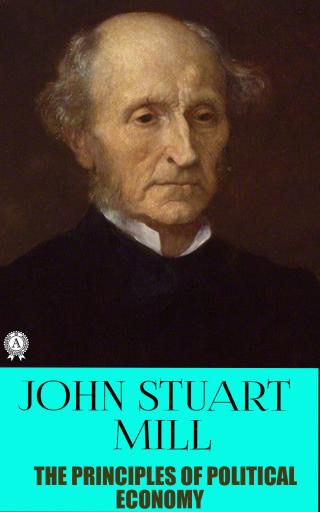
Principles Of Political Economy
- Автор: Mill John Stuart
- Год: 2022
- Язык: английский
- Год: Strelbytskyy Multimedia Publishing
- Жанр: Политика

Электронная книга - «Principles Of Political Economy». Краткое содержание книги:
Beside discussing descriptive issues such as which nations tended to benefit more in a system of trade based on comparative advantage (Mill's answer: those with more elastic demands for other countries' goods), the work also discussed normative issues such as ideal systems of political economy, critiquing proposed systems such as communism and socialism.
Along with A System of Logic, Principles of Political Economy established Mill's reputation as a leading public intellectual. Mill's sympathetic attitude in this work and in other essays toward contemporary socialism, particularly Fourierism, earned him esteem from the working class as one of their intellectual champions.
In the United States there have been some successes as well as failures. In January, 1872, a number of machinists and other working-men organized in the town of Beaver Falls, Pennsylvania, a Co-operative Foundry Association for the manufacture of stoves, hollow-ware, and fine castings. On a small capital of only $4,000 they have steadily prospered, paid the market rate of wages, and also paid annual dividends, over and above all expenses and interest on the plant, of from twelve to fifteen per cent. In 1867 thirty workmen started a co-operative foundry in Somerset, Massachusetts, with a capital of about $14,000. In the years 1874-1875 the company spent $5,400 for new flasks and patterns, and yet showed a net gain of $11,914. In 1876 it had a capital of $30,000, and a surplus fund of $28,924.[328]
§ 6. Industrial Partnership.
The difficulties of productive co-operation arising from the need of skilled management, together with the existing unsatisfactory relation between employers and laborers when wholly separate from each other, have led to a most promising plan of industrial partnership by which the manager retains the control of the business operations, but shares his profits with the workmen. The gain through increased efficiency, greater economy, and superior workmanship, recoups the manager for the voluntary subtraction from his share, and yet the laborers receive an additional share; but more than this, it educates the laborer in industrial methods, discloses the difficulties of management, and stimulates him to saving habits and greater regularity of work. This system is particularly adapted to reaching those laborers who would not themselves rise to the demands of productive co-operation.
The principle was tried on one of the Belgian railways. “Ninety-five kilogrammes of coke were consumed for every league of distance run, but this was known to be more than necessary; but how to remedy the evil was the problem. A bonus of 3-½d. on every hectolitre of coke saved on this average of ninety-five to the league was offered to the men concerned, and this trifling bonus worked the miracle. The work was done equally well, or better, with forty-eight kilogrammes of coke instead of ninety-five; just one half, or nearly, saved by careful work, at an expense of probably less than one tenth of the saving.”[329]
The experiment which has attracted most attention in the past has been that of the Messrs. Briggs, at their collieries in Yorkshire, England.[330] The relations between the owners and the laborers were as bad as they could well be. “All coal-masters is devils, and Briggs is the prince of devils,” ran the talk of the miners, when they did not choose to send letters threatening to shoot the owners. In 1865 Messrs. Briggs tried the plan of an industrial partnership with their men, purely from business considerations. Seventy per cent of the cost of raising coal consisted of wages, and fully fifteen per cent of materials which were habitually wasted. The whole property was valued, and divided into shares of $50 each, of which the owners retained two thirds, together with the control of the business. The remaining one third of the shares was offered to the employés. If any subscriber was too poor to pay $50 for a share, the subsequent dividends and payments were to be applied to purchasing the share. After reserving a fair allowance for expenses, like the redemption of capital, whenever the remaining profits exceeded ten per cent on the capital, that excess was to be divided into two equal parts, one of which was to be distributed among all persons employed by the company in proportion to their wages, and the other was to be retained by the capital. In previous years but once had they made ten per cent profit on their capital, and twice only five per cent. In the first year after the new system came into operation, the total profits were fourteen per cent, and the four per cent of excess was divided, two to the laborers' bonus, and two to the capital, so that capital received twelve per cent. In the second year the profits were sixteen per cent, in the third year seventeen per cent; the first year the work-people received in addition to their wages $9,000, in the second $13,500, in the third $15,750. The moral effect was striking. Work was done regularly, forbearance was exercised, habits improved, and the faces of the men were set toward improvement in life. The scheme worked successfully for years, but was finally ended by the pressure of the outside trades-unions, who compelled the workmen to give up the arrangement.
A similar experiment was tried by the Messrs. Brewster, carriage-manufacturers, of New York. They offered to their workmen ten per cent of their profits, before any allowance was made for interest on the capital invested, or before any payment was made for the services of the firm as managers. In one year as much as $11,000 was divided among the laborers. Again, as in the case of the Briggs colliery, the experiment was brought to an end by an unreasoning submission to the pressure of outside workmen during a strike.[331]
But, all in all, industrial partnership[332] offers a great field for that kind of improvement which is worth more than a mere increase of wages, and seems to make it possible to reach the heavy weight of sluggishness among the lower and more hopeless strata of society. And it is possible that it will stir in them the powers which may afterward find employment in the harder problems of productive co-operation.[333]
§ 7. People's Banks.
In Germany the struggle between the two theories—self-help and state-help—was fought out by Schultze-Delitsch—that is, Schultze of Delitsch, a town in Saxony—and Lasalle, and the victory given to the former. Schultze-Delitsch, as a consequence, was successful in directing the co-operative principle in Germany to giving workmen credit in purchasing tools, etc., when he had no security but his character. This form of co-operation works to give the energetic and industrious workmen a lever by which, through the possession of credit, they can raise themselves to the position of small capitalists, and thus widen the field of possible improvement. While the former schemes of co-operation described above have given the wages-receivers a share of the unearned increment from land, and tend to give them a share of the manager's wages, the plan of Schultze was to assist them to gain a share in the advantages belonging to the possession of capital. The capital was to be accumulated by their own exertions, and, in his scheme depended on the principle of self-help. The following is the plan of banks adopted:
“Every member is obliged to make a certain weekly payment into the common stock. As soon as it reaches a certain sum he is allowed to raise a loan exceeding his share in the inverse ratio of the amount of his deposit. For instance, after he has deposited one dollar, he is allowed to borrow five or six; but, if he had deposited twenty dollars, he is allowed only to borrow thirty. The security he is compelled to offer is his own and that of two other members of the association, who become jointly and severally liable. He may have no assets whatever beyond the amount of his deposits, nor may his guarantors; the bank relies simply on the character of the three, and the two securities rely on the character of their principal; and the remarkable fact is, that the security has been found sufficient, that the interest of the men in the institutions and the fear of the opinion of their fellows has produced a display of honesty and punctuality such as perhaps is not to be found in the history of any other banking institutions. Such is the confidence inspired by these institutions that they hold on deposit, or as loans from third parties, an amount exceeding by more than three fourths the total amount of their own capital. The monthly contributions of the members may be as low as ten cents, but the amount which each member is allowed to have in some banks is not more than seven or eight dollars, in none more than three hundred dollars. He has a right to borrow to the full amount of his deposit without giving security; if he desires to borrow a larger sum, he must furnish security in the manner we have described. The liability of the members is unlimited. The plan of limiting the liability to the amount of the capital deposited was tried at first, but it inspired no confidence, and the enterprise did not succeed till every member was made generally liable. Each member, on entering, is obliged to pay a small fee, which goes toward forming or maintaining a reserve fund, apart from the active capital. The profits are derived from the interest paid by borrowers, which amounts to from eight to ten per cent, which may not sound very large in our ears, but in Germany is very high. Not over five per cent is paid on capital borrowed from outsiders. All profits are distributed in dividends among the members of the association, in the proportion of the amount of their deposits—after the payment of the expenses of management, of course—and the apportionment of a certain percentage to the reserve-fund. Every member, as we have said, has a right to borrow to the extent of his deposit without security; but then, if he seeks to borrow more, whether he shall obtain any loan, and, if so, how large a one, is decided by the board of management, who are guided in making their decision just as all bank officers are—by a consideration of the circumstances of the bank as well as those of the borrower. All the affairs of the association are discussed and decided in the last resort by a general assembly composed of all the members.”[334] The main part of the capital loaned by the banks is obtained from outside sources on the credit of the associations. In 1865 there were 961 of these institutions in Germany; in 1877 there were 1,827, with over 1,000,000 members, owning $40,000,000 of capital, with $100,000,000 more on loan, and doing a business of $550,000,000.[335]
328
Barnard, “Co-operation as a Business,” pp. 150-152.
329
Holyoake, “History of Co-operation,” p. 235.
330
See Thornton, “On Labor,” p. 370. Also see “Parliamentary Documents,” 1868, 1869, xxxi; “Trades-Unions of England,” by the Count de Paris; Brassey's “Work and Wages,” chap. xiii.
331
See Walker, “Wages Question,” p. 283. Also see Mill, Book IV, Chap. VII, § 5, for an account of M. Leclaire's experiments in France with house-painters.
332
See also Von Böhmert, “Gewinnbetheiligung,” second edition, 1878, and Jevons's “Methods of Social Reform” (1883). Professor Jevons (“The State in Relation to Labor,” pp. 146, 147) has given a brief bibliography, which I reproduce here:
Charles Babbage, “Economy of Manufactures,” chap. xxvi; H. C. Briggs, “Social Science Association,” 1869; H. C. and A. Briggs, “Evidence before the Trades-Union Commission,” March 4, 1868, Questions 12,485 to 12,753 [Parliamentary Documents]; “The Industrial Partnerships Record”; Pare, “Co-operative Agriculture” (Longmans) 1870; Jean Billon, “Participation des Ouvriers aux Bénéfices des Patrons,” Genève, 1877; Fougerousse, “Patrons et Ouvriers de Paris” (Chaix), 1880; Sedley Taylor, “Society of Arts Journal,” February 18, 1881, vol. xxix, pp. 260-270; also in “Nineteenth Century,” May, 1881, pp. 802-811, “On Profit-Sharing”; J. C. Van Marken, “La Question Ouvrière: Essai de Solution Pratique” (Chaix) 1881
333
In his last edition of his “Manual,” Professor Fawcett thus describes a co-operative experiment in agriculture: “The one that has attracted the most attention was made nearly forty years since by Mr. Gurdon, on his estate at Assington, near Sudbury, in Suffolk. Mr. Gurdon was so much impressed with the miserable condition of the agricultural laborers who were employed on his estate, that he was prompted to do something on their behalf. When, therefore, one of his farms became vacant, he offered to let it at the ordinary rent, £150 a year, to the laborers who worked upon it. As they, of course, had not sufficient capital to cultivate it, he in the first instance loaned them the requisite stock and implements. The laborers were, in fact, formed into a company in which there were eleven shares, and no laborer was permitted to hold more than one share. The plan was so eminently successful that in a few years sufficient had been saved out of the profits to repay all that had been advanced, and the stock and implements became the property of the laborers. Each share greatly increased in value. Mr. Gurdon was so much encouraged, not only by the pecuniary advantages secured to the laborers, but also by the general improvement effected in their condition, that some years afterward he let another and a larger farm on similar terms. Although no statement of accounts has ever been published, the remarkable pecuniary advantages secured to the laborers is proved by the fact that, after enjoying at least as high wages as were paid in the district, they were able in a few years to become the owners of a valuable property, consisting of the stock and implements on the farms. One of the most significant and hopeful circumstances connected with the experiment is, that it was not carried out by a picked body of men; and if so much could be done by laborers who were probably among the worst educated in the country, it maybe fairly concluded, that when the intelligence of our rural population has been better developed, co-operation may be applied in a more complete form to agriculture, and with even more striking results than were obtained at Assington.... In the description which has been frequently given of the system of peasant proprietorship, it is shown how powerfully the industry of the laborer is stimulated by the feeling of property. When he cultivates his own plot of ground, he exerts himself to the utmost, because he knows that he will enjoy all that is yielded by his labor. Each year, with the extended use of machinery in agriculture, it is becoming more advantageous to carry on farming on a large scale. When, therefore, co-operative agriculture becomes practicable, land may be cultivated by associations of laborers, and thus many of the advantages associated with the system of peasant proprietorship may be secured, while at the same time the disadvantages of small farming may be avoided. The progress toward co-operative agriculture will no doubt be slow and gradual.”
334
Godkin, “North American Review,” 1868. Also see Hermann Schultze-Delitsch, “Die Entwickelung des Genossenschaftswesens in Deutschland” (1870). This eminent philanthropist died April 29, 1883. For other forms of co-operation, building associations, etc., see Barnard, “Co-operation as a Business”; Pajot, “Du Progrès par les Sociétés de Secours Mutuels” (1878).
335
See “Economics of Industry,” by Mr. and Mrs. Marshall, p. 223.