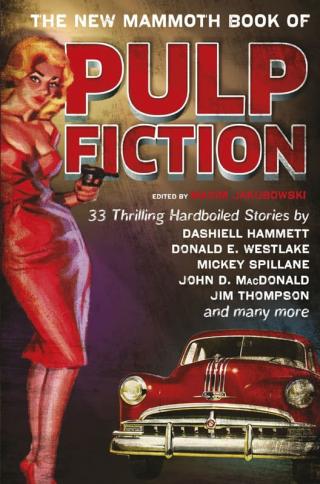
The New Mammoth Book of Pulp Fiction
- Автор: Якубовски Максим, Беллем Роберт
- Год: 2014
- Язык: английский
- Год: Constable & Robinson
- ISBN: 9781472111807
- Жанр: Крутые детективы

Электронная книга - «The New Mammoth Book of Pulp Fiction». Краткое содержание книги:
The bartender had mixed her Manhattan and was pouring it. I ordered a refill on my whisky-high. Why not? It was going to be my last drink for a long while. The wagon from here on in, even after I got back to Chicago for at least a few weeks, until I was sure the stuff couldn’t get me, until I was sure I could do normal occasional social drinking without letting it start me off.
We drank our drinks and went out. Out into the sun, the warm sunny afternoon. Just before we got to the corner, Billie stopped me. “Just a minute, Howie.”
She ducked into a store, a liquor store, before I could stop her. I waited. She came out with a wrapped bottle and a cardboard carton. “The ready-mixed wasn’t on ice, Howie, but it’s all right. I bought some ice cubes too. Are there two glasses in the room?”
I nodded; we went on. There were two glasses in the room. The wagon not yet. But it wouldn’t have been right not to have a last drink or two, a stirrup cup or two, with Billie the Kid.
She took charge of the two tumblers, the drinks. Poured the drinks over ice cubes, stirred them around a while and then fished the ice cubes out when the drinks were chilled.
While I talked. While I told her about Chicago, about me in Chicago, about my family and the investment company. She handed me my drink then. She said quietly, “Go on, Howie.”
I went on. I told her what Mame had told me about her guest Jesus the night before she was killed. I told her of the death of Jesus Gonzales as I’d read it in the Mirror. I added the two up for her.
She made us another drink while I told her about Ramon, about what had happened, about how I’d just killed him.
“Ramon,” she said. “He has knife scars, Howie?” I nodded. She said, “Knife scars, a hype, a chef. I didn’t know his name, but I know who his woman was, a red-headed junkie named Bess, I think it’s Bess, in a place just down the block from Karas’ joint. It’s what happened, Howie, just like you guessed it. It must have been.” She sipped her drink. “Yes, Howie, you’d better go back to Chicago, right away. It could be bad trouble for you if you don’t. I brought money. Sixty. It’s all I have except a little to last me till I can get more. Here.”
A little roll of bills, she tucked into my shirt pocket.
“Billie,” I said. “I wish—”
“Don’t say it, honey. I know you can’t. Take me with you, I mean. I wouldn’t fit, not with the people you know there. And I’d be bad for you.”
“I’d be bad for you, Billie. I’d be a square, a wet blanket. I’ll have to be to get back in that rut, to hold down—” I didn’t want to think about it. I said, “Billie, I’m going to send you what I owe you. Can I count on your being at the same address for another week or so?”
She sighed. “I guess so, Howie. But I’ll give you my sister’s name and address, what I use for a permanent address, in case you ever – in case you might not be able to send the money right away.”
“I’ll write it down,” I said. I tore a corner off the paper the bottle had been wrapped in, looked around for something to write with; I remembered the fountain pen I’d stuck in my trousers pocket at Mame’s. It was still there.
I screwed off the cap. Something glittered, falling to the carpet, a lot of somethings. Shiny little somethings that looked like diamonds. Billie gasped. Then she was scrabbling on the floor, picking them up. I stared at the pen, the hollow pen without even a point, in my hand. Hollow and empty now. But there was still something in the cap, which I’d been holding so it hadn’t spilled. I emptied the cap out into my hand. Bigger diamonds, six of them, big and deep and beautifully cut.
My guess had been wrong. It hadn’t been heroin Gonzales had been smuggling. Diamonds. And when he’d found himself followed to Mame’s, he’d stashed them there for safety. The pen hadn’t fallen from his coat pocket; he’d hidden it there deliberately.
They were in two piles on the table, Billie’s hands trembling a little as she handled them one at a time. “Matched,” she said reverently. “My husband taught me stones, Howie. Those six big ones – over five carats each, cut for depth, not shallow, and they’re blue-white and I’ll bet they’re flawless, all of them, because they’re matched. And the fifteen smaller ones – they’re matched too, and they’re almost three carats apiece. You know what Karas would give us for them, Howie?”
“Karas?”
“Fifteen grand, Howie, at least. Maybe more. These aren’t ordinary; they’re something special. Sure, Karas – I didn’t tell you everything, because it didn’t matter then, when I said I thought maybe he had some racket – not dope. He handles stones, only stones. Gonzales might have heard of him, might have been trying to contact him through Mame.”
I thought about fifteen thousand dollars, and I thought about going back to Chicago. Billie said, “Mexico, Howie. In Mexico we can live like kings – like a king and queen – for five years for that much.”
And stop drinking, straighten out? Billie said, “Howie, shall I take these to Karas right now so we can leave quick?” She was flushed, breathing hard, staring at me pleadingly.
“Yes,” I said. She kissed me, hard, and gathered them up.
At the doorway, hand on the knob. “Howie, were you kidding when you said you were in love with a girl named Honor in Chicago? I mean, is there a real girl named that, or did you just mean—?”
“I was kidding, Billie the Kid.”
The door closed.
Her heels clicked down the wooden hall. I poured myself a drink, a long one, and didn’t bother to chill it with ice cubes. Yes, I’d known a girl named Honor in Chicago, once, but – . . . but that was in another country, and besides, the wench is dead.
I drank my drink and waited.
Twenty minutes later, I heard Billie’s returning footsteps in the hall.
SO DARK FOR APRIL
Howard Browne
When I got through telling the sergeant at Central Homicide about it, he said to sit tight and not touch anything, that somebody would be right over. I told him I wouldn’t even breathe any more than was absolutely necessary and put back the receiver and went into the reception room to take another look at the body.
He was at the far end of the couch, slumped in a sitting position, with his chin on his chest and an arm hanging down. A wick of iron-gray hair made a curve against the waxen skin of a high forehead, his half-open eyes showed far too much white, and a trickle of dark blood had traced a crooked line below one corner of a slack-lipped mouth. His coat hung open, letting me see a circular red stain under the pocket of a soiled white shirt. From the center of the stain protruded the brown bone handle of a switchblade knife.
I moved over to lean against the window frame and light a cigarette. It was one of those foggy wet mornings we get early in April, with a chill wind off the lake and the sky as dull as a deodorant commercial. Umbrellas blossomed along the walks eight floors below and long lines of cars slithered past with a hooded look.
I stood there breathing smoke and staring at the dead man. He was nobody I had ever seen before. He wore a handsomely tailored suit coat of gray flannel, dirty brown gabardine slacks spattered with green paint and an oil stain across one knee, and brown bench-made shoes. His shirt was open at the throat, showing a fringe of dark hair, and he wasn’t wearing a tie.
The rummage-sale air of those slacks bothered me. This was no Skid Row fugitive. His nails had that cared-for look, his face, even in death, held a vague air of respectability, and they didn’t trim hair that way at barber college.