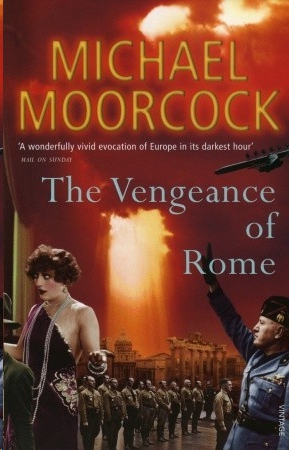
The Vengeance of Rome
- Автор: Муркок Майкл
- Серия: Between The Wars #4
- Язык: английский
- Жанр: Научная фантастика

Электронная книга - «The Vengeance of Rome». Краткое содержание книги:
FORTY-FIVE
‘I gather there have been many burglaries in the area?’
I asked them to sit down, to have some coffee. But they were on duty. They refused. I found my American passport. Most of my other papers were still hidden in Corneliusstrasse. ‘And after we have been promised improved law and order!’
‘The crimes are mainly directed at individuals,’ I was told politely. ‘Certain kinds of people are singled out. It’s the current climate. Munich will settle down soon.’
‘So there is no pattern?’
‘Certainly there’s a pattern. That’s the sad thing. We don’t condone it either.’ A sigh. ‘We believe in protecting all law-abiding citizens of every race and religion. But a formal report must be made. It’s the rules.’ A small shrug. ‘Better wear your overcoat, sir. Chilly this morning.’
I locked my door carefully behind me. The pleasant ruddy-faced policeman tested it to make sure. Satisfied, he gestured for me to precede him.
‘We’ll have you back here well in time for lunch,’ said the lean one.
‘I would hope so,’ I said. ‘I have a meeting with a director. You probably know that I’m a film actor. The “Winnetou” pictures?’
‘I was a great Karl May fan as a kid,’ said the pleasant policeman.
‘Very good of you, sir, to do this.’ In spite of his manner, the wolfish policeman seemed a reasonable man. ‘These ruffians spoil things for everybody.’
We went downstairs and got into their car. The morning was beautifully cool. The air was unseasonably sharp. A civilian driver sat in the driving seat. He did not greet me. They opened the back door. I climbed in. I sat between them.
‘We are going where? To which station did you say?’
‘To headquarters. To the old “lions’ pit”.’ The ruddy policeman laughed. Because of its other street entrance, the Ettstrasse Polizeipräsidium was popularly known in Munich as the Löwengrube, or lions’ pit. I was still not alarmed. I was confident the famous German love of formal law would keep me safe, as I had committed no crime.
‘I have only the greatest admiration for Munich’s police corps, both civil and political,’ I said conversationally as we rode along. ‘I’m sure you’ll soon have the burglars behind bars.’ The policemen made no response. The atmosphere became less congenial, and I began to feel a little nervous. They, in turn, seemed embarrassed. I simply could not read their mood. I thought I had best remind them of my connections as subtly as possible. The shadow was rising in me again, the sense of panic so hard to control and almost impossible to recollect. We who have been in its power are despised by those who have never experienced it.
‘I’m a good friend of your Chief, Ernst Röhm. I’m sure he’ll be glad to know you’re looking after me so well.’ Perhaps I should not have mentioned my association with the Stabschef. It would have been better to have invoked Baldur von Schirach. I had to take control of myself. I would be home in an hour or so, and all this would be over.
‘Not our Chief, as it happens.’ The first policeman appeared anxious to make that clear. ‘But we all like praise, sir . . .’
‘Ten at the most,’ said the wolfish one. I think he had misheard me. ’A tick of the clock.’ He did not meet my eye but stared gloomily out of the window at a tram we were passing. On the pale blue side of the big, streamlined vehicle was an advertisement for my new Western. I wondered if this visit had anything to do with my recent filming. Could Freddy and Kitty have deliberately given me over to the police? I felt queasy. Other enemies must be considered. Had Kitty’s mother’s ‘dossier’ fallen into official hands? Röhm might have been careless. He might even have said something to Hitler. Had the Gestapo themselves searched my apartment?
I was sleepless and shaky. This was how the police always arrested you. Not with shouts and blows and threats, but with polite requests for your cooperation. My emotions were in turmoil. I reminded myself that if I was in serious trouble, they would not have sent two ordinary uniformed chaps. It would have been SA or Gestapo, without doubt. The Geheime Staatspolizei dealt with political issues. They would not be worried about minor burglaries or even pornographic movies. I pulled myself together as best I could and returned to my earlier, more formal manner.
The car stopped outside the tall, classical stonework of the Ettstrasse headquarters. The policemen politely helped me from the car. The entrance, imposing and solid, reassured me, and again I was reminded of the well-known German respect for law and order, convinced they would play by the rules. I had done nothing wrong. I was a victim, not a criminal. These chaps were decent upholders of traditional justice.
We went straight past the reception sergeant, who nodded to us and raised his hand in an enthusiastic ‘Heil Hitler’ salute, so I knew I could not be under arrest. The policemen returned the salute rather less energetically. We walked down Corridor B, heading no doubt for the criminal investigation offices.
But we did not stop at Corridor B. At the end of this passage was a set of doors which the red-faced policeman stooped to unlock with a special key. ‘Short cut,’ he murmured. Descending a flight of steps we found ourselves in a poorly lit passage with a low roof. The doors on either side had peepholes and little grilled windows. I recognised them as police cells. My heart began to sink. But again we did not stop. We quickly walked the length of the corridor and came to door number 107, on which the vulpine policeman knocked. It was opened, and we went in.
From somewhere behind me I heard a thin, womanish scream, a kind of sob, and then silence. I felt a moment of fatalistic alarm, yet continued to force myself to believe the best. I was a complainant, not a criminal. Because some prisoner had become hysterical did not mean they were being harmed!
The doors were quickly shut behind me and relocked. Suddenly the policemen were at attention on either side of me. The room was full of young men in shirtsleeves, rushing about, picking up telephones, slamming them down, inspecting files, yelling information at one another. Clearly none of them had been in their jobs long. They seemed to have no idea what they were supposed to be doing.
Removing my hat I extended my hand to the man who greeted us. He seemed one of the few to carry any real authority. He wore an ill-fitting civilian suit. He had a thin, pale face, small, bright blue eyes, prominent ears and thinning hair.
‘Good morning, officer,’ I said. ‘It’s kind of you to show such an interest in my case. With so much crime and chaos taking place on our streets, it’s reassuring to know the police still care.’
He lifted his arm in a rather languid Nazi salute, offering us a muttered ‘Grüss Gott’ and dismissing my escorts. He signalled for me to enter a smaller, much darker room, with barred windows. This, no doubt, was where I would dictate my statement to the stenographer. Yet, instinctively, I hesitated.
‘I am of course here to give you details of the suspected violation of my flat,’ I said.
He looked at me blankly for a moment then shook his head. ‘No,’ he said.
‘But surely? Your uniformed men . . . ?’
‘They were sent to pick you up about some citizenship enquiries. You’re not a German national, I understand.’
‘No, I’m American.’
He shook his head. He was silent, unhelpful.
‘Now look here, officer . . .’ I began.
He sighed and indicated the room again. I had no choice.
One chair sat on the other side of a narrow desk. Behind the chair was a filing cabinet on which stood a cup of coffee. The coffee looked as if it had not been touched for days. On the wall was a picture of Hitler riding a white horse and posing as St George setting off to slay the dragon. A rather exaggerated portrait. I had seen it before and remember thinking it was the beginning of the end for Hitler as a serious social force. He had left the world of realpolitik and joined a world of myth and drama. Slowly but surely, and then with ever increasing speed, he would lose his soul’s connection to its native planet; it would drift like an asteroid erratically circling the Earth not knowing how or where to land. I did not blame Hitler. He had allowed himself to become weak. His sycophants and advisers deserved the blame, those Byzantine adventurers who specialised in whispering eviclass="underline" Goebbels, Rosenberg and Himmler. They corrupted everything Hitler’s old friends stood for. They had encouraged him to turn his back on the Strasser brothers. I had seen him — can I even now afford to tell? — bewildered eyes glaring from wounded body, as unstrong and as vulnerable in those days as he believed himself to be. That is why he fought so mightily against his inherited Catholicism. His arguments were with his own past, not our common future.