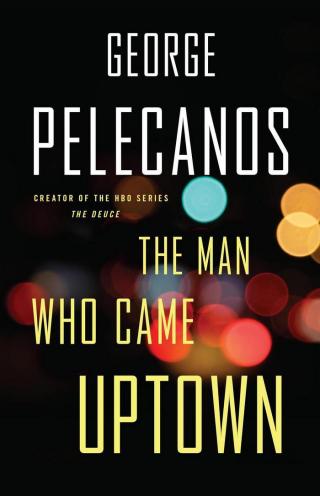
The Man Who Came Uptown
- Автор: Пелеканос Джордж
- Год: 2018
- Язык: английский
- Год: Mulholland Books / Little, Brown and Company
- ISBN: 978-0-316-47982-0
- Жанр: Криминальные детективы

Электронная книга - «The Man Who Came Uptown». Краткое содержание книги:
Michael went to the big room where they kept the fiction books. Folks of all ages sat at a long table holding keyboards and screens, doing research, or just reading random stuff on the internet. The floor in here was a nice checkerboard design, and there was an inactive fireplace at the rear of the room where people sat on comfortable furniture and read. Some of the windows gave to a view of the nicely kept football field at Roosevelt High, home of the Rough Riders. Michael spent an hour or so browsing the stacks, picking out a couple of books from the hardwood shelves. He was happy here and could have stayed all day.
At the desk, he checked out the books from the same bearded man who’d greeted him when he came in. He asked the man if they had a fiction book called Hard Rain Falling, by Don Carpenter. The man looked it up on a monitor and told him that they didn’t have the book at that particular branch, but that they could have it transferred over to Petworth.
“I’d like that,” said Michael. “Thanks.”
The man scanned the bar code on the books Lost in the City and The Things They Carried, which had been one of Anna’s recommendations from when Michael was locked up.
“Edward P. Jones,” said the bearded man, tapping his finger on the cover of Lost in the City. “He went to Cardozo. Did you know that?”
“I didn’t,” said Michael. “I went to Cardozo too.”
“There you go,” said the bearded man. “Another win for the D.C. public-school system.” Michael took the books off the counter and once again thanked the man for his help.
Walking back to Sherman Avenue, Michael thought of his time at Cardozo, the wasted opportunities, the teachers and administrators there who’d tried to help him along. But he was too much of a knucklehead then to listen to them or even to his mom.
There was this one teacher, O’Leary, also the school’s baseball coach, who’d encouraged him to sign up for the AP English class. In that class they had this Writers in Schools program, where the students would all read a certain book, and then the author who wrote that book would come into the classroom and discuss it with the kids. That would have been cool, but Michael at that point was not a reader and lacked the confidence to give it a try. He was always good with numbers and passed his mathematics exams without even studying. But books scared him some. Books were like a foreign language he had yet to learn.
Wasn’t till Anna turned him on to reading at the jail that he began to appreciate the difference books could make in someone’s life. She had brought authors to the chapel, and celebrities too, the way O’Leary had brought in real writers to Michael’s high school. The poet Ethelbert Miller, longtime D.C. dude, was one he remembered well. Lisa Page, an author and a creative writing professor over at GW. And that news lady on Channel 4, Wendy Rieger, a woman who didn’t talk down to the inmates and looked each one of them in the eye. He knew what Miss Anna had been doing: Giving them a connection to the outside world and showing the men who were incarcerated that writers and celebrities were flesh-and-blood people. Taking the mystery out of folks like them. Saying: They’re talented but they’re not necessarily better than you. They set their sights on something and they worked to get it. You can work toward something too.
Back on the concrete porch of his mother’s house on Sherman, Michael sat in a rocker sofa and began to read “The Girl Who Raised Pigeons,” the first short story in the book by Mr. Jones. The row house was brick, painted red, with a red-and-white metal awning over the porch and a smaller, matching metal awning above each of the three windows on the second floor. Brandy lay out on the porch by his feet. She had found a spot in the early-spring sun.
He looked out to the street. Sherman Avenue had that grassy island in the middle of it, separating the north- and southbound lanes, which made it seem special. Across the road, on the west side of Sherman, were restored row homes topped with turrets. On the east side, the 3200 block where his mother’s house sat, a large condominium building had gone up next to an old Baptist church while Michael had been incarcerated. The upward transformation of his neighborhood was happening too quickly for his taste, but it meant that his mother’s property, which she owned outright, was growing tremendously in value. His mom would retire and live comfortably for the rest of her life when she sold the house.
Presently a uniformed mailman, a lean, middle-aged man named Gerard who had been on their route for quite some time, came up the steps. When he saw Michael, a look of pleased surprise came to his face.
“How’s it going, young man?”
“Sir.”
“Haven’t seen you for a long time.”
“I been away. But I’m back now, permanent.”
Gerard nodded. He knew. “Well, we need to catch up, talk about those Redskins. But not today. I got to get on it.” He handed Michael some mail folded up in a magazine.
“You look good, Mr. Gerard.”
“Shoot, I walk ten miles a day.” Gerard turned to the side and showed Michael his flat stomach. “U.S. Postal Service pays me to stay in shape.” It was something Gerard said often, and Michael smiled.
“Be easy, Mailman.”
“Yeah, you too.”
Michael watched Gerard quickstep down the block. It reminded Michael that he needed to look for work straightaway. He wasn’t trying to freeload off his mother. Back in lockup, he had spoken to a lady from Open City Advocates, folks who helped juvenile offenders come back out into the world. He was a long way from being a juvenile, but this lady knew someone who knew someone, a man who ran a restaurant in Columbia Heights, who might want to talk to him about a kitchen job. But Michael didn’t even have a phone, so the next thing on his list was to go out and get a new cell so people could contact him. His mother would have to help him out with that. Probably she’d need to put him on her phone contract too. She would do it. He’d let her down many times, but she’d never lost faith in him or pushed him away.
There was so much to do. He felt like he was ready.
Anna lived with her husband, Rick, in a row home on the 3600 block of Warder Street in Park View, between Quebec and Princeton, a block west of the Soldiers’ Home with its wooded acreage, pond, and putting green. Theirs was a tan brick home with interesting architectural details, a porch just large enough for a single chair, and bars on the first-floor windows. A wide, clean alley paved in red brick ran behind the house.
The Byrnes were home-owning gentrifiers who had moved onto the block four years earlier and were now familiar by sight to the long-timers. Outwardly, they were accepted. Though you never knew what was in people’s hearts.
Anna liked her neighborhood and most of the people they’d met there. She and Rick could walk to the bars and restaurants on Georgia, to the newish Safeway up on Randolph — an addition to the hood that had changed the game in a way that only a grocery store could — and to the refurbished library in Petworth. There was a reborn recreation center complete with a small pool, playgrounds, and a beautiful field with bleachers, steps away. Bruce-Monroe Elementary, with its crenellated, castle-like walls, was a block south. That was a plus for Rick, who was ready to have children. He felt that the school was a sign that they should stay here and try to make it work. Anna mostly let him talk about it. She wasn’t sure she wanted kids yet. Or at all.
Her parents, who visited a couple of times a year, had their reservations about Anna and Rick’s chosen home. They’d ask her if living here was “safe,” and she reassured them that it was fine. She was no urban dilettante. When she was out at night, she was aware of her surroundings and had no liberal guilt about crossing the street to avoid groups of young men who were coming her way. Knowing where you were was simply a reality of city life. Many young couples had dogs for security, both in their homes and on their nightly walks, but Anna felt it was unfair to keep an animal alone in the house so much of the time, as she and her husband spent every weekday at work. There were street robberies, armed and strong-arm, and the occasional homicide, and every so often she would hear the pop of gunshots at night. But there were far fewer incidents of violence than there had been when they’d first moved here. In fact, there was progress citywide.