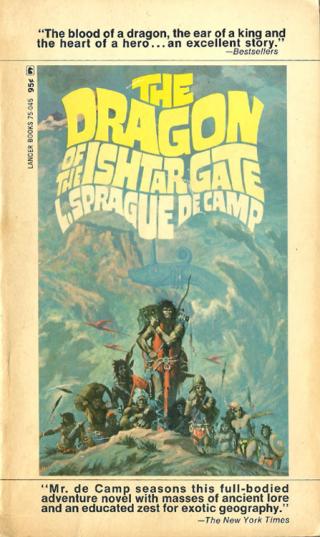
The Dragon of the Ishtar Gate
- Автор: Де Камп Лайон Спрэг
- Год: 1968
- Язык: английский
- Год: Lancer Books
- Жанр: Научная фантастика

Электронная книга - «The Dragon of the Ishtar Gate». Краткое содержание книги:
Dragon is probably closest in mood to de Camp's fantasy novels, while Bronze God and Arrows are closer to his science fiction, with their description of engineering problems, and personality clashes among researchers and engineers. Dragon also reflects de Camp's then-recent acquaintance with the Conan stories and other works of Robert E. Howard. Bessas, the huge Persian nobleman, is not only a close match for Conan in physique, but his mood swings, fixation on his mother, and tendency to toss of verses, seems a reflection of Howard himself. (Fortunately, his poems reflect de Camp's verbal dexterity and wit, not Howard's melancholy.)
BESSAS SON OF PHRAATES GREETS TROOP LEADER OCHUS
With this letter I send you the prisoner Puzur. The road guard will tell you how he tried to ambush us. You see, it is not so hard to catch these mountain goats.
As he sealed the letter, Bessas said to Myron: "My only regret is that I let you talk me out of betting with Ochus that I could do it! Next time, stick to things whereof you know."
III – The Gate of the Gods
On the evening of the ninth, Myron and Bessas forded the Idide River. Beyond the ford, the road was paved with broad fiat bricks set in asphalt. Out of the plain before them, dotted with groves of palm, acacia, tamarisk, and poplar, rose Shushan the Palace, as the Persians called their second capital. Its hills, topped by fortresses, temples, and palaces, stood up in black silhouette against the blood-red sunset.
An indifferent guard waved them through the Persepolis Gate into Shushan. In deepening darkness they rode along an avenue until Myron said:
"I turn off here to get to my friend's house."
"I'll stay with you until you are delivered," said Bessas. "When the king is away, the cutthroats make merry."
They turned down a narrow unpaved lane, the hooves of their horses striking the mud with shapeless wet sounds. Inky blackness closed in upon them. Slinking shapes scurried out of their way, and nauseous stenches assailed their nostrils. On either side the close-set walls reared up above their heads, leaving overhead but a narrow strip of starlit sky, like a gem-studded girdle. There was no light, and no sound but the snarl of pariah dogs fighting for offal.
As Myron's eyes adjusted to the blackness, he made out an occasional window, small and barred, high up; or a small but massive door, set deep in an ancient wall. Down the walls, stinking liquids trickled over coatings of moss, mold, and grime. From one window came the snarl of an angry man, followed by the crack of a whip on flesh and a woman's scream.
Another turn, and Myron said: "Here we are." He dismounted and rapped.
"Who is that?" said a voice through the peephole.
Myron gave his name. The door opened and a shaven-headed man in white linen called out: "Come in, Myron, ere we let all the vermin of the night in with you!"
Myron untied his small bag of possessions from his horse. "This is my friend Uni, the Egyptian priest," he said. "And this wee little fellow is Bessas of Zariaspa."
"Your servant," said Uni.
"God give you long life," said Bessas. "Myron, I am for the barracks. Tomorrow I must deliver these nags and study how to get us farther along on our journey. If you cannot find me elsewhere, come to Indabigas' tavern tomorrow even. Mithra preserve you!"
"The same to you," said Myron. "I shall spend tomorrow in the archives, for ignorance to a traveler is- the same as blindness."
The priest touched noses with Myron and called to his wife to get food and drink for the traveler. He said: "A thousand welcomes, old friend! What brings you hither ahead of the Great King and his court?"
Having spilt a small libation, Myron drank deeply. Gazing at the' procession of animal-headed gods that paraded stiffly, in red and white and yellow paint, around the walls of the room, he recounted what had befallen. By the time the tale was told, he had eaten and drunk;
"Four and a half days!" said Uni. "Only the postal riders do better."
"Oimoi! At the end of the first day I feared I should die, and at the end of the second I hoped I should! However, I have toughened up since. I've led too soft a life these many years."
"How goes the City of the Persians?"
"The same as ever: plots and intrigues in the palace; Persian arrogance in the streets; peasant ignorance in the countryside. By the World Egg of the Orphics, I shall never be happy until I can dwell again in a Greek city!"
"Haven't you made a good living?"
"Yes, but the soul finds refreshment in change. True, the Persian gentry have their good points. They are all brave, mostly well-mannered, and many even honest. The trouble is, there is nobody to converse with. All I hear is court gossip, and hunting, and the great equestrian game of stick-and-ball, which means to them what the Olympics do to us. Nobody has one thought to rub against another, and those who have are looked upon as insane. Pheu!"
"You need a wife," said Uni.
"You mean I once did. But try to find one when you live in a foreign city, where there are but a handful of your own kind! Why, fifteen years ago, when I was just past thirty, I courted the daughter of Pythonax the Eretrian here in Shushan. Pythonax was willing, but his daughter would have none of it. She told him I was old, and dull, and worst of all I thought all the time! I decided that the gods preferred me to stay a widower, and now, by the Dog, I am accustomed to my single state. I am less subject to
eager desire and passion that wasteth the bodies
of mortals
than I was twenty years ago."
"What are your plans?"
"If I survive this journey, I will ask permission to return to Miletos."
"I am told," said Uni, "that Miletos is full of Karians, brought in to replace the enslaved Milesians."'
"Some true Milesians will have trickled back. Anyway, this hope of future return is one reason for the journey."
"How mean you?"
"I do not desire to return to Ionia as merely one more wandering Greekling, who has tutored noblemen's sons and accumulated a few shekels. I should be as much a nobody then as now. But let me come as the man who has seen lands that no other Hellenic eyes have beheld ..."
Uni pursed his lips. "It seems like a desperate risk for a doubtful gain. I had rather search for spiritual perfection in contemplation of the deathless gods."
"Please yourself; but to labor eternally for the same masters is wearisome. Don't you see, man, I might even settle the question of whether the earth is a flat disk as says Thales, or a cylinder as says Anaximandros, or boat-shaped as say the Babylonians?"
"All very interesting, no doubt; but take care that in your searching you fall not over the edge."
"With danger even danger is overcome," said Myron. "And, as says Herakleitos, who hopes for nothing wins nothing."
"I must give you letters to some of my colleagues in Egypt; for, to a traveler in a strange land, next to a well-filled purse a good introduction is the best thing. But, speaking of purses, how do you expect to gain tangible wealth from your wanderings? I would not count upon Xerxes' gratitude. A king's wrath is as lasting as the hills, but his favor is as dew upon the grass."
"You are right. But I may acquire understanding, which to me is more than darics. My master Herakleitos used to say: Most men might as well be blind and deaf, for all that they comprehend what lies about them. If you would gain wisdom, he said, get about, see things for yourself, and subject the impressions thus gained to the divine power of reason. And why should not I be the man to put Herakleitos' advice into effect?"
Later they played sacred way, on a narrow board, three cells by twelve. At length Myron threw the elongated die, cried, "Four!" and took Uni's last piece.
"May Seteh gnaw your bones!" exclaimed the shaven man. "By the rays of Amon-Ra, you have placed a spell upon that die."
"My dear Uni," said Myron, "see for yourself." He held up the die. "It is your own perfect die, and not a flattened one that I have craftily substituted for it."
"True, though a clever man could control the fall of even a perfect die." The Egyptian finished his cup of Syrian wine and yawned. "Next time we shall play tjau and I shall slaughter you. But I should be abed. I must be full of holy unction for my little flock tomorrow."