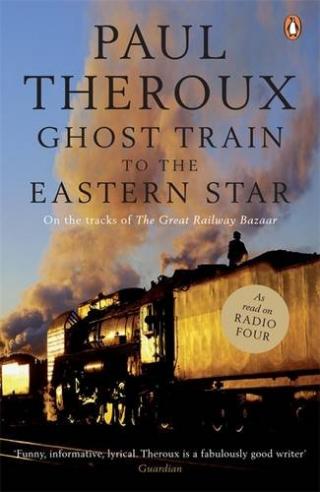
Ghost Train to the Eastern Star
- Автор: Теру Пол
- Год: 101
- Язык: украинский
- Год: Houghton Mifflin Harcourt (www.hmhco.com)
- Жанр: География, путевые заметки

Электронная книга - «Ghost Train to the Eastern Star». Краткое содержание книги:
An unmitigated treat for the hundreds of thousands of fans of the first Bazaar.
In The New Railway Bazaar, Theroux recreates an epic journey he took thirty years ago, a giant loop by train (mostly) through Eastern Europe, Turkey, the Caucasus, Central Asia, the Indian Subcontinent, China, Japan, and Siberia. In short, he traverses all of Asia top to bottom, and end to end. In the three decades since he first travelled this route, Asia has undergone phenomenal change. The Soviet Union has collapsed, China has risen, India booms, Burma slowly smothers, and Vietnam prospers despite the havoc unleashed upon it the last time Theroux passed through. He witnesses all this and more in a 25,000 mile journey, travelling as the locals do, by train, car, bus, and foot.
His odyssey takes him from Eastern Europe, still hungover from Communism, through tense but thriving Turkey, into the Caucasus, where Georgia limps back toward feudalism while its neighbour Azerbaijan revels in oil-driven capitalism. As he penetrates deeper into Asia’s heart, his encounters take on an otherworldly cast. The two chapters that follow show us Turkmenistan, a profoundly isolated society at the mercy of an almost comically egotistical dictator, and Uzbekistan, a ruthless authoritarian state. From there, he retraces his steps through India, Mayanmar, China, and Japan, providing his penetrating observations on the changes these countries have undergone.
Brilliant, caustic, and totally addictive, The New Railway Bazaar is Theroux at his very best.
Istanbul is ancient, and Istanbullus carry its old-fangledness in their heads—Pamuk is the proof of that. What do you think of us? the Turks often ask of strangers. New Yorkers and Parisians never ask such things, nor do Londoners, who take the view that strangers are the ones to be assessed or mocked, certainly not themselves. In most cities, the inhabitants are too busy and hard-pressed to care. But Turks are different, self-conscious of their longitude on the map, straddling Europe and Asia.
"To some degree, we all worry about what foreigners and strangers think of us," Pamuk says. "My interest in how my city looks to western eyes is—as for most Istanbullus—very troubled; like all other Istanbul writers with one eye on the West, I sometimes suffer in confusion."
"To see Istanbul through the eyes of a foreigner always gives me pleasure," Pamuk goes on. Flaubert, Gide, Nerval, Knut Hamsun, and Hans Christian Andersen all visited Istanbul and recorded their impressions, and in most instances what they saw was a fading Orientalism that ceased to exist as soon as it was described—the harem, the grotesque and the picturesque, dervishes, hubble-bubble pipes, the slave market, Ottoman clothing, floppy sleeves, Arabic calligraphy, and, he says, the hamals, the porters, though such men can still be seen, heavily burdened with huge loads on wooden pack frames, trudging up and down the cobbled streets of the old city. Whenever I began to generalize about Istanbul's modernism, I encountered an exotic vignette—a shroud, a fez, a minaret, a veil, a donkey, or someone grilling fish over coals by the roadside.
But Pamuk's book, like all passionate books, is a bewitchment. Once you've read his Istanbul, you have been persuaded to see the city with his eyes—a gloomy, smoky warren of narrow lanes and conflicted families, serene, half fictional, like a city in a dream.
I find most cities nasty, but I can see that Istanbul is habitable, a city with the soul of a village. Unless there is a bomb in the bazaar, or a Kurd-related outrage, there is never news of Istanbul in the Western press. To say it is beautiful is so obvious as to be frivolous, yet the sight of its mosques and churches can be almost heart-stopping. I am impervious to its charm, even the word "charm," but I admire Istanbul for its look of everlastingness, as though it has always existed (it has been a noble city since its first incarnation as Byzantium 1,700 years ago, and looks it in part). Most of all I like the city for its completeness and its self-sufficiency: it is a finished work, distinctly itself. Of course, you can buy gold and carpets in the Grand Bazaar, or jewelry and leather goods in the Egyptian bazaar, but everything else is available throughout the city too, because Turkey makes everything—stationery, cheap clothes, computers, knives, cigarettes, refrigerators, furniture. Heavy industry flourishes. The newspaper business is lively and competitive, book publishing is energetic, Turkish literacy is high, and book sales are brisk.
Given the fact that Turkey shares borders with Iraq, Iran, Syria, Arme nia, and Georgia, as well as Greece and Bulgaria, it could be a cockpit, yet it is a generally calm and self-assured place.
Istanbul now was vastly more prosperous in the look of its spruced-up buildings and well-dressed inhabitants. The ferry to Besiktas was proof of that, with its Sunday-serene passengers: little families holding hands, groups of muttering boys, smiling girls with their eyes downcast for modesty's sake, elderly women in shawls, bearded mullahs, shrouded wives in black burqas, every gradation in the chairs and pews of the ferry, from defiant unbeliever to scrupulous Koran reader.
The city is dramatic in its vistas, its spaces, its mixed population, and for appearing to accommodate everyone, but it is too big and sprawling to be definable. Yet because it is whole and coherent, self-sufficient, with an impressive profile of domes and spires, it is an easy city to visit, allowing the traveler to be presumptuous. The formalities of Turkish life, the elaborate courtesies of the Turkish language, encourage politeness.
The massacre of Armenians a century ago, the later expulsion of Greeks, and the Kurdish outrages and Turkish reprisals are lamentable facts of Turkish history; still, no city in Asia is so self-consciously reform-minded. And it is lucky in its writers, who are public intellectuals in the European mode—Orhan Pamuk was one of many who denounced the downplaying of the Armenian slaughter. He represented a public conscience. Yashar Kemal had played that role, as had his near namesake Yaya Kemal. All such people—public speakers, makers of statements, sometime journalists, polemicists with their passion and daring—were almost unknown in the countries I'd just passed through: Hungary, Romania, Bulgaria. A young woman novelist, Elif Shafak, was also outspoken against excessive Turkification and in defense of Sufism. Many of the writers were in hot water when I arrived, but they seemed (as Turkish writers frequently do) to regard hot water as their natural element.
That it is one of the most easily negotiated and hospitable cities in the world makes me a mild Turkophile. Although it's a frustrating city to drive in (the traffic moves at a crawl), it is full of alternatives—a metro, commuter trains, buses, dolmuses (minivans)—and it is one of the great cities for walking or taking a ferry from embankment to embankment. I had been too young and hurried to appreciate its virtues on my first visit. For one thing, Istanbul is a well-used city: its marvels are not mere artifacts and museum pieces. They are part of everyday life. The ancient mosques and churches, the bazaars, the bridges, the gardens, the promenades, the fish markets, and the fruit stalls are busily patronized by Turks. Being a secular country, Turkey thrives on Friday, the Muslim day of prayer and rest, and the bazaars and shops are closed on Sunday, the Christian Sabbath.
Istanbul had an air of Sunday serenity and an off-season slackness. Worry beads were not in evidence. It was only the next day in the empty bazaars that the hawkers were frowning, but when I remarked on the lack of customers, they said, "The tourists will come next month, Inshallah"
I was aware of being a solitary traveler on a long journey. With no detailed onward plans, I was not looking much beyond Turkey at the moment. The newspaper headlines were all about the Iraq War—it was a one-day bus trip to the Iraq border. The war was clearly unpopular, but no one singled me out or harassed me. On the contrary, I was welcomed in restaurants, and I delighted in the food: stuffed grape leaves, bluefish, cheese dumplings, and an eggplant dish so delicious its name is a catchphrase, imam bayildi, "the imam fainted."
In the rain and the raw March wind off the Bosporus, the streets were uncrowded. I walked from mosque to mosque, then made some calls, agreeing to give a talk at a local college, as I had done on my first visit. I was invited to a dinner party and asked if there was anyone I wished to meet.
"What about Orhan Pamuk?"
"He usually says no."
The next day I gave my talk, at Bogazçi University, a former missionary college on the heights of Bebek, and this being hospitable Turkey, I was guest of honor at a lunch where all the other diners were women. One was an American who was writing a book on all the writers who had lived and written about Istanbul, among them Mark Twain, James Baldwin, Paul Bowles, and a man I bumped into after lunch, John Freely, a New Yorker who has lived and worked here for thirty-five years, the author of many books on Istanbul subjects.