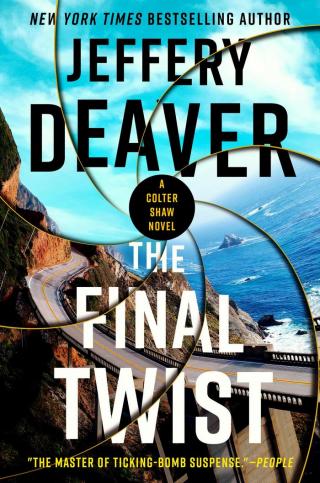
The Final Twist
- Автор: Дивер Джеффри
- Серия: Colter Shaw #3
- Год: 2021
- Язык: английский
- Год: G.P. Putnam's Sons
- ISBN: 978-0-525-53913-1
- Жанр: Триллеры

Электронная книга - «The Final Twist». Краткое содержание книги:
Following the enigmatic clues his father left behind, Shaw plays cat and mouse with the company’s sadistic enforcers, as he speeds from one gritty neighborhood in the City by the Bay to another. Suddenly, the job takes on a frightening urgency: Only by finding the courier bag can he expose the company and stop the murder of an entire family — slated to die in forty-eight hours.
With the help of an unexpected figure from his past, and with the enforcers closing the net, Shaw narrows in on the truth — and learns that the courier bag contains something unexpected: a secret that could only be described as catastrophic.
Shaw’s right hand would dip into the jacket for the pistol he hoped the man still had on him and draw. He wouldn’t threaten Blond, tell him to drop the SIG. He’d just fire away. He’d aim for the gun arm and hand. He recalled where the safety was located on Droon’s Beretta.
If Droon didn’t have the gun, or if Shaw couldn’t get to it instantly, he’d rip the bar from Droon’s hand and fling it toward Blond’s face, then break a wrist and pull the knife.
He and his siblings had been taught the art of knife throwing by Ashton. It was hard to hit your target with the point, but you could count on your enemy to be distracted by a spiraling razor-sharp blade. Shaw would charge Blond when he ducked and try to wrestle the SIG from his hand.
If not, as a last resort, he’d vault the dumpster. The other men didn’t look like they could follow him in a leap. It would take some seconds to push the unit out of the way. He would turn back toward the library — the direction they would least expect him to run, and the one with the fewest innocents on the street.
Shaw plastered an expression of dread on his face as Droon stepped forward, hefting the metal. The facilitator’s gaze was one of pleasant anticipation.
Four feet away, three feet...
Playacting again, Shaw said, “Look, let’s work this out, can’t we? Money. You want money?”
Droon was drawing back with the bar.
“Wait.”
Droon was beaming. “Don’t you go whining, there, boy.”
Shaw was perfectly balanced, ready to move, awash with the exhilaration that comes just before combat. Irrational, mad, intoxicating.
Which is when Blond said, “Stop.”
Pausing, Droon turned.
“Get back. He’s going to move on you. We’ll do it this way.” He looked down at his pistol.
13
Droon frowned. He clearly didn’t see what Blond saw. “He’d take you,” the big man offered.
“I wouldn’t be so sure about that, my friend.” But Droon stepped away from Shaw.
Blond said, “I’d risk a bullet. Top of the foot shouldn’t be much bleeding.”
Shaw sighed.
Droon walked back to Blond, who lifted the gun and pointed it at Shaw’s foot. Now, he really meant it when he said, “We can work something out. You want information. I’ll get you information.”
Blond aimed carefully.
Even if he survived the Tannery, what would a bullet wound do to his foot? Shattering the complex bones of the appendage would render the Restless Man disabled for a very long time.
Silencers do not, in fact, make a weapon completely mute. There’s a distinctive phhhht, followed by the click of the gun’s slide snapping back and then returning into position. Often you can hear the ring of the spent shell jittering on the floor or concrete or cobblestone, like what the men were standing on now.
Colter Shaw heard the first two of these, the muted gunshot and the click of the pistol as the gun reloaded for a second shot. He did not hear the dancing of the spent brass.
He did, however, hear another sound. The wet, smacking snap of a bullet hitting Blond’s forehead. The big man gave no facial reaction to the impact. He simply dropped.
Shaw crouched. The gunshot had come from above and behind him — the shooter was in the air, maybe on some scaffolding on the other side of the wooden construction fence.
Droon’s sense of survival kicked in. Not waiting to parse the situation he tore back to the street — and proving Shaw wrong — easily vaulted the dumpster. He landed and rolled, then righted himself and sprinted back toward the library.
Shaw immediately thought of the green Honda Accord, his shadow. Had the driver followed him here and been aiming at Shaw, but hit Blond by mistake? He leapt forward and rolled through the grimy alley, snatching up Blond’s SIG Sauer pistol.
Rising, in a crouch, Shaw glanced at Blond — he was dead — and drew back the slide of the SIG a quarter inch to make sure a round was chambered, something you always did with a weapon not your own.
He went prone behind the man’s body — the only cover in the alley — and trained the weapon on the plywood construction site wall.
A man’s voice called, “I’m not a hostile.” Then to Shaw’s surprise, the caller added, “Colter, I’m coming over the fence. Don’t shoot.”
He knows my name?
Something fell to the ground with a thud. It was a backpack, Oakland A’s.
This would have to be the man he’d seen at the coffee shop up the street from the safe house on Alvarez — the bearded man in the thigh-length black coat and stocking cap. He climbed over the fence and landed lithely on the cobblestones, his low combat boots dampening the force.
Colter Shaw gasped. Which was something he had not done for years — since a piton gave way and he dropped twenty feet on a half-mile-high rock face before the safety rope arrested the fall.
He was not sure which shocked him the most at the moment: That he’d been saved from the fate of being shot with only seconds to spare.
Or that the man who’d done the saving was his long-lost brother, Russell.
14
Russell said, “I understand. You have questions. I do too. Later. First, this.”
He was then on his phone, speaking in modulated yet commanding tones.
His brother was nearly identical in appearance to the man Shaw had last seen years ago at their father’s funeral. He’d had a beard then, though it was shorter than this, as was his hair. These were two reasons Shaw hadn’t recognized him near the safe house. Also, who the hell would expect the Reclusive One to be in San Francisco at the same time Shaw was?
The skin around the eyes was more weathered and ruddier. The beard was a uniform brown, without a touch of white or gray. The same was true for the tufts of straight hair protruding from the stocking cap.
One other difference between then and now: his eyes were presently cold, utterly inexpressive about the fact he’d just killed someone. Remorse, or even concern, let alone guilt, did not register.
“Help me here,” Russell said, nodding toward the dumpster. Shaw noted his brother’s voice was reminiscent of their father’s. He was startled by the near mimicry, though he supposed he shouldn’t be.
Shaw kept the muzzle of the SIG pointed away as he clicked the safety on and slipped the gun into his waistband — Russell glancing at him as he did so, apparently taking note that his younger brother had not forgotten their father’s endless lessons and drills about weapons.
They pushed the dumpster out of the mouth of the alley.
Shaw was wondering why his brother had wanted to move the big contraption; doing so would expose Blond’s body for any passerby to see. But the minute the dumpster was pushed aside and the alley was clear, a white van skidded to a stop in front of them and the side door slid open quickly.
Growing cautious, Shaw lifted the gun.
“They’re mine,” Russell said.
Three people climbed out.
Had the moment been less fraught — and confusing — Shaw might’ve smiled. He’d seen two of the trio earlier. One was Tricia, the woman in the street in front of the Alvarez Street safe house, and the man who’d attacked her — a verb Shaw put into mental quotation marks, since there’d been no assault at all, he now understood. Her screams for help had been merely a strategy to force Shaw outside and learn if he were a threat or not.