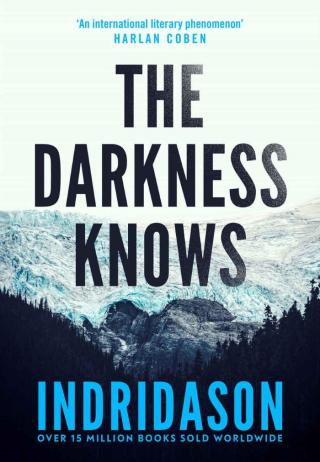
The Darkness Knows
- Автор: Indridason Arnaldur
- Серия: Detective Konrad #1
- Год: 2021
- Язык: английский
- Год: Harvill Secker/Penguin Random House UK
- ISBN: 978-1-78730-232-7
- Переводчик: Victoria Cribb
- Жанр: Криминальные детективы

Электронная книга - «The Darkness Knows». Краткое содержание книги:
The case: impossible to solve. Until now.
A frozen body is discovered in the icy depths of Langjökull glacier, apparently that of a businessman who disappeared thirty years before. At the time, an extensive search and police investigation yielded no results-one of the missing man’s business associates was briefly held in custody, but there wasn’t enough evidence to charge him.
Now the associate is arrested again and Konrád, the retired policeman who originally investigated the disappearance, is called back to reopen the case that has weighed on his mind for decades.
When a woman approaches him with new information that she obtained from her deceased brother, progress can finally be made in solving this long-cold case.
‘Ambition will be the death of that lot,’ was his sister Beta’s verdict whenever the subject came up in conversation.
Konrád had driven the boys to school that morning, then picked them up from their guitar lesson before taking them to the cinema. The guitars were in the boot of his four-wheel drive, and when they got home that evening he asked the boys to show him what they could play. But they begged to be excused, saying it was boring enough having to do the lessons. Instead, they commandeered the television in the sitting room with their game console, and after that they were lost in a world of their own until bedtime. Since it was a Friday and they had the whole weekend ahead, Konrád allowed them to stay up as late as they liked. Sometime after eleven, though, Húgó called from Gothenburg and ordered him to send the boys to bed. He obeyed.
Clearly, the body in the ice had been discussed at the boys’ house.
‘Granddad,’ one of the boys said as he laid his head on the pillow, ‘did you know the dead man they found on the glacier?’
‘No.’
‘Dad said you knew him,’ the other boy objected, his eyes still bloodshot from all the on-screen slaughter.
‘I didn’t know him personally but I knew who he was.’
‘Dad said you searched for him for years and years. When you were a cop.’
‘That’s right.’
‘But you never found him.’
‘No.’
‘Why not?’
‘Because he was hidden on the glacier. That was a terrible film you tricked me into seeing.’
‘No way! It was awesome,’ the twins protested. ‘Totally kickass.’
‘You’re idiots,’ Konrád said, smiling to himself as he pushed the door to.
He could hear them giggling as he tidied up in the kitchen before going to bed himself. Just as they’d finally quietened down, there was a faint tapping on the front door. At first he thought it was the autumn wind rattling the letterbox, but then he heard another light knocking, louder this time. He wasn’t expecting anyone. Beta could be trusted to drop in at all hours, but she would march in armed with her own set of keys and would never tap politely like that. It could hardly be a salesman. Konrád made a habit of buying lobsters and dried fish from door-to-door salespeople, but they would never dare to disturb him at this time of night.
He went to the front door, opened it and saw a woman of indeterminate age standing on the step.
‘I saw a light on,’ she said. ‘Could I possibly speak to you for a moment?’
She came across as shy and diffident. ‘Timid’ was the word. Konrád assumed she was going to try to sell him something, like a newsletter or a lottery ticket, and was tempted to send her packing, but there was something so pathetic about her that he didn’t have the heart to be rude. He took in the cheap clothes hanging off her thin body: the faded jeans, brown fake-leather jacket and purple jumper. She was wearing a black headband over her ears. Under it her hair was thick and blonde, and her face was pretty, though age and experience had etched soft wrinkles in her skin, pursing her lips and deepening the pouches under her eyes.
‘Sorry,’ she said, ‘for disturbing you like this.’
‘What are you selling?’ Konrád asked. ‘It’s very late. You do realise that?’
He scanned the parking area to see if she was alone. There had been a few occasions when men Konrád had crossed paths with in the line of duty hadn’t been content with swearing at him down the phone but had turned up outside his house after work, with a confused idea of getting something straight. Usually drink had played a role. It hadn’t led to any trouble, though. Konrád had always managed to calm the visitor down, if he was agitated, or else listened patiently to his bullshit, if the guy was in the mood to rant, before sending him away without taking any further action.
‘Oh no, I’m not selling anything,’ the woman said. ‘I wanted to talk to you about my brother. If I could come in for a moment?’
‘Your brother? Do I know him?’
‘No,’ the woman said. ‘No, I don’t think so.’
‘Should I know you?’
‘No.’
‘Then why do you want to tell me about your brother?’
‘Because of something he saw when he was a boy. By the tanks on Öskjuhlíd.’
10
The unknown woman whispered these last words so quietly that Konrád could barely catch them. He stared at her, instantly grasping what she meant by her reference to the tanks on Öskjuhlíd: the old hot-water tanks where Sigurvin’s jeep had been found. The woman avoided his eyes, as if she had said something shameful. There was an interval of silence, broken only by a noisy car driving past. Konrád was sure he had never seen this woman before; she couldn’t have been on their radar during the original inquiry.
‘I take it you’re referring to the Sigurvin affair?’ he asked warily. ‘When you refer to the tanks?’
‘Sorry to come round at such a stupid time.’
‘Don’t worry about it.’
‘Could I come in?’
‘Please do.’ Konrád opened the door wider and ushered her into the hall. ‘I didn’t mean to leave you standing out there in the cold like that. I’m just not used to getting visits so late in the evening.’
He glanced at his watch. It was midnight. The woman edged her way into the sitting room, still shy and diffident, gazing around her at the paintings on the walls and the shelves full of books.
‘Have a seat,’ Konrád said. ‘Would you like a coffee, maybe? Or something else?’
‘I wouldn’t mind a coffee,’ the woman said. ‘My name’s Herdís,’ she added, holding out her hand. ‘You wouldn’t have a shot of something to put in the coffee, would you? I’m a bit chilly. There’s quite a northerly blowing out there.’
‘Sure, can do,’ Konrád said.
The woman perched on a chair in the sitting room and continued to study her surroundings, while Konrád put on the coffee and dug out the bottle of vodka he kept in one of the kitchen cupboards along with the gin and the rum. He himself drank only in moderation, and then mostly red wine. He poured a generous splash of vodka into a cup, feeling puzzled by this unexpected visit. It was a mystery to him why she should have come round to see him in the middle of the night rather than going to the police. He guessed she must think he was still working on the inquiry. His name had been quite prominent in the coverage of the original investigation, when he’d had to take the role of police spokesman at times. On his way back to the sitting room, he checked on the boys, who turned out to be sound asleep, and firmly closed the door to their room.
‘Yes, it’s turning chilly,’ he remarked as he sat down and handed the woman the cup.
She took it. As the coffee wasn’t very hot, she finished it in one gulp and handed it straight back.
‘Like another?’ he asked.
Herdís nodded. Konrád went into the kitchen and fetched the coffee pot and the bottle, placing both in front of the woman. She poured a tiny splash of coffee into her cup, filled it up with vodka, drained half in one go, then finished it. Konrád waited patiently.
‘He was only nine,’ she said, once she had thawed out a bit. ‘We were very hard up. We lived in a tiny basement flat in the Hlídar area and used to play outside all day long. We’d hang about in the streets or kick a ball around in the park at Klambratún or go onto Öskjuhlíd. The hill was a brilliant playground for us kids. You know... the wartime bunkers left over from the British occupation, the quarry and the woods. It was... And the hot-water tanks at the top of the hill... it was like this magical world.’