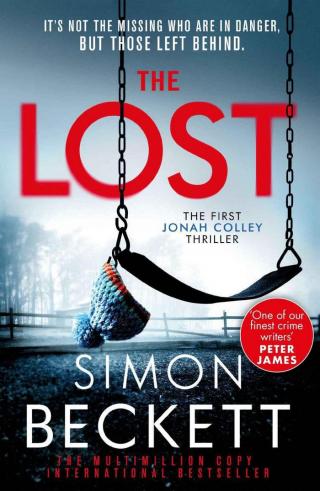
The Lost
- Автор: Бекетт Саймон
- Серия: Jonah Colley #1
- Год: 2021
- Язык: английский
- Год: Orion/Trapeze
- ISBN: 978-1-398-70690-3
- Жанр: Триллеры

Электронная книга - «The Lost». Краткое содержание книги:
Ten years ago, the disappearance of firearms police officer Jonah Colley’s young son almost destroyed him.
A GRUESOME DISCOVERY
A plea for help from an old friend leads Jonah to Slaughter Quay, and the discovery of four bodies. Brutally attacked and left for dead, he is the only survivor.
A SEARCH FOR THE TRUTH
Under suspicion himself, he uncovers a network of secrets and lies about the people he thought he knew — forcing him to question what really happened all those years ago...
‘I’m sorry...’
Next day, Jonah had gone back to the park for the first time. At the play area, high-pitched voices and laughter rang from the children who played there, watched over by bored-looking parents. Seeing them, Jonah felt an envy so sharp it hurt. The crime scene tape had been taken away, except for a small area cordoned off within the rhododendrons. Here the leathery-leaved bushes had been cut back, exposing a low archway whose stone blocks were wet and green with algae. It straddled the same stream where he and Theo had played Poohsticks, a dark cave into which the fast-flowing water dis-appeared. Rusted iron stumps protruded from the stonework, but a new gate of galvanised steel had been fixed over its mouth like the bars of a cage.
Jonah’s eyes blurred as he stared into the darkness beyond, with a sense of bleakness and loss so great it had neither beginning nor end.
On his way out, he stopped by the bench where Owen Stokes had sat. Ordinary slats of weathered wood, stained white with bird droppings. A pressure built up in him at the sight of it. He wanted to lash out, to stamp it into splinters, and it took all his willpower for him to turn and walk away. DCI Wells had got it wrong. Something like this, something so monumental, couldn’t just happen. Theo, his laughing boy, couldn’t have just ceased to be. Something had to be to blame.
Someone.
Chapter 7
‘Come on, you can do it.’
I can’t. I really can’t. He squeezed his eyes shut and gritted his teeth. Doing his best.
‘You’re doing great. Just a bit more.’
You call this great?
Sunni eased his leg fractionally more.
‘Jesus!’ Jonah slapped the padded bench, tears leaking from his eyes.
‘OK. I think we’ve done enough for one day.’
Jonah nodded weakly.
‘I know it might not seem like it, but you’re doing really well,’ Sunni said.
He wiped the sweat from his forehead. ‘Yeah, feels like it.’
‘You’ve had a bad injury, so it’s going to take time,’ she told him. ‘That’s normal. But take it from me, we are making progress.’
Progress. Having someone manipulate his leg, trying to bend it a few millimetres at a time, while he broke out in a clammy sweat and tried not to yell out loud at the pain. He’d been shocked the first time he’d seen his knee without its dressings. It was purple and swollen to twice its normal size, with stitched wounds criss-crossing its misshapen surface. It looked like an offcut from a butcher’s shop, something a dog had been chewing on, rather than part of him.
The orthopaedic surgeon had been briskly realistic. Jonah’s knee had suffered the sort of trauma seen in motorbike accidents. The patella had shattered, and there was also damage to the ligaments and tendons. The surgeon sounded pleased with himself as he’d described rebuilding the patella, securing the displaced bone fragments with titanium screws and wire. But the damage was extensive. Further operations might be required, though that would be assessed in a few months’ time, when the joint had had time to heal. Either way, Jonah should be prepared for recovery to be a long and painful haul.
Jonah had been trying not to think about his future, but that was becoming harder. There was talk of him being discharged in another day or two, but even the most optimistic prognosis made it clear he wouldn’t be returning to his team any time soon. Perhaps at all.
The prospect of that scared him.
‘The battle’s in here.’ Sunni tapped a finger against Jonah’s temple as he pushed himself upright on the bench. ‘Pain’s just your body’s way of telling you something’s wrong. It’s how you deal with it that matters.’
It was just hard to believe that when it hurt so much.
Still, at least he was mobile again. To start with he’d been pushed to his physio sessions in a wheelchair, but now he could make it there and back on elbow crutches. This was his second week in hospital, and as he swung himself along the familiar corridor to his room, he thought how quickly he’d adapted to its routines and rhythms. It helped that he was allowed visitors now. There had been formal visits from his bosses, right up to the Chief Superintendent, and from a Police Federation representative checking on his welfare. And it had been good to see some of his team again, especially Khan and Nolan. It was a reminder that the normal world outside the hospital still existed.
They’d also been able to tell him more about the larger fallout following the events at the quayside. The murders at Slaughter Quay had made national headlines, accompanied by the predictable media glee over the quayside’s name. The general assumption was that it was part of an undercover op that had gone tragically wrong, something the enquiry team’s PR machine had evidently done nothing to deny.
But there were precious few details in the news stories Jonah read. The formal police statements were little more than platitudes, vowing to bring those responsible to justice. That even extended to Gavin. His death was now officially regarded as a ‘no body’ murder, and much had been made in the press of the fact that his killers hadn’t been found. Yet while the media coverage portrayed him as a hero who’d died trying to save others, the police tributes to him seemed oddly low-key. There were no off-the-record theories as to the killer’s identity or motives; no unattributed quotes from anonymous sources. With so many question marks hanging over the case, the official policy seemed to be to say as little as possible rather than admit ignorance. Starve the story of oxygen and let the press fill the vacuum with speculation.
At least Jonah’s own involvement had been largely overlooked. There were references to ‘an unnamed police officer’ who’d been injured, but little else. And the three unidentified warehouse victims received even less attention. According to rumours passed on by Khan and Nolan, each of them had been clubbed, then wrapped up in polythene sheeting while they were still alive. Cause of death had been asphyxiation, aggravated in the young woman’s case by dehydration and organ failure. The polythene hadn’t only been to conceal the bodies prior to their disposal. It had been the means of execution.
But Khan and Nolan had been unable to tell him any more than that. Although the three victims hadn’t been identified, that didn’t prevent the media from concluding they must be illegal migrants, probably killed by the same traffickers who’d smuggled them into the country. Nadine’s first name and possible Middle Eastern ancestry had been made public, but without a photograph to humanise her, she and the two other victims became little more than a footnote. Their deaths had prompted press calls to crack down on organised crime gangs, and predictable criticism of UK borders and immigration policy. Yet the outrage somehow overlooked the fact that three individuals had died brutal, senseless deaths.
Fletcher and Bennet had been back to interview Jonah on two more occasions, neither any more pleasant than the first. The DI clearly thought he knew more than he was saying, and Jonah couldn’t blame him. There might not be any actual evidence against him — he was thankful he’d taken care not to get any of Gavin’s blood on him when he’d checked for a pulse. But the man he’d fought with still hadn’t been found, and apart from the single call from Gavin on his phone log, there wasn’t anything to corroborate Jonah’s version of events. It left him in limbo, uncertain if he was a suspect or not.
So far Fletcher wasn’t saying.
The walk from the physio suite was a long one. But, tired as he was, a heaviness descended on him when he came into view of his room. Although there was no longer a PC outside — the guard been quietly removed several days ago, which Jonah took as a good sign — the small windowless space felt like a cell. It was bad enough during the day, when the harsh fluorescent light showed every scuff mark and gave the room a timeless, purgatorial feel. It was even worse at night. Jonah hadn’t slept well in years, but since being in hospital he’d have welcomed his old insomnia. Closing his eyes now meant the cinema of his subconscious would start. He couldn’t recall much about the nightmares, except that he’d wake, terrified and gulping for air, convinced there was someone in there with him.