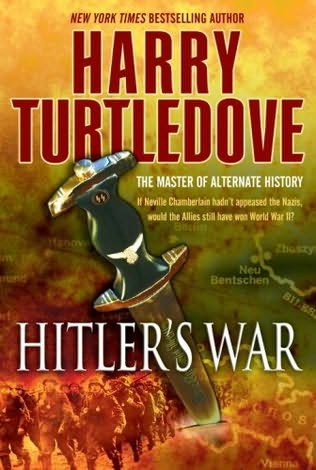
Hitler's war
- Автор: Тертлдав Гарри Норман
- Серия: The War that came early #1
- Язык: английский
- Жанр: Альтернативная история

Электронная книга - «Hitler's war». Краткое содержание книги:
Now, in this thrilling, provocative, and fascinating alternate history by Harry Turtledove, another scenario is played out: What if Chamberlain had not signed the accord? What if Hitler had acted rashly, before his army was ready-would such impatience have helped him or doomed him faster? Here is an action-packed, blow-by-blow chronicle of the war that might have been-and the repercussions that might have echoed through history-had Hitler reached too far, too soon, and too fast.
Turtledove uses dozens of points of view to tell this story: from American marines serving in Japanese-occupied China to members of a Jewish German family with a proud history of war service to their nation, from ragtag volunteers fighting in the Abraham Lincoln Battalion in Spain to an American woman desperately trying to escape Nazi-occupied territory-and witnessing the war from within the belly of the beast.
A novel that reveals the human face of war while simultaneously riding the twists and turns that make up the great acts of history, Hitler's War is the beginning of an exciting new alternate history saga. Here is a tale of powerful leaders and ordinary people, of spies, soldiers, and traitors, of the shifting alliances that draw some together while tearing others apart. At once authoritative, brilliantly imaginative, and hugely entertaining, Hitler's War captures the beginning of a very different World War II-with a very different fate for our world today.
The two M-100A radial engines thundered to life. The props blurred into invisibility. Yaroslavsky checked the instruments, one after another. Everything looked good. The mechanics were Czechs, too. They were better than any Russian mechanics he’d ever had. They seemed to care more about the work they did.
Five more bombers were also warming up on the airstrip. They were going to give the Nazis one right in the eye. Sergei hoped so, anyhow. More than a week into the war, and the Germans still hadn’t cut Czechoslovakia in half. Lots of the Czech army was pulling back into Slovakia to keep up the fight here-and to sit on the pro-Fascist Slovaks.
Down the runway bounced the SB-2. It was made for taking off from grassy fields. Paved runways were as rare as capitalists inside the Soviet Union.
Sergei pulled back on the stick. The bomber’s nose came up. No more bouncing-he was airborne. He’d shake again soon enough, when they started shooting at him. Best to enjoy the calm while he could.
If running didn’t help, he could shoot back. Mouradian was in charge of two machine guns in the SB-2’s nose. Kuchkov had a machine-gun blister on the back of the airplane and another in its belly. Those looked like a good idea. Bombardiers were rapidly discovering, though, that you had to be lucky to hit anything with either gun. If you weren’t lucky, you might use the dorsal gun to shoot off your own tail. At least one intrepid bombardier had already done that.
If he’d lived, they would have court-martialed him and then shot him. As things were, he saved them the trouble.
“All good,” Mouradian shouted, pointing to the instruments. He wasn’t in the front glasshouse yet. With 840 horsepower roaring away to either side, you had to yell to make yourself heard.
“I see ‘em.” Sergei nodded. “Let’s hope they stay that way.” The SB-2 was a robust warplane. It could take a beating. Sergei didn’t want it to this time around.
On he flew with his buddies. Down below, bursting shells and bombs told when they entered the combat zone. The Czechs were still pulling back through the gap between the Nazi armies advancing from the north and south. If the Czechs got enough men and materiel into eastern Moravia and Slovakia before the Germans finally sealed that gap, they could keep fighting a while longer.
When Sergei said as much to Anastas Mouradian, the copilot-who also served as gunner and bomb-aimer and navigator-nodded. “Da,” he said, for all the world as if he were a real Russian. Then he added, “If they don’t, they’re fucked.” Any Russian might have said that, too. He sure wouldn’t have been wrong if he did.
Antiaircraft fire started bursting around the bombers. Yaroslavsky jinked, going up and down to the left and right at random and slowing down and speeding up to keep the German gunners from being able to lead him like a duck. When a shell filled the air with nasty black smoke close by, it was as if he drove over a big pothole. His teeth came together with a click.
Mouradian growled something in what had to be Armenian. Then he came back to words Sergei could understand: “Too damn close.”
“No kidding,” the pilot said. Just then, another shell went off even closer to the SB-2. A fragment clanged off-or, more likely, bit through-the fuselage. Yaroslavsky checked the controls to the rudder and elevator. They answered-no cables cut. He yelled into the speaking tube to the bombardier: “You all right, Ivan?”
“Khorosho,” Kuchkov answered. “A little draftier, but no damage.”
“Get ready,” Sergei told him. “We’re almost there.”
They were almost there if Mouradian’s navigating was worth a kopek, anyway. He’d got them where they were supposed to go before. The target this time was just outside of Brno, the biggest factory town in Moravia. The Czechs were still holding out there, still holding up the Nazis. If 600 kilos of high explosive could help them hang on a little longer, Sergei would deliver the goods.
That thick cloud of smoke ahead had to be Brno. Who needs navigation? Sergei thought wryly. The Germans were bombing the crap out of Czechoslovakian civilians. Thousands and thousands were supposed to be dead in Prague. Brno was catching it, too.
“So where’s our target from here?” Yaroslavsky asked.
“Southwest, Comrade Pilot,” Mouradian answered from the nose-he was ready to fight now.
That made sense: it was the direction from which the Nazis were advancing. Sergei didn’t want his bombs coming down on the Czechs’ heads. He spotted something ahead that looked like a division HQ. “Aim for those tents,” he ordered. “I’ll bring us in low and straight.”
“We’ll get ‘em,” Ivan Kuchkov said. And maybe they would, and maybe they wouldn’t. But they’d scare the crap out of the Nazis if they didn’t.
The bomb bay opened. The extra drag slowed the SB-2 and made it sluggish in the air. At Mouradian’s shouted command, the bombs tumbled free, one after another. The plane would be livelier with them gone: they made up about a tenth of the weight it was carrying.
And the Tupolev bomber would need to be livelier, too. German fighters jumped the Russians just as they were finishing their bombing runs. These Messerschmitts were terrifying. They could have been more maneuverable, but they were well armed and fast as the Devil’s godson. And diving down on the SB-2s made them faster yet.
One of the bombers fell out of the sky. By the way it dove, the pilot was dead at the controls. Fire filled the left wing. Another SB-2 fled east with smoke trailing from one engine. Maybe it could get down safely in Czech-held territory. Maybe the Germans would hack it down first.
Sergei couldn’t worry much about the other SB-2s. He had to worry about his own. The Chimp started blazing away from the dorsal turret. Tracers snarled past the bomber from behind.
But Ivan made the 109 pull up. From the nose, Mouradian squeezed off a long burst at the lean, predatory shape. The enemy fighter didn’t catch fire or go down. But it didn’t try another attack, either.
With all the throttle he could use, Sergei got out of there. Then he had another bad moment, when two Czech Avias buzzed up in what might have been another attack. At the last second, they saw he was no Nazi and swung away. One of the pilots waved from his cockpit. Yaroslavsky returned the compliment.
Then he had to find the airstrip again. Mouradian came back to help him. Between them, they figured out where the hell Poprad was. They got down smoothly enough. One other plane from the flight came in a few minutes later. Sergei could hope some of the rest had landed elsewhere. The one that had plummeted to the ground…He shuddered. Better not to think of such things.
He had to, though, because he needed to report to his superiors. “One of our planes damaged, one definitely lost,” he said.
They nodded. All part of the game, as far as they were concerned. “We’ll keep banging away,” one of them said. Till you’re expended, too , Sergei thought, and made himself nod.
* * *
Vaclav Jezek dug like a mole. What was left of his company was trying to hold the Germans out of Kopecek, a little town six or eight kilometers northeast of Olomouc. In and of itself, Kopecek hardly mattered. But Olomouc did. Olomouc was the last surviving northern rampart against the Nazi flood. The Czech army was pulling back to the east between Olomouc and Brno. If Hitler’s bastards closed off that passageway…
Then we’re fucked, Jezek though, making the dirt fly with his entrenching tool. Czechoslovakia was probably fucked anyway. No, scratch probably. Czechoslovakia was fucked anyway. But the stubborn Czechs were making Germany pay a hell of a high price.
Artillery came down in and around Kopecek. The Nazis were shelling the pilgrimage church. It stood on a hill a couple of hundred meters above the plain, and made an observation post dangerous to them. Vaclav would have been surprised if his side didn’t have some guns of its own around the church.