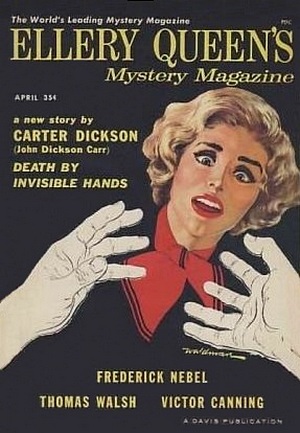
Ellery Queen’s Mystery Magazine. Vol. 31, No. 4. Whole No. 173, April 1958
- Автор: Ballard Helen Mabry, Блох Роберт Альберт
- Год: 1958
- Язык: английский
- Год: Davis Publications
- Жанр: Другие детективы

Электронная книга - «Ellery Queen’s Mystery Magazine. Vol. 31, No. 4. Whole No. 173, April 1958». Краткое содержание книги:
“I’ll be hale, at least. That’s a promise,” John told him as Marla reached back and shut the soor.
There followed a bad ten minutes during which John threw back the sheets and forced himself to swing his legs out of the bed. His cane was handy. By leaning on it and holding on to the bedpost, he pulled himself to a standing position. It hurt but, unexpectedly, his leg behaved much better when he was on his feet. He worked down to the foot of the bed, supporting himself with one hand on the mattress. From there, with his cane, he snaked a straight-backed chair into the position he desired. It was the steady prop he had needed. Moving it forward a few inches at a time, he made his way to the closed door. He put his ear against it, listening.
Voices. Marla’s voice and then Granville’s, but either they were so muffled by the door, or purposely had been pitched so low, that he couldn’t make cut more than an occasional word. But it was hardly necessary to hear what they were saying. It was as though, in some previously neglected corner of his mind, he knew the burden of their whisperings, had known what they had talked about and plotted from the beginning. He inched back to bed.
He dozed a little that night, but there was no real sleep. And in the morning when Marla brought his breakfast, which he did not touch, he was already dressed.
“Well, this is a surprise,” she said. “Glad to see you’re feeling better, but you needn’t have put your clothes on.”
“As a matter of fact, that’s exactly what I did need. The authorities take a dim view of people wearing pajamas on the beach.”
“You’re going to the beach?”
“I have to go somewhere. I can’t lie here forever.”
She hesitated, but only for a moment. “Maybe you know best.”
This time when Marla raced the red and white convertible past the Circle Bar and into the short shell road, John sat tensely upright, fighting to control his jangled nerves. As usual, she hauled out the deck chair, and as usual she asked if he needed anything before she left. On the surface everything was as it had been before but, unknown to Marla, a radical change had entered their relationship. He had found her out. He was convinced she was trying to get rid of him. She had no money of her own and since she couldn’t reasonably expect much alimony, she was going about it in the most elementary of all ways.
Two young women walked by. They were pretty and had nice figures. Perhaps they were the same two he had seen before. If so, he watched them this time for a different reason — enviously, because they were so alive. He watched them until they reached the Point of Rocks, then saw them turn and stroll back up the beach again. They walked along the water’s edge, meeting Luella who came from the opposite direction. Luella climbed the beach toward him. Her paper sack had been replaced by a small canvas bag.
“Where you been?” She halted in front of him, shifting her weight from one foot to the other. Her eyelids were half lowered with a new secretiveness.
“Hello,” he said.
“Where you been?”
“At home. Do something for me, will you, Luella?”
“Depends.”
“Get me a hamburger and a carton of black coffee. No sugar.” He gave her a dollar. “Get something for yourself,” he added when she did not move.
She nodded and walked toward the Circle Bar.
The two young women had stretched out on the sand. They lay close together, talking confidentially, and an aura of feminine mystery surrounded them. Presently they got up and waded into the sea.
“Here’s your stuff.” Luella had come back.
“Thanks. Where’s yours?”
She squatted and laid her canvas bag on a flat rock. With another rock she pounded on the bag. There was a sound of breaking glass. “I’ll save the money. Got a lot of money saved up now.”
“That’s nice. Saving for anything in particular?”
“Wouldn’t you like to know?” She pounded on her bag. Her next question came abruptly. “Where’s your wife?”
“Home.”
“She was here yesterday. So was Shelby,” she added, after a pause.
He changed the subject, irritably. “Luella, what are you doing with that bag?”
“Smashing up this glass. It’s for my pictures. I make real pretty pictures.” She answered unemotionally but, for the first time in all the weeks he had known her, he caught a glint of enthusiasm in the thin, small face. “Got the walls of my room almost covered. You smear paint on first — any kind of paint just so it’s sticky. Then you draw a picture with your finger. Then you get the glass all powdery and blow it on the picture with a bellows. Makes it glitter,” she said. “What you sweating so much for?”
“It’s very hot.”
“Don’t feel hot to me.” She kept pounding with her rock.
He leaned forward, perspiration rolling down his face. “Tell you what,” he said. “I’ll give you a dollar for that bag. How about it?”
She looked up slowly, amusement in her half closed eyes. “You want this glass? What for?”
“Never mind. Here’s the dollar.”
“Well—”
He gave her a bill. She examined it carefully, then lifted the canvas bag with both hands, in a sort of ritual gesture. He put the bag in his pocket. She got up and slowly walked toward the water. No further word was spoken but at a distance of several yards she glanced back over her shoulder. Then she giggled, disconcertingly.
Marla had to choose that particular day to have what she called a heart-to-heart talk. He sat at the table while she prepared lunch, and the sugar bowl was in front of him. Marla used lots of sugar. She did not have to worry about her weight.
She said, “We can’t go on like this. Do you realize you’ve hardly spoken a word to me for days?” She paused, then went on. “What’s happened to us? We were so happy until you had that accident. The doctor says that all you need is exercise.”
“Doctors!”
“You pay their bills. It seems to me you’d listen to what they say.”
Talk, talk, talk. She was in and out of the kitchen, but never out long enough for him to open the sugar bowl and do what he planned to do. The suspense was torture. By the time they finished lunch John was exhausted and had to lie down on his bed. And that afternoon Marla varied her routine. She stayed at home until four thirty and then went out for only twenty minutes to get a carton of cigarettes.
Before dinner he was similarly blocked from unobserved access to the sugar bowl, and he got no sleep the first part of the night. He struggled up shortly after midnight. Taking his flashlight he went quietly to the kitchen, found the bowl, and emptied about half of the canvas bag into it. Then he returned to bed and slept soundly the balance of the night.
But in the morning, when Marla brought him orange juice, he sat up quickly. “I’ll eat at the table.” He fumbled for his cane. “Have you had breakfast?”
“Just some juice.”
“No coffee? No cereal?”
“Not yet. Why don’t you have breakfast here? It’s just as easy—”
“I’ll eat at the table!” he repeated loudly, and squirmed into his bathrobe. Marla was in the kitchen when he took his usual place. She brought in two cups of steaming coffee.
“None for me,” he said.
She started to protest, then shrugged. She picked up the sugar to sweeten her own coffee. The bowl dropped to the floor and smashed.
“Clumsy!” she said. “Darn thing slipped out of my hand.” She got a whiskbroom and a dustpan and swept up the sugar. John muttered inarticulately when she finally sat down.
“What did you say?”
“Nothing.”
Nothing, he thought — there was nothing to be done. Fatalistically, he accepted the fact that he was going to die. It was really all right: in such circumstances he didn’t want to live. For the first time in days he ate a hearty breakfast. Afterward, the expected pain and nausea failed to materialize. He was almost relaxed when Marla drove him to the beach.