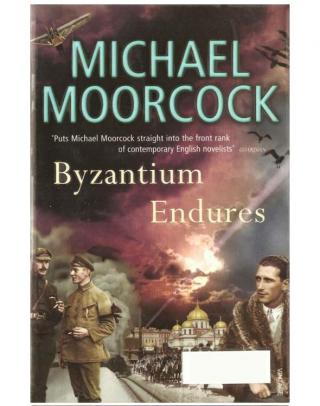
Byzantium Endures
- Автор: Муркок Майкл
- Серия: Between The Wars #1
- Язык: английский
- Жанр: Научная фантастика

Электронная книга - «Byzantium Endures». Краткое содержание книги:
Published in 1981 to great critical acclaim—then condemned to the shadows and unavailable in the U.S. for thirty years—Byzantium Endures, the first of the Pyat Quartet, is not a book for the faint-hearted. It’s the story of a cocaine addict, sexual adventurer, and obsessive anti-Semite whose epic journey from Leningrad to London connects him with scoundrels and heroes from Trotsky to Makhno, and whose career echoes that of the 20th century’s descent into Fascism and total war.
This is Moorcock at his audacious, iconoclastic best: a grand sweeping overview of the events of the last century, as revealed in the secret journals of modern literature’s most proudly unredeemable outlaw.
Makhno soon turned against the Bolsheviks again and for a while he and Hrihorieff planned an alliance, but Hrihorieff’s ego centricity and pogromist activities (Reds, Greens and Whites were all responsible for uncountable atrocities against Ukrainian and Polish Jews) disgusted the Anarchist and, in a well-documented meeting at the village of Sentovo near Hrihorieff’s Alexandria camp, under the noses of Hrihorieff’s own followers, Makhno and his lieutenants assassinated the Ataman for ‘pogromist atrocities and anti-revolutionary activities’. But the insurgents never reclaimed their former glory. Bit by bit they were betrayed and conquered by the Reds, whose frequent tactic was to invite insurgent leaders to conferences and then (as Trotsky did with Makhno’s lieutenants) have them shot on the spot. In an atmosphere of chaos and mass-murder reminiscent of the worst days of the Thirty Years War, Petlyura and his men held out a little longer in Galicia but by early 1920 the Bolsheviks had gained most of the Ukraine and would soon turn the weight of Budyenny’s Red Cavalry upon the invading Poles and the remnants of the Whites. By this time, of course, Pyat had no personal interest in the matter.
Lobkowitz recommends Konstantin Paustovsky’s Story of a Life [Six volumes published by Collins/ Harvill Press, 1964-1974] as ‘excellent, if diplomatically-edited’ background reading to this period of Ukrainian-Russian history. He also tells me that ‘al least one of Pyat’s claims is partially vindicated by Paustovsky: in Vol. III (In That Dawn), page 141, where he mentions a rumour circulating in Kiev that a “Violet Ray” was to be used by Petlyura to defend the city against the Bolsheviks.’ He goes on to suggest that it is ‘worth reading between the lines of Paustovsky’s account, which was, of course, published first in the Soviet Union and therefore tends to take an official view, on the surface at least, of Petlyura Makhno and various other personalities of those years’. He also recommends, as an academic source, The Ukraine, 1917-1921: A Study in Revolution, edited by Taras Hunczak and published by the Harvard Ukrainian Research Institute, 1977 (distributed by Harvard University Press).