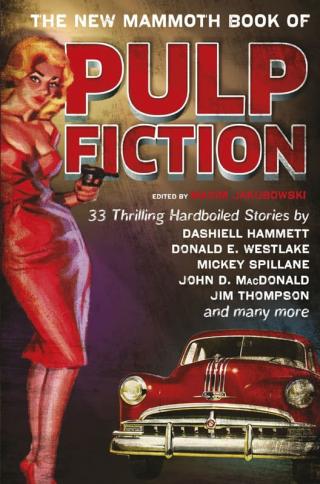
The New Mammoth Book of Pulp Fiction
- Автор: Якубовски Максим, Беллем Роберт
- Год: 2014
- Язык: английский
- Год: Constable & Robinson
- ISBN: 9781472111807
- Жанр: Крутые детективы

Электронная книга - «The New Mammoth Book of Pulp Fiction». Краткое содержание книги:
It was less than three minutes later and they had him. He was walking south on Ninth, between Race Street and Arch, and the black Olds 88 was cruising on Arch and he didn’t see them but they saw him, with Oscar grinning at Coley and saying, “There’s our boy.”
Oscar drove the car past the intersection and parked it on the north side of the Arch about twenty feet away from the corner. They got out and walked toward the corner and stayed close to the brick wall of the corner building. They listened to the approaching footsteps and grinned at each other and a few moments later he arrived on the corner and they grabbed him.
He felt Coley’s thick arm wrapped tight around his throat, pulling his head back. He saw the glimmer of the five-inch blade in Oscar’s hand. He told himself to think fast and he thought very fast and managed to say, “You’ll be the losers. I made a connection.”
Oscar hesitated. He blinked puzzledly. “What connection?”
He smiled at Oscar. Then he waited for Coley to loosen the armhold on his throat. Coley loosened it, then lowered it to his chest, using both arms to clamp him and prevent him from moving.
He made no attempt to move. He went on smiling at Oscar, and saying, “An important connection. It’s important enough to louse you up.”
“Prove it,” Oscar said.
“You’re traced.” He narrowed the smile just a little. “If anything happens to me, they know where to get you.”
“He’s faking,” Coley said. Then urgently, “Go on, Oscar, give him the knife.”
“Not yet,” Oscar murmured. He was studying Ken’s eyes and his own eyes were somewhat worried. He said to Ken, “Who did the tracing?”
“I’ll tell that to Riker.”
Oscar laughed without sound. “Riker’s in Los Angeles.”
“No he isn’t,” Ken said. “He’s here in Philly.”
Oscar stopped laughing. The worry deepened in his eyes. He stared past Ken, focusing on Coley.
“He’s here with Hilda,” Ken said.
“It’s just a guess,” Coley said. “It’s gotta be a guess.” He tightened his bear-hug on Ken. “Do it, Oscar Don’t let him stall you. Put the knife in him.”
Oscar looked at Ken and said, “You making this a quiz game?”
Ken shrugged. “It’s more like stud poker.”
“Maybe,” Oscar admitted. “But you’re not the dealer.”
Ken shrugged again. He didn’t say anything.
Oscar said, “You’re not the dealer and all you can do is hope for the right card.”
“I got it already,” Ken said. “It fills an inside straight.”
Oscar bit the edge of his lip. “All right, I’ll take a look.” He had the knife aiming at Ken’s chest, and then he raised it and moved in closer and the tip of the blade was touching Ken’s neck. “Let’s see your hole-card, sonny. All you gotta do is name the street and the house.”
“Spruce Street,” Ken said. “Near Eleventh.”
Oscar’s face became pale. Again he was staring at Coley.
Ken said, “It’s an old house, detached. On one side there’s a vacant lot and on the other side there’s an alley.”
It was quiet for some moments and then Oscar was talking aloud to himself, saying, “He knows, he really knows.”
“What’s the move?” Coley asked.
He sounded somewhat unhappy.
“We gotta think,” Oscar said.
“This makes it complicated and we gotta think it through very careful.”
Coley muttered a four-letter word. He said, “We ain’t getting paid to do our own thinking. Riker gave us orders to find him and bump him.”
“We can’t bump him now,” Oscar said. “Not under these conditions. The way it stacks up, it’s Riker’s play. We’ll have to take him to Riker.”
“Riker won’t like that,” Coley said.
Oscar didn’t reply. Again he was biting his lip and it went on that way for some moments and then he made a gesture toward the parked car. He told Coley to take the wheel and he’d sit in the back with Rockland. As he opened the rear door he had the blade touching Ken’s side, gently urging Ken to get in first. Coley was up front behind the wheel and then Oscar and Ken occupied the rear seat and the knife in Oscar’s hand was aimed at Ken’s abdomen.
The engine started and the Olds 88 moved east on Arch and went past Eighth and turned south on Seventh. There was no talk in the car as they passed Market and Chestnut and Walnut. They had a red light on Locust but Coley ignored it and went through at forty-five.
“Slow down,” Oscar said.
Coley was hunched low over the wheel and the speedometer went up to fifty and Oscar yelled, “For Pete’s sake, slow down. You wanna be stopped by a red car?”
“There’s one now,” Ken said, and he pointed toward the side window that showed only the front of a grocery store. But Oscar thought it might really be a side street with a police car approaching, and the thought was in his brain for a tiny fraction of a second. In that segment of time he turned his head to have a look. Ken’s hand moved automatically to grab Oscar’s wrist and twist hard. The knife fell away from Oscar’s fingers and Ken’s other hand caught it. Oscar let out a screech and Ken put the knife in Oscar’s breast just over his heart. The car was skidding to a stop as Ken stabbed Oscar to finish him. Coley was screaming curses and trying to hurl himself sideways and backwards toward the rear seat and Ken showed him the knife and it didn’t stop him. Ken ducked as Coley came vaulting over the top of the front seat, the knife slashing upward to catch Coley as he came on. It buried itself deep enough into his breast to reach the heart and left Coley collapsed with his legs still over the front seat and his body sprawling across the lifeless form of Oscar in the back.
“I’m dying,” Coley gurgled. “I’m—” That was his final sound. His eyes opened very wide and his head snapped sideways and he was through for this night and all nights.
Ken opened the rear door and got out. He had the knife in his pocket as he walked with medium-fast stride going south on Seventh to Spruce. Then he turned west on Spruce and walked just a bit faster. Every now and then he glanced backward to see if there were any red cars but all he saw was the empty street and some alley cats mooching around under the street lamps.
In the blackness above the roof-tops the bright yellow face of the City Hall clock showed ten minutes past six. He estimated the sky would be dark for another half-hour. It wasn’t much time, but it was time enough for what he intended to do. He told himself he wouldn’t enjoy the action, and yet somehow his mind was suffused with a kind of anticipatory satisfaction. It looked like Tillie had been right about that black pudding.
He quickened his pace just a little, crossed Eighth Street and Ninth, and walked faster as he passed Tenth. There were no lit windows on Spruce Street but as he neared Eleventh the moonlight blended with the glow of a street lamp and showed him the vacant lot. He gazed across the empty space to the wall of the old-fashioned house.
Then he was on the vacant lot and moving slowly and quietly toward the rear of the house. He worked his way to the sagging steps of the back porch, saw a light in the kitchen window, climbed two steps and three and four and, peering through the window, saw Hilda.
She was alone in the kitchen, sitting at a white-topped table and smoking a cigarette. There was a cup and saucer on the table, the saucer littered with coffee-stained cigarette butts. As he watched, she got up from the table and went to the stove to lift a percolator off the fire and pour another cup of coffee.
She moved with a slow weaving of her shoulders and a flow of her hips that was more drifting than walking. He thought, She still has it, that certain way of moving around, using that body like a long-stemmed lily in a quiet breeze. That’s what got you the first time you laid eyes on her. The way she moves. And one time very long ago you said to her, “To set me on fire, all you have to do is walk across a room.” You couldn’t believe you were actually married to that hothouse-prize, that platinum-blonde hair like melted eighteen-karat, that face, she still has it, that body, she still has it. It’s been nine years, and she still has it.