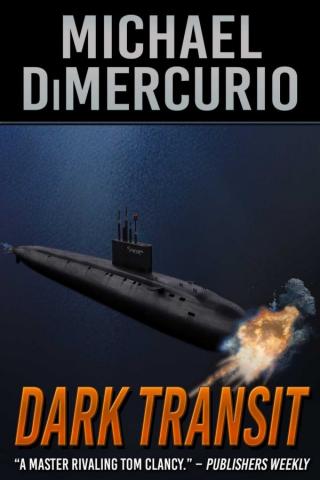
Dark Transit
- Автор: DiMercurio Michael
- Серия: Anthony Pacino #1
- Год: 2021
- Язык: английский
- Год: Crossroad Press
- ISBN: 9781637899199
- Жанр: Триллеры

Электронная книга - «Dark Transit». Краткое содержание книги:
After Vermont misses the mark on an easy mission, there are questions asked about her ability to conduct the next mission, one that is vital to the security of the United States and the future of the submarine force. Vermont is tasked with stealing a revolutionary submarine that the Russians are testing with an Iranian crew because it's too risky to use Russian sailors. It's a high-stakes gamble for all involved, with the losers vanishing if things go wrong, the winners validating a world-changing technology.
Pacino is part of the mission to steal the submarine, but the toughest obstacle is a wolf-pack of Russians coming to the defense of the Iranian submarine. Getting it back to the United States for evaluation becomes secondary to surviving an exchange of missiles and torpedoes in an underwater battle that threatens to let the final genie out of the bottle.
Next to the oxygen generators were the carbon dioxide scrubbers, two units even larger than the oxygen generators, which blew ship’s air over an amine system that absorbed the carbon dioxide, an absolute poison to human beings. The amine was able to discharge the carbon dioxide overboard with the oxygen generator’s hydrogen, the stream refreshed to absorb more carbon dioxide. And next to the scrubbers were the number one and number two carbon monoxide burners, which were simple units with hot wires where the even more poisonous carbon monoxide would oxidize in the presence of the oxygen in the air and become more mundane carbon dioxide, the discharge of the two machines fed to their respective carbon dioxide scrubbers.
Redundancy demanded that each machine be doubled, in case one of them experienced trouble. Engineer Captain Second Rank Yevgeny Montorov was harshly critical of the design, insisting that all the ship’s eggs were in one basket, and that any sane designer would have split each machine into two different rooms with the rooms spread far apart, in case one room had a casualty. After all, the crew’s nickname for the oxygen generator was “the bomb,” because it made hydrogen and oxygen in the exact chemical proportions for a perfect explosion. Of course, Montorov would scold anyone who used the term “bomb” or “explosion.”
It’s an unplanned energy release,” he’d say. “Or an unintended rapid disassembly.” Lukashenko would laugh at him, sometimes taunting his friend the engineer by asking him if, on his watch, could he please keep the bomb from exploding? That never seemed to get old, with Montorov always reacting with deep annoyance.
But even though the room contained all the ship’s atmospheric control equipment, other compartments had emergency oxygen generators and carbon dioxide removal means. A small can the size of cooking pot could be lit off to make oxygen, enough to fill a room and keep a dozen men alive for several hours, with lockers full of the emergency generators. There were curtains that could be hung to absorb carbon dioxide, the curtains eventually becoming thick and heavy as they absorbed the harmful gas.
The room had automatic firefighting equipment. There were automatic sprinklers fed by the auxiliary seawater system, actuated automatically by high temperature sensors, and a hydrogen concentration sensor would kick off a deluge of halon gas, which could be dangerous to an occupant, but obviously a hydrogen fire would be a much worse consequence. Hydrogen was so dangerous because it was odorless, colorless and needed no ignition source to detonate in the presence of oxygen. Just stray static electricity would set off a hydrogen fire. A space filled with hydrogen and oxygen, in the presence of energized electrical equipment like the scrubbers and burners, would threaten the continued survival of the ship, so the high-pressure halon system had been installed, and set up to actuate automatically from a high hydrogen concentration.
At 0815 Moscow time, the hydrogen leak in the upper flange of the hydrogen receiver exploded into flames and blew the number two oxygen generator’s oxygen receiver into atoms. The explosion growing at the detonation carried away the number one oxygen generator’s oxygen and hydrogen tanks, which in turn blew open the high-pressure oxygen manifold, which then dumped the high pressure oxygen from the oxygen banks into the room. By the time the halon system started to actuate to open the halon valves, the explosions in the room blew the firefighting rig into fragments, the halon insufficient to come anywhere close to putting out the raging inferno in the room fed by the blasting oxygen flow. The main manifold for the emergency air system ran through the room, fed from air banks stored farther aft, but the conflagration melted the check valve in the system, and both the aft and forward emergency air banks depressurized and blew air into the burning room, further feeding the fire, and making the system unavailable for crew survival, their only source of air when there was a severe fire. The scrubbers and burners burst into flames next, generating roiling black toxic smoke, the other equipment in the room adding to the conflagration, the pipe insulation going up next, then the vaporized electrical cables adding toxic fumes to the black smoke.
The only equipment in the room that still functioned, at least partially, was the suction air box to the ventilation fan, which normally sucked air from the room with such force that it could pin a man to the suction grating. The high horsepower fan continued pulling in the flames, smoke and toxic fumes and pushed it with tremendous force into the ventilation system.
Within seconds, every space of the submarine Voronezh filled with toxic black smoke, smoke so thick that visibility shrank to less than ten centimeters in any direction. The high temperature smoke poured into the central command post from every ventilation diffuser, the room almost immediately so smoke-filled, the light from the overhead couldn’t be seen, much less the light from the consoles and navigation chart.
Lukashenko coughed violently, clamping his eyes together as tears flew down his cheeks from whatever was in the atmosphere. He lunged to the command console seat, opening his mouth to bark orders at the second captain.
“Second Captain,” he bellowed. “Emergency blow forward and aft ballast! Shut down all ventilation!”
The second captain’s calm, slow female voice answered him. “Please repeat. Your voice was distorted.”
“Jesus! Second Captain, emergency blow all groups! Shut down all ventilation!”
The AI was infuriatingly repeating that it couldn’t understand his panic-stricken voice. He would have to get into his emergency air mask and go to the software screens manually to emergency blow and shut down the ventilation systems. He had to get his emergency air breathing system mask on. He made it three steps from the navigation display before he fell to the deck, gasping for breath, his hand reaching furiously up to the command seat to pull himself to the console. He found his air mask and hastily strapped it on and took a breath, but no air came into the mask. He checked that it was plugged in and that the regulator looked okay. He was barely able to see through the smoke, but finally felt the hose and it was definitely plugged into the emergency breathing air manifold and the regulator seemed fine. But there was still no air. He pulled off the mask and dumped it and lunged for the mask at the middle console seat. A coughing fit hit him then, and his head spun in dizziness and his hand seemed to have a mind of its own. He found the second mask and strapped it on, and there was no air from it either. Lukashenko’s hand flopped to the deck as he coughed, and he thought frantically that he had to save the ship, but then the entire idea seemed strange to him.
Ship? What ship? Where the hell was he?
Lukashenko’s breathing stopped fifteen seconds later. Forty-five seconds after that, his heart stopped beating.
The other command post watchstanders had collapsed before Lukashenko, even Laska, who had been at the sonar-and-sensor console, and had convulsed violently as he’d reached for and put on his useless air mask, and he died in his seat. Captain Novikov coughed in his sea cabin, trying to reach for the phone before falling to the deck and losing consciousness. First Officer Anastasia Isakova had been in the shower, trying to feel better about her father by using warm water and shampoo, knowing it would only make things a little better, when the toxic smoke filled the bathroom and she dropped limply to the deck, the warm water still cascading over her dying body.