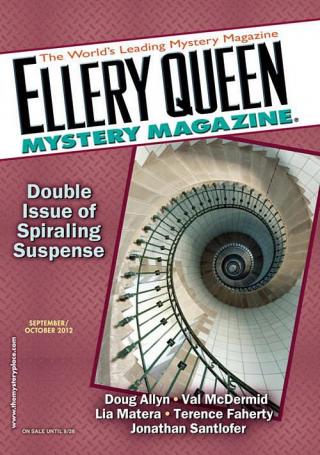
Ellery Queen’s Mystery Magazine. Vol. 140, Nos. 3 & 4. Whole Nos. 853 & 854, September/October 2012
- Автор: Макдермид Вэл, Манфредо Лу
- Год: 2012
- Язык: английский
- Год: Dell Magazines
- ISBN: 0013-6328
- Жанр: Другие детективы

Электронная книга - «Ellery Queen’s Mystery Magazine. Vol. 140, Nos. 3 & 4. Whole Nos. 853 & 854, September/October 2012». Краткое содержание книги:
Helping Margo collect the insurance money her man had died for wasn’t the only reason I sold the state police a bill of goods. It was my last chance to give Sherry what she’d always needed so desperately. More than anything in this world, she’d wanted to be a star.
By God, she went out as one.
My version of events conveniently omitted her complicated love life. Instead, Sherry died as a courageous newswoman hot on the trail of a big story.
I think Zee knew better, but by the time she wrapped up her own investigation, the raids were already underway and my fairy tale had gone viral in the media. On the Net, facts never get in the way of a good story.
Desperate for a heroine after the recent scandals, the national press turned Sherry into an instant icon. Overnight, her dream came true. Everyone knew her name. She was the center of attention.
It won’t last, of course. Andy Warhol set fame’s expiration date at fifteen minutes, and most of us never achieve that.
But Sherry got her share and then some. Her funeral was a media circus. Talking heads from the major networks and most of the minors covered it live from the cemetery, wearing somber faces and black armbands.
It was a spectacular, star-spangled sendoff. I only wish she could have seen it.
And maybe she did.
I’m not religious. The afterlife is a mystery to me. But I knew Sherry down to the bone. Knew her drive and her desperation.
No power in this world or the next could have kept her away from that show. In my heart, I know she saw that turnout, and warmed herself in the spotlight one last time.
And if you could ask her if it was worth it?
I know exactly what she’d say.
Copyright © 2012 by Doug Allyn
Gymnopédie No. 1
by Susan Lanigan
The short fiction of Irish author Susan Lanigan has appeared in a variety of publications, including The Stinging Fly, Southword, The Sunday Tribune, the Irish Independent, and The Mayo News. She has been shortlisted twice for the Hennessy New Irish Writing Award and has won several other awards. Nature magazine’s science-fiction section recently acquired two of her stories and her work is featured in the science-fiction anthology Music For Another World.
Once again, the sunset. To be precise, the bit I am allowed to see: parallel gold diagonals streaking across the edge of my bunk and hitting the door, while the sink and privy stay in the dark and the mirror reflects nothing. I prefer the shadow. Since they moved me here five years ago, a kindly promotion from the cell that faced the prison’s north wall, I have seen too many sunsets, each one leading back to the same memory: my mother, long dead now, playing the piano.
She always became more girlish when she played; even then I noticed the shy hesitant smile when she made the odd mistake. I was five then, standing in the doorway of the study in a manner, Dearbhla told me afterwards, of a child self-consciously trying to be “cute.” I have no idea whether Dearbhla told me this out of malice — whether she already detected a resentment I could find no words to express — or because she was genuinely amused. Anyway, she was not there to witness it firsthand. By the time she was there on a regular basis, my mother and her orange kaftans and hair tied back with a grubby chenille ribbon had gone, gone forever.
My mother had few pieces in her repertoire but since I, at the age of five, was her primary listener, it should not have mattered too much. Yet I recall, in flashes, how her head would jerk upwards when my father pushed the creaking gate of our little garden open. The look of strained hope that crossed her face as she pushed the open window full out and started a few bars of the same piece. She started in medias res, I believe, to fool my father into thinking that she had been playing on for hours, unaware of his presence, in some sort of creative trance. I don’t believe he fell for it. He would come to the door and wink at me as she fingered the keys like alien objects, her eyes self-consciously shut.
It was always the same piece, Satie’s Gymnopédie No. 1, and she was never able to get all the way through without making a mistake. To me now, that seems absurd; unlike Dearbhla, I never had a great talent for music, but even I could pick my way through something of that level with no great difficulty. But my mother’s mistakes were always so small — a missed note when it unexpectedly changed to F minor on the second repetition, an E instead of a D in the bass — that somehow I could always hear the soft chords transcending the little awkwardnesses. I remember (this must have been earlier, I must have been even younger then) hearing the muffled ripple of bass and right-hand chords through the timber of the shivering piano as I curled myself into a ball at my mother’s feet. I nearly fell asleep with my cheek touching the cold bronze of the una corda pedal, spittle drooling down my cheek. The evening sun was coming through the two-paned window, shafts of it warming the wood, and warming my mother’s orange kaftan and warming the pale brown carpet where I lay my head. The soft pedal remained cold, unmoving. I don’t know how long I lay there until I was picked up and brought to bed. It seemed like infinity, but then again this happened long ago, before I learned to measure time, each begrudging second, hour, and year of it.
She never quite got it right. Each rendition was a diamond with a different flaw. I didn’t mind. Like an idiot savant, I craved routine. The routine of sun falling on my mother and the Gymnopédie, the routine of drizzle soaking the unmown grass in our front garden and the Gymnopédie, the dying elm shedding its last leaves as the Dutch beetle gnawed away at it from the inside — and the Gymnopédie—
“I’ll get it,” my mother would call out, “I will, you’ll see.” Then she would fling her head back and laugh, and the light would catch the fine hairs on her neck, her neck that was able to arch so elegantly and make my father catch his breath. Dearbhla says I don’t remember properly, after all I was very young and children idealise things a lot, don’t they? But then again, rare things are easy to recall by virtue of their rareness — and happy memories of my childhood are rare indeed.
I don’t know why Dearbhla still visits me, week in, week out. I should be the last person she wants to see. She is a joy to look at through the Perspex paneclass="underline" those tapering, gloved fingers are still beautiful, their clasp of the thin, unlit cigarette irreproachably filmic. They will never touch a piano again. But even in late middle age she retains the proud cheeks and prominent eyes that captivated her audience as much as the pieces she performed for them. The last time she came, she brought a letter in a vellum envelope. Typed, of course; she can hardly write by hand now. I haven’t read it yet. I want to hold off as long as possible to make the anticipation all the keener. Prison has taught me discipline, the ability to ration pleasure. She arrives again tomorrow: I will have read it by then.
She has forgiven me much, Dearbhla, or perhaps she visits me out of need: I am the only surviving witness of the great tragedy of her life. As long as she blames me, she is safe. She can duck responsibility for her one failure.
Perhaps she is correct. Perhaps it is my fault.
When Dearbhla first came to the house, the laughter was different. It was laughter that sounded as if it were trapped in a bad sitcom and never let out. It banged crossly against the china my mother brought out for her visitor and rat-tatted irritably against the walls.