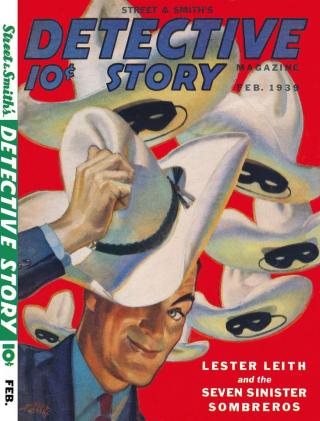
The Seven Sinister Sombreros
- Автор: Гарднер Эрл Стенли
- Год: 1939
- Язык: английский
- Год: Street & Smith Publications
- Жанр: Классические детективы

Электронная книга - «The Seven Sinister Sombreros». Краткое содержание книги:
“I couldn’t see what he was doing on account of that broad-brimmed hat,” Captain Carmichael said. “There’s Beaver coming down the street. Let’s flag him and see what he has to say. We’ll have a minute before Leith can get back to the front of that lot. Pull into the curb, driver. Oh, Beaver!”
The undercover man stiffened to attention, looked furtively back over his shoulder, then came to the curb.
“What is it?” Ackley asked.
“I’m to go up to 613 Moronia Building and have Io Wahine put on a hula. When she’s finished, I’m to present her with the brooch made in the form of a gold surfboard with a border of small diamonds.”
“What’s the idea?” Captain Carmichael asked.
“You can search me. He telephoned me I’d find a 1936 Ford waiting out in front of the place, registered in his name. I was to get in it, drive to a certain place, wait until he came past, then follow his car, and drive into the same parking place. Watch out, boys. Here he comes.”
Beaver, with elaborate unconcern, walked down to the entrance of the Moronia Building. The police car dashed ahead. Lester Leith, attired in cowboy regalia, the high-heeled leather boots making him walk awkwardly, came clumping down the sidewalk.
Harry Lanten and Nano Kapiolani, who had parked Lester Leith’s Buick in a garage, a block down the street, returned in time to give Leith the parking ticket and receive some low-voiced instructions from Leith as they stood for a moment at the entrance to the Moronia Building.
Leith walked to the elevators, was whisked to the sixth floor, and heard the sounds of voices and laughter in 613.
Leith opened the door.
Job Wolganheimer, his face dark with jealousy, was standing near the window. Out in the center of the floor, Io Wahine was talking with Beaver. She was standing very close to the undercover man, looking up into his appreciative eyes, her face upturned, her lips parted in a friendly smile.
Leith said, “Pardon me a moment,” and motioned to Beaver.
The undercover man reluctantly left the dancer’s presence to follow Leith into the hall.
“Everything going all right, Scuttle?” Leith asked.
“Yes, sir,” the spy said, with complacent self-satisfaction.
Leith said: “Give me the parking ticket on your car, Scuttle. Here’s the ticket on my Buick. You take it, and I’ll take your car. I’ll meet you at my apartment. No need to hurry back. Incidentally, Scuttle,” Leith said, lowering his voice, “I think this man who’s with her is going to be busy with some friends in a few minutes, and if you want to take the little girl to dinner, there’s no objection; it’ll be on the expense account.”
“Dinner!”
“That’s right, Scuttle. Of course, when I say dinner, that includes cocktails, champagne, and a liqueur.”
The spy pushed the pasteboard parking ticket into Leith’s hand, took the one which Leith gave him, and almost stumbled over his own feet in his anxiety to get back into the office of the Hawaiian-American Aesthetic Art Association.
Leith took the elevator, left the Moronia Building, and walked over toward the parking station. Harry Lanten and Nano Kapiolani were waiting for him.
“Ready?” Harry Lanten asked.
“Ready,” Lester Leith said. “Now, I’m going to drive out the car I took in. You folks will be driving another car, same make and model, but a different car. It’s the one my valet drove in a few moments ago. You meet me at the corner of Seventh and Center streets. I’ll drive out first, but you pass me in the middle of the next block, and I’ll follow you.”
“Very good,” Harry Lanten said.
Nano Kapiolani inquired archly: “When am I going to be called on to do my dancing? I don’t want to get out of practice, you know.”
Leith, taking her arm, escorted her into the parking station. “You might hula your way down to the car,” he said.
Laughing, she started to comply. Leith said: “Whoa, back up. I didn’t really mean it.”
The service station attendant said, “You folks are back early.”
“We come and go,” Lester Leith observed, casually giving the attendant the parking ticket which he took from his pocket. “How much?” he inquired.
“Fifteen cents.”
Leith handed him the fifteen cents. The service station attendant got out the car.
Harry Lanten said: “I presume it’s the same on this car?”
“Sure,” the service station attendant told him, and went back to get out the other Ford.
Leith was just leaving the entrance to the parking station when a car containing Karl Bonneguard and Emil Bradercrust swung into a lurching turn, narrowly avoiding him, and skidded on into the parking station.
Leith frowned his annoyance at such careless driving, swung his car to the right, and proceeded slowly down the street. Midway in the block, Harry Lanten passed him. The right rear tire on Leith’s car was so soft it was almost flat.
Lagging behind, Sergeant Ackley and Captain Carmichael had a choice to make. Sergeant Ackley made it.
“Tag that car with Bradercrust in it,” he ordered. “Leith has been setting the stage. The stuff which doesn’t affect Bradercrust is all hooey. We tag Bradercrust now.”
Captain Carmichael said: “I’m trusting your judgment in this, sergeant.”
Sergeant Ackley tilted his cigar upward, said confidently: “And you ain’t making no mistake either, captain.”
After four blocks, Leith tooted his horn several times, speeded up and signaled for Lanten to pull into the curb.
“I’m getting a flat tire over on my right rear wheel,” Leith said.
As Leith put on his brakes, the added strain on the tire finished the casing. Lanten parked his car. The two men got out and walked around to stare at the puncture with that hesitant appraisal which is the universal first reaction of motorists everywhere to a flat casing.
“Well,” Leith said, “we might as well change it. You get the tools out, and I’ll get the spare off.”
Leith took off his leather jacket, displaying the resplendent silk shirt.
“Here we go,” he said.
Leith had some trouble with the bolt on the spare tire. It had been put on so that the threads were crossed. The ordinary lug wrench had no effect on it, but from the car Lanten was driving, Leith took a huge monkey wrench which he brought into play, and which made short work of the cross-threaded nut.
Lanten started getting out the tools. Lester Leith peeled the tire cover from the spare tire, then leaned forward as though to inspect the tire closely. For several moments, the broad brim of his ten-gallon hat hid exactly what he was doing.
A short time later, when Lanten was getting the jack under the car, Leith said:
“Take a look at this spare tire, Harry. What do you make of it?”
Harry Lanten got up from his knees, and said:
“Why, it looks all right. It—”
“Touch it,” Leith said.
Lanten tapped the spare with his knuckles.
Leith said: “Not there, down here on the side.”
Lanten tapped the edge of the spare tire.
“What the devil!” he said. “It’s metal, with rubber on top.”
Leith said: “Looks like a section of metal had been vulcanized right in the tire. That’s the part that was the bottom. I turned it up when I was taking it off.”
“What the devil’s the idea?” Lanten asked.
“I don’t know,” Leith said. “Let’s see if we can get it open.”
It was Lanten who found the little catch concealed in the side of the casing which released the lock and enabled a section to be swung downward, disclosing a lacquered interior.
“Seems to be empty,” Leith said.