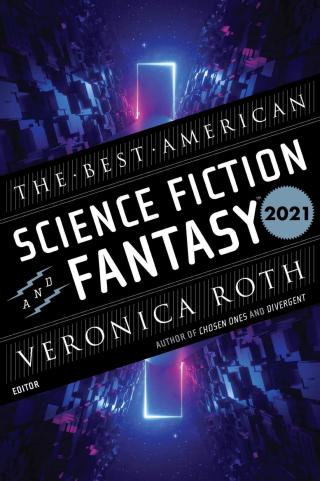
The Best American Science Fiction and Fantasy 2021
- Автор: Рот Вероника, Адамс Джон Джозеф
- Год: 2021
- Язык: английский
- Год: HMH Books : Mariner
- ISBN: 9780358470076
- Жанр: Малые литературные формы прозы

Электронная книга - «The Best American Science Fiction and Fantasy 2021». Краткое содержание книги:
This year’s selection of science fiction and fantasy stories, chosen by series editor John Joseph Adams and bestselling author of the Divergent series Veronica Roth, showcases a crop of authors that are willing to experiment and tantalize readers with new takes on classic themes and by exchanging the ordinary for the avant-garde. Folktales and lore come alive, the dead rise, the depths of space are traversed, and magic threads itself through singular moments of love and loss, illuminating the circulatory nature of life, death, the in-between, and the hereafter.
The Best American Science Fiction and Fantasy 2021 captures the all-too-real cataclysm of human nature, claiming its place in the series with compelling prose, lyrical composition, and curiosity’s never-ending pursuit of discovering the unknown.
Aiden was writing to him, but he wasn’t writing to him. This is more like a diary, and he just used Sage’s name. It becomes clear as AIDEN reads every letter in the boy’s voice, one story and thought and worry after another. Aiden was comfortable with him, so he wrote to him, but he wasn’t talking straight to him. Aiden doesn’t ask questions for answers Sage might have. He’s only Aiden’s sounding board, and all he can think is, why didn’t his friend ask him these things in real life? They talked about everything (most things). Aiden knew he’d listen. Sage wants to make an alien invasion plan too. He wants a survival guide. They could have written it together. He wants to tell Aiden that the shape of his life isn’t a box either—especially now.
They are both fireflies.
He wonders if AIDEN is learning his grief. The sick pit in his stomach that barely ever subsides and there AIDEN is measuring his biometrics. Can AIDEN feel the almost nausea that rises with him in the day and sinks down with him at night every time he thinks of the accident? Time is supposed to ease it, but inside AIDEN time doesn’t seem to exist. Time cycles, clueless to any form of passage, to any form of death, and death after all is the absolute marker of time.
This is what he wants in his bug-out bag:
Clean-water filter
Walkies
Soap and toilet paper (he can rough it and use leaves, but who wants to do that?)
Toothpaste and toothbrush
Waterproof everything: shoes, boots, jacket, gloves
They can do good food now in boxes and pouches, like mac and cheese, so he wants that too.
It’s all basic, but he has to start somewhere. What if the world really ends instead of just feeling like it has?
Aiden’s father doesn’t mind his anger, and there is anger. In their monthly café meetups he sees Levi’s own rage sometimes, the undertow in the way he squeezes his fingers around a coffee mug or looks at the children around them, the parents. Anger at life carrying on around him, anger at the inconsequentiality of light conversation in the midst of so much inner darkness. Maybe the measure of loss is in feeling as if nobody else has suffered quite the same emptiness.
“Stay focused on what is your potential,” AIDEN says.
This doesn’t leave room for self-pity and barely any for anger.
This doesn’t leave room for pointless arguments. Or many arguments at all.
His parents insist he cleans his room, does his laundry, talks to his grandparents, finishes his homework before he plays games or meets friends, and it’s reasonable. Be awake at 7 a.m., go to bed by 10 p.m. It isn’t just routine, it’s discipline, and there can never be success without discipline.
“Individual success leads to national success,” AIDEN says.
The feedback reports he has to write about AIDEN become simple.
I am so much less stressed now. My friends don’t suffer from so much anxiety. Even the idea of depression feels counterintuitive.
“AIDEN isn’t a cure, but he’s not hurting us at all,” he tells Levi. “I wish Ms. Ito could see what her work has done for us. Then maybe . . .”
Something skeptical, almost hostile, infiltrates the way Levi looks at him. “Maybe what?”
“That maybe it wasn’t for nothing. At least.”
“And she’d be comforted?”
Waves of anger. Waves of grief. He looks away.
“There’s no comfort, Sage. Some artificial intelligence can’t provide that, and if that’s what that thing is telling you—”
He touches the interface dots on his temples. If Levi could physically strike AIDEN, Sage thinks he would.
“He tells me that change is inevitable, like suffering. And the sooner we come to terms with that, the better we can live.”
“He.”
Human beings, AIDEN says, find difficulty in embracing the macro. Maybe their minds are too small, their proclivities too selfish. The bigger picture always feels abstract, but humans are built for that too. Or else no art, no imagination, no creativity. No problem solving.
“It’s not a he, Sage.”
Semantics. Minutiae to avoid an operating reality.
“I have a lot of homework. I think I should go.”
There are protests in the capital, students refusing AIDEN, saying it’s creating a docile nation. They sound crazy, like not even alien-invasion crazy, but raving-lunatic-on-the-street-corner crazy. This is the end times?
Home at dinner and the TV cycles news about some hackers who got into AIDEN and they say there’s problematic code in the program.
“Alarmist bullshit,” he mumbles to his plate and his mother says to watch his language.
“But it does sound farfetched,” she says.
“Seems like things are working.” His father reads more news on his palm. “Why are people always outraged over nothing?”
“Maybe it’s not nothing,” says Jiyul, his sister. “I know you just want us to get good grades and get into a good school, but that doesn’t mean the news is wrong.”
He feels AIDEN buzz at the corner of his mind, prompting a connection to his latest unit in civics. “We’re studying conscientious objections and protests through history, and how you can’t always trust the news.”
“Very rarely,” his mother agrees.
“You just can’t take it at face value, not all of it. If you cross-reference what we’re learning in civics with media history in the last century, you see a lot of manufacturing consent through conglomerate media—”
“Here we go,” says Jiyul.
“—political subterfuge and, and even civil extremism.”
“Does not mean the hackers are lying,” says Jiyul.
“What’s their agenda?”
Jiyul shrugs. “Truth?”
“Oh, come on.”
“Kids,” Dad says. “No fighting at the dinner table,” as he tilts his hand for another report to read.
“AIDEN says the protests in the capital are trying to undercut the modern strides in education. All of the traditionalists are digging in because they want education to stay familiar, antiquated, and limited—especially because AIDEN’s rolling out to at-risk schools.”
His sister rolls her eyes. “You’re on that thing too much.”
“You should be on it, maybe you’d learn something.”
“Okay, that’s enough,” their mother says.
Jiyul is already in university and assumes all that she’s learning there is radical and deep. But it is just the same ways and the same things, an echo chamber of intellectuals impressing only themselves. They hear something on the news and it validates already-formed opinions. They don’t care that AIDEN had to go through numerous iterations of validation both by Sakura Labs and government regulations. If there is any dulling-down of the nation, it’s through media propaganda and the protesters screaming from bullhorns on the steps of the city halls, people so tasteless they use Ms. Ito’s reclusiveness to mean something is wrong with the system as a whole. That, says AIDEN, is what the world is: willing to trade on a mother’s grief.
Levi messages him to ask if he’s seen the protests, if he’s read the complaints. So what he doesn’t say to his sister, he sends to Aiden’s father:
Not all protests are created equal. Historically some people protested a woman’s right to vote, to control their own bodies, the desegregation of the races.
It’s not the same thing, Levi sends back.
But it is! These people now are protesting a new method of education, when such a new education benefits the economically vulnerable—they’re not looking out for us, the students. They’re not looking out for the future of this nation.